American Alligator
The American alligator is one of the great wildlife conservation success stories in U.S.
🗓️ Last reviewed: June 2026
Overview
The American alligator is one of the great wildlife conservation success stories in U.S. history - and a uniquely Southern big-game hunt. Once heavily depleted and listed as endangered, the alligator rebounded so completely under federal protection and state management that it was removed from the endangered list decades ago. Today, regulated alligator hunting exists across the Gulf South, managed through strict tag, permit, and quota systems that keep populations thriving.
For the U.S. hunter, an alligator hunt is unlike any other big-game pursuit. It happens at night on the water, it demands specialized methods and gear, and it produces both meat and a durable hide. This guide covers the alligator as the carefully regulated, conservation-funded hunt it is - emphasizing legality, safety, ethics, and respect for a powerful native reptile. Because regulations are strict and vary widely, confirming current rules with your state wildlife agency is the essential first step.
Identification & Appearance
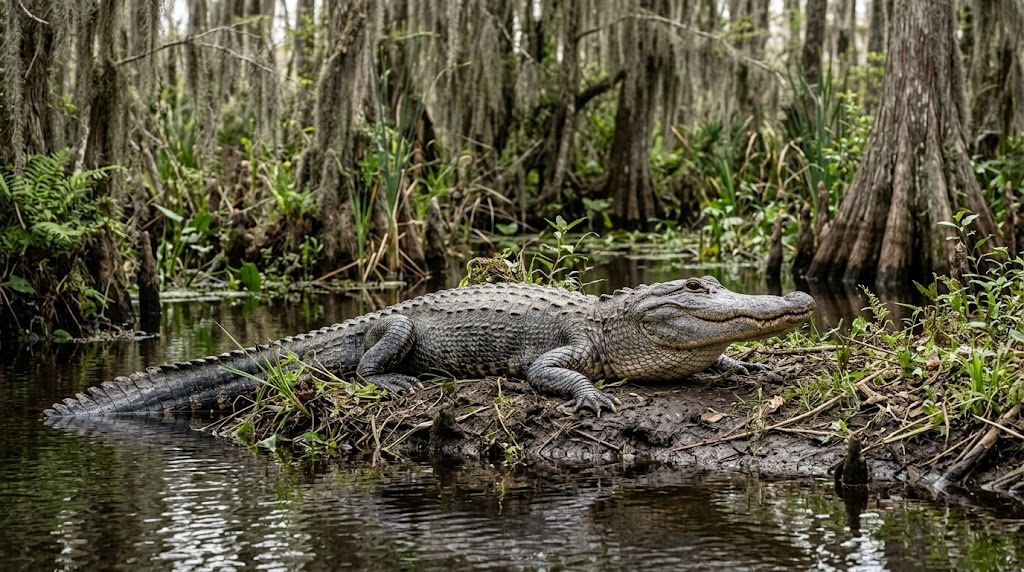
The American alligator is a large crocodilian with a broad, rounded, U-shaped snout - the key feature that distinguishes it from the narrow-snouted American crocodile, which in the U.S. is restricted to a small part of south Florida and is not legal to hunt. Adult alligators are dark gray to nearly black, with a heavily armored back of bony plates (osteoderms), a powerful tail roughly equal to body length, and short, sturdy legs.
Mature animals commonly reach 8-12 feet; large males can exceed 13 feet. Hunters measure and report alligators by total length. At night, an alligator's eyes reflect a distinctive bright reddish-orange glow in a spotlight beam - the primary way hunters locate them on the water. Sexing in the field is difficult; size and length, not sex, drive harvest decisions under most tag systems.
Range & Habitat (US)
The American alligator inhabits the freshwater and brackish wetlands of the Southeast and Gulf South: Louisiana, Florida, Texas, Georgia, Alabama, Mississippi, South Carolina, Arkansas, and parts of North Carolina and Oklahoma. They occupy swamps, marshes, slow rivers, bayous, lakes, ponds, canals, and coastal estuaries. Louisiana and Florida hold especially large populations and well-developed hunting programs. Alligators favor warm, lowland water with bank cover, basking spots, and abundant prey.
Behavior & Sign
Alligators are ectothermic - their activity tracks temperature. They are most active in warm weather, basking on banks by day and moving and feeding at night, which is why most hunting is nocturnal. In cool weather they become sluggish and may shelter in dens. They are ambush predators, generally wary of humans, and a hunter must treat every alligator as a powerful, potentially dangerous animal.
Sign that an area holds alligators includes:
- Eyeshine at night - the reddish glow of eyes above the waterline.
- Slides - smooth, flattened paths where gators enter and exit the water on muddy banks.
- Basking sign - body and tail impressions on sunny banks.
- Dens and burrows - tunnels dug into banks.
- Bellowing - deep, resonant calls during the warm-season breeding period.
- Tracks - clawed footprints with a tail-drag line in soft mud.
Hunting Seasons & Timing
Alligator seasons are typically short and fall in the late summer to early fall warm-water period - for example, Louisiana's traditional season runs in September, and Florida's statewide season spans roughly mid-August into early November. Hunting is permit- and tag-based: states issue a limited number of tags through draws, landowner allocations, or specific area quotas, and each tag must be attached to a harvested alligator immediately. Quotas, legal hours (often including night hunting), legal methods, and area rules vary substantially. Every hunter must obtain the correct license, permit, and tags and study current state regulations before hunting.
Hunting Methods
Alligator hunting uses specialized, regulated methods that differ from any other big-game hunt. Common legal methods, which vary by state, include:
- Baited hook lines - a large hook on a heavy line, set legally where permitted, checked on a schedule.
- Hand lines and snares - used to secure an alligator brought near the boat.
- Harpoons and snatch hooks - to attach a line to an alligator.
- Bowfishing-style gear with attached lines in some states.
- A firearm or bangstick is then used at very close range only to dispatch a secured, restrained alligator quickly and humanely - never on a free-swimming animal, and only where and how the law specifies.
The defining safety principle: an alligator is brought under control on a line first, secured, then dispatched at close range. Legal methods are strict and state-specific - follow them exactly.
Where to Find Them - Reading the Terrain
Alligators concentrate where warm water, cover, and food come together. Work the edges: bank lines with overhanging vegetation, the mouths of canals and bayous, marsh edges, and points where open water meets cover. At night, slowly idle these edges with a spotlight, scanning for eyeshine. Larger alligators often hold in deeper water with good bank access nearby and tend to be more cautious. Basking banks, well-used slides, and den sites all mark productive areas. Calm, warm nights typically produce the most active alligators.
Gear & Optics Needed
Alligator hunting gear is specialized and safety-focused. You will need a stable, properly equipped boat, a powerful spotlight or headlamp for spotting eyeshine, and the legal capture equipment for your state (heavy line, hooks, snares, harpoon, snatch hook as permitted). Add strong gloves, a sturdy knife, and the legal dispatch tool (firearm or bangstick) used only on a secured animal. Bring life jackets, a first-aid kit, insect protection, and a means of communication. Coolers and ice are essential for the meat. This is a hunt where safety equipment and following the law matter more than optics.
Shot Placement & Field-Dressing
The only ethical dispatch of an alligator is after it is secured and restrained on a line at the boat, never on a free-swimming animal. With the animal controlled, the dispatch target is the small soft spot at the back of the skull behind the eyes, where a single close-range, well-placed shot or bangstick strike reaches the brain quickly. Precision and a calm, controlled setup make this fast and humane. After dispatch, the tag is attached immediately as required. Field care focuses on cooling the meat fast and properly skinning and salting the hide; processing an alligator is labor-intensive, and many hunters use a licensed processor.
Meat & Eating Quality
Alligator is a genuinely good and popular food in the South. The prime cut is the tail meat - pale, mild, and firm, with a texture often compared to a cross between chicken and fish. The white tail meat is the most tender; darker meat from the body and legs is stronger-flavored and excellent in slow-cooked dishes. Classic preparations include fried alligator, gumbo, sauce piquante, and grilled tail. Cool the meat quickly and keep it clean. A single mature alligator yields a substantial amount of meat, and the hide is a valuable, durable byproduct.
Common Mistakes
- Hunting without fully understanding the strict, state-specific legal methods and tag rules.
- Attempting to dispatch a free-swimming, unsecured alligator - unsafe and unethical.
- Underestimating an alligator's strength, speed, and danger at the boat.
- Poor boat safety - overloading, no life jackets, careless handling.
- Failing to cool the meat fast in the warm season.
- Confusing the protected American crocodile with the alligator in south Florida.
Regulations & Conservation Note
The American alligator's recovery is a model of how regulated, science-based management restores a species. After protection allowed populations to rebound, states built carefully controlled hunting programs with limited tags, defined seasons, mandatory reporting, and hide-tagging systems that also help combat illegal trade. Hunting today supports wetland conservation and gives alligators economic value that incentivizes habitat protection. Every hunter must obtain proper permits and tags, follow all legal methods exactly, and never target the protected American crocodile. Confirm current rules with your state wildlife agency before every season.
Best Suited For
An alligator hunt suits hunters who are comfortable on the water, detail-oriented about regulations, and committed to safety. It is not a beginner's casual outing - it demands specialized gear, a capable boat, and respect for a powerful animal handled at close range. Hunters who enjoy night hunting, problem-solving, and a hunt rich in regional tradition will find it deeply rewarding. Many first-timers go with an experienced mentor or licensed guide, which is a smart and often recommended way to learn this unique pursuit.
FAQ
Is it legal to hunt American alligators? Yes, in several Southern states under strict permit, tag, and quota systems. The species recovered fully and is managed through regulated hunting. Always confirm current state rules.
Why is alligator hunting done at night? Alligators are most active in warm weather after dark, and their eyes reflect a bright glow in a spotlight, making them far easier to locate at night.
How is an alligator legally and humanely harvested? It is first secured on a line and restrained at the boat, then dispatched quickly at close range with a precise shot or bangstick to the brain - never while free-swimming.
Is alligator meat good to eat? Yes. The white tail meat is mild and firm and widely prized; darker meat is excellent slow-cooked. Fried alligator and gumbo are Southern favorites.
Can a beginner hunt alligators? It is possible but demanding. Specialized gear, boat skills, and strict regulations mean many first-timers hunt with an experienced mentor or licensed guide.