Whitetail Deer
The whitetail deer is the most widely hunted big-game animal in North America, and for good reason.
🗓️ Last reviewed: June 2026
Overview
The whitetail deer is the most widely hunted big-game animal in North America, and for good reason. Found in 45 of the 50 states, adaptable to nearly every habitat type, and supported by populations numbering in the tens of millions, the whitetail is the species most American hunters cut their teeth on. It is a manageable first big-game pursuit: hunts can happen close to home, gear costs are reasonable, and the meat is excellent. At the same time, a mature whitetail buck is one of the craftiest, most pressure-sensitive animals in the woods, so the species rewards a lifetime of study. Whether you are sitting a treestand over a Midwestern fencerow or still-hunting Appalachian hardwoods, the whitetail offers a complete hunting education.
Identification & Appearance
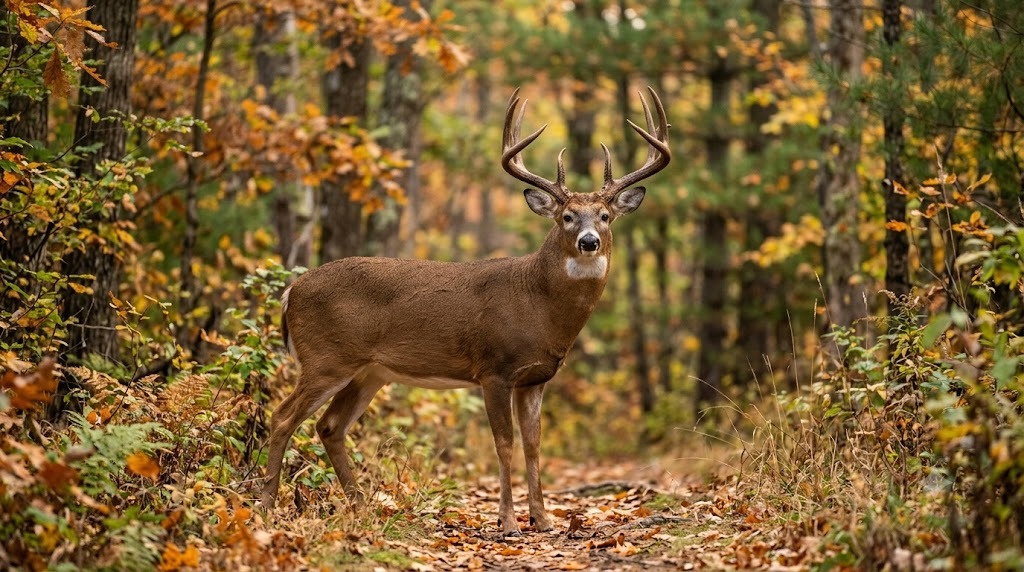
The whitetail takes its name from the broad, bright-white underside of its tail, which the deer "flags" upright when alarmed. The summer coat is a reddish-tan; the winter coat shifts to a grayish-brown that blends with bare timber. Adult does in most regions weigh 90 to 140 pounds; bucks commonly run 130 to 250 pounds, with northern deer noticeably larger than southern ones. Bucks grow a new set of antlers each year, branching forward from a main beam with individual tines rising vertically - a structure distinct from the forked pattern of mule deer. Look also for the white throat patch, white belly, white eye rings, and a black-tipped muzzle. Fawns are reddish with white spots that fade by early fall.
Range & Habitat (US)
Whitetails occupy nearly the entire eastern two-thirds of the United States and extend west into the Rockies and parts of the Pacific Northwest. They thrive in "edge" habitat - the seams where forest meets field, where young regenerating timber meets mature woods, where a creek bottom meets an agricultural plateau. Classic whitetail country includes Midwest farm-and-woodlot mosaics, Southern pine plantations and river bottoms, Northern big-woods, and Texas brush country. The common thread is a mix of cover for bedding and security with reliable food and water nearby. Suburban green spaces also hold surprising numbers of deer.
Behavior & Sign
Whitetails are crepuscular, most active at dawn and dusk, and become increasingly nocturnal under hunting pressure. They are creatures of habit but quick to abandon a pattern once disturbed. During the autumn rut, mature bucks throw caution aside in pursuit of does, creating the best window of the season for hunters. Key sign includes heart-shaped tracks, oval beds pressed into leaves or grass, droppings, and - most telling - rubs and scrapes. Rubs are saplings stripped of bark where a buck has polished his antlers; scrapes are pawed-bare patches of earth beneath a licking branch, used as scent communication hubs. Trails connecting bedding and feeding areas funnel deer movement predictably.
Hunting Seasons & Timing
Whitetail seasons are set state by state and typically span September through January, divided among archery, muzzleloader, and modern firearm segments. The single most productive window is the rut, which across most of the country peaks in November. Pre-rut (late October) offers heavy scraping activity; the rut peak brings cruising bucks at all hours; the post-rut (December) sees deer keying hard on food to recover. Early-season hunts rely on tight food-source patterns, while late-season hunts are about cold-weather feeding and bedding cover. Always confirm your state and unit dates and any antler restrictions before the hunt.
Hunting Methods
Treestand and ground-blind hunting over funnels, food sources, and trail intersections is the dominant method, prized for its low-impact, scent-controlled ambush. Still-hunting - slipping slowly through cover, pausing often to glass - suits big-woods terrain and hunters who dislike sitting. Spot-and-stalk works in open Western and agricultural country. Rattling and grunt calling can pull rut-phase bucks into range. Deer drives, in which a line of hunters gently pushes a block of cover toward posted standers, are a traditional method on larger groups of hunters. Each method has its place; matching it to the terrain and the season is the skill.
Where to Find Them - Reading the Terrain
Think in terms of bedding, food, and the travel corridors between. Bucks bed in thick, secure cover - cedar thickets, cutovers, brushy points, leeward ridges that let them watch downwind. Mark food sources: standing crops, white-oak acorns, browse-rich clearcuts, green fields. Then find the funnels. Inside corners of fields, saddles in ridgelines, creek crossings, fingers of timber connecting larger blocks, and the narrow neck between two patches of cover all concentrate movement. Hunt the wind first: position so your scent blows away from where you expect deer to come from.
Gear & Optics Needed
A dependable 8x42 binocular is the cornerstone - useful for picking apart cover and judging antlers. A compact rangefinder removes guesswork on distance. Quiet, layered clothing matched to the temperature, plus a thermal base layer for late season, keeps you on stand longer. Scent-control practices - clean clothing, rubber boots, playing the wind - matter more than any product. A safety harness is mandatory for treestand hunting; falls are the leading cause of hunting injury. Round out the kit with a sharp knife, a quality pack, a headlamp, and a phone-based mapping app for e-scouting and marking sign.
Shot Placement & Field-Dressing
Ethical, fair-chase hunting demands a clean, quick harvest. The broadside shot to the heart-lung area - low and just behind the front shoulder - offers the largest margin for error. Wait for a calm, unobstructed, well-ranged opportunity and pass anything marginal. After the shot, give the animal time before tracking. Field-dressing promptly preserves meat quality: the carcass must be cooled fast. Work cleanly, keep the body cavity free of debris, and get the animal out of the field and skinned as soon as conditions allow. Wear gloves and follow your state's regulations on carcass transport and chronic wasting disease zones.
Meat & Eating Quality
Whitetail venison is lean, mild, and versatile - one of the best wild meats available. Eating quality depends far more on field care than on the animal itself: rapid cooling, clean handling, and proper aging make the difference. Backstraps and tenderloins are prized for quick high-heat cooking; hindquarter muscles roast or grind well; the rest makes excellent burger, sausage, and stew meat. A single deer can supply a family with a substantial portion of a year's red meat, making the whitetail both a sporting and a practical pursuit.
Common Mistakes
The most common error is ignoring the wind - deer live by their noses, and a swirling thermal will end a hunt before it begins. New hunters also over-pressure their best spots, hunting them too often and too early until deer go nocturnal. Other frequent mistakes: moving too much on stand, hunting from poorly concealed positions, taking rushed or quartering-away-too-hard shots, neglecting to scout in the off-season, and giving up at midday during the rut when bucks may be cruising. Patience and discipline outperform fancy gear every time.
Regulations & Conservation Note
Whitetail deer are a conservation success story. Nearly wiped out by market hunting a century ago, they rebounded through regulated hunting, habitat work, and license-funded wildlife management. Hunter dollars - through licenses and the federal excise tax on equipment - remain the financial backbone of state wildlife agencies. Always buy the proper tags, follow bag limits and antler restrictions, report harvests where required, and respect chronic wasting disease testing and carcass-movement rules. Hunting within the law is part of keeping the resource healthy for the next generation.
Best Suited For
The whitetail is the ideal first big-game animal and a lifelong pursuit for the experienced. Hunters who can hunt close to home, who enjoy patient ambush hunting, and who want quality meat will find the whitetail rewarding. It also suits archers, who benefit from the deer's predictable travel patterns. Anyone willing to scout, play the wind, and learn one piece of ground deeply can be consistently successful.
FAQ
When is the best time to hunt whitetail deer? The rut - peaking in November across most of the country - is the prime window, when mature bucks move more during daylight. The early season and late season also produce when deer are locked onto food.
Do I need a treestand to hunt whitetails? No. Treestands are popular and effective, but ground blinds, still-hunting, and spot-and-stalk all work. Hunt the method that fits your terrain and comfort, and always wear a harness when elevated.
How far away can a deer smell me? Under the right conditions a deer can detect human scent hundreds of yards away. This is why playing the wind is the single most important skill in whitetail hunting.
Is whitetail venison good to eat? Yes - it is lean, mild, and excellent table fare. Quality comes down to fast cooling and clean field care more than anything else.
What should a beginner focus on first? Learn to read sign, understand wind and thermals, and hunt one property well rather than spreading effort thin. Discipline and scouting beat gear.