Mule Deer
The mule deer is the iconic deer of the American West - a big-eared, high-country wanderer that defines the experience of hunting open, rugged terrain.
🗓️ Last reviewed: June 2026
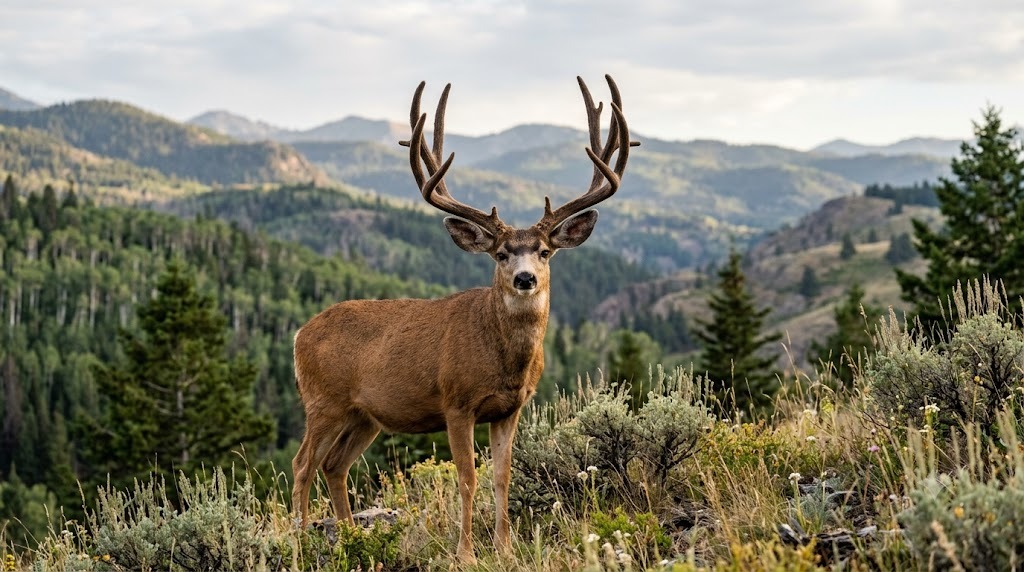
Overview
The mule deer is the iconic deer of the American West - a big-eared, high-country wanderer that defines the experience of hunting open, rugged terrain. Where the whitetail is a creature of edges and ambush, the mule deer is a creature of vistas and glass. Hunting "muleys" usually means covering ground, climbing in elevation, and spending long hours behind a binocular picking apart sagebrush flats, aspen pockets, and timbered ridges. It is physically demanding, often done on vast public lands, and deeply rewarding. A mature mule deer buck, with his tall, forked rack and unhurried confidence, is one of the great trophies of Western hunting, and the pursuit will teach you more about reading country than almost any other hunt.
Identification & Appearance
Mule deer are named for their oversized, mule-like ears, which constantly swivel to catch sound. The most reliable identifying feature is the antler structure: muley antlers fork and re-fork (bifurcate) rather than rising as single tines off a main beam like a whitetail's. The tail is rope-like, white with a distinctive black tip, and is not flagged when the deer flees. Mule deer also have a unique stiff-legged bounding gait called "stotting," in which all four feet leave the ground together. Bucks typically weigh 150 to 280 pounds, does considerably less. The summer coat is reddish-brown, fading to a blue-gray in winter, with a white rump patch and a dark forehead.
Range & Habitat (US)
Mule deer range across the western United States - the Rocky Mountain states, the Great Basin, the Southwest, and into the Pacific states. They occupy an enormous variety of terrain: high alpine basins in summer, sagebrush steppe, pinyon-juniper foothills, aspen and conifer forests, and desert mountain ranges. A defining trait is seasonal altitudinal migration - many herds summer high and winter low, following snowlines and forage. Habitat quality hinges on a mix of nutritious browse, broken terrain for security, and water. Much mule deer country is public land, making it a premier do-it-yourself hunt.
Behavior & Sign
Mule deer are less neurotic than pressured whitetails but rely heavily on eyesight and their phenomenal hearing. They feel secure in open country where they can see danger coming, and they often bed where they can watch their backtrail with the wind at their nose. They are most active at first and last light, bedding through midday in shade or on a cool, breezy point. Sign includes blocky tracks, clustered pellet droppings, browsed shrubs, and beds scraped into shaded slopes. During the late-autumn rut, bucks become far more visible and vulnerable, tending does on open slopes.
Hunting Seasons & Timing
Western states set mule deer seasons through a draw-based tag system in most units, with some over-the-counter opportunity. Archery seasons usually open in late August or September, when bucks are still in bachelor groups and somewhat patternable on summer range. Rifle seasons span October and November. The rut, generally peaking in mid-to-late November, is the most productive timing for spotting mature bucks but often requires a hard-to-draw tag. Migration timing - driven by snow - can concentrate deer dramatically in late season. Always research the specific unit's draw odds, dates, and weapon restrictions well in advance.
Hunting Methods
Spot-and-stalk is the signature mule deer method and the one most worth mastering. The hunter glasses from a high vantage at dawn, locates a feeding or bedded deer, plans a wind-conscious approach using terrain to stay hidden, and closes the distance. Patience is essential - it is often best to watch a buck bed down, then stalk him in his bed. Still-hunting works in timber and broken country. Ambushing water sources or trails between bedding and feeding can be productive, especially in arid units. Tracking in snow is a traditional late-season tactic. Above all, mule deer hunting is glassing - the hunter who covers the most country with optics finds the most deer.
Where to Find Them - Reading the Terrain
Read the country in layers. In early season, focus on high basins, north-facing slopes, and aspen pockets with shade, water, and lush forage. As the season progresses and snow accumulates, shift down-elevation onto winter range - sagebrush benches and protected south-facing slopes. Mule deer love edges between cover and openings, brushy draws, rim-rock with shade, and pockets of forage that catch morning sun. Bedded bucks favor terrain that lets them see below and smell above. Glass shaded slopes hard during midday and feeding edges at first and last light.
Gear & Optics Needed
Optics are not optional for mule deer - they are the hunt. A high-quality 10x42 or 12x binocular and a tripod transform your ability to find deer; a spotting scope lets you judge a buck before committing to a long stalk. A reliable rangefinder is critical in open terrain where distances deceive. Build the rest of the kit around mobility and the mountains: a comfortable pack frame for hauling meat, sturdy broken-in boots, layered clothing for big temperature swings, trekking poles for steep ground, and plenty of water capacity. A good mapping app helps you e-scout vast units and identify glassing points.
Shot Placement & Field-Dressing
Mule deer hunting often presents longer shots than whitetail hunting, which makes honest practice at field distances and a steady rest essential. Take only the shots you have rehearsed. The broadside heart-lung shot, low and behind the shoulder, remains the ethical standard. Range the animal, build a solid rest, control your breathing, and pass marginal opportunities. Because muleys are often killed far from a road, plan the pack-out before the shot. The quartering or "gutless" method is popular for breaking an animal into manageable, clean loads. Cool the meat fast, keep it clean and dry, and protect it from heat during the hike out.
Meat & Eating Quality
Mule deer venison is excellent - lean, mild, and comparable to whitetail, with eating quality strongly tied to field care given the warm early seasons and long pack-outs. Getting the meat cooled and into the shade quickly is the single biggest factor. Backstraps and tenderloins shine with quick cooking; the larger muscles roast or grind well. A mature buck yields a substantial amount of high-quality red meat, and the satisfaction of carrying it off a mountain you climbed yourself is part of the reward.
Common Mistakes
The most common mistake is not glassing enough - new mule deer hunters walk too much and look too little, bumping deer they never saw. Other errors include stalking too fast, skylining themselves on ridgelines, ignoring thermals (which rise in the morning and fall in the evening), and underestimating both distances and the difficulty of the pack-out. Many hunters also give up at midday, when patient glassing of shaded beds can locate a buck for an afternoon stalk. Finally, applying for tags too late or in the wrong units costs hunters entire seasons.
Regulations & Conservation Note
Mule deer populations have faced long-term pressure from habitat loss, drought, harsh winters, and fragmented migration corridors. Western states manage them carefully through limited draw tags, and hunter license dollars fund the research, habitat projects, and winter-range protections that mule deer depend on. Increasingly, conservation efforts focus on protecting migration routes - the ancient pathways herds use between summer and winter range. Hunt legally, support migration-corridor and winter-range conservation, follow carcass-transport and disease rules, and treat the resource as something to hand down intact.
Best Suited For
Mule deer hunting suits hunters who love big country, physical effort, and the craft of glassing. It is ideal for the do-it-yourself public-land hunter willing to scout, draw tags strategically, and cover ground. Backpack hunters and those who want a true Western mountain experience will find the mule deer a perfect quarry. It demands more conditioning and patience than a typical whitetail hunt, but it teaches terrain-reading skills that carry over to elk and other Western game.
FAQ
How is hunting mule deer different from hunting whitetails? Mule deer hunting is mostly spot-and-stalk in open Western country, built around long hours of glassing, while whitetail hunting often relies on ambush from a stand in thicker cover. Muleys also tend to live in bigger, more rugged terrain.
Do I need a spotting scope? It is highly recommended. A spotting scope lets you evaluate a buck from a distance before committing to a long, physical stalk, saving time and energy.
When does the mule deer rut happen? The rut generally peaks in mid-to-late November, when bucks are most visible and active. Tags for that timing can be hard to draw, so plan your applications well ahead.
Are mule deer hard to find on public land? There is abundant public-land mule deer habitat in the West, but finding mature bucks takes scouting and glassing skill. E-scouting maps and time behind glass make the difference.
Is mule deer meat good? Yes - it is lean and mild, comparable to whitetail venison. Because seasons are often warm and pack-outs long, fast cooling and clean handling are key to quality.