Bison
The American bison is the largest land animal in North America and one of the most powerful symbols of the continent's wild heritage.
🗓️ Last reviewed: June 2026
Overview
The American bison is the largest land animal in North America and one of the most powerful symbols of the continent's wild heritage. Once numbering in the tens of millions across the Great Plains, bison were brought to the brink of extinction in the nineteenth century and then pulled back through one of conservation's earliest and most important rescue efforts. Today, regulated hunting of bison plays a role in managing wild and free-ranging herds, and a bison tag is one of the rarest and most memorable opportunities in American big-game hunting.
A bison hunt is unlike any other in the lower 48 and Alaska. The animal is enormous, the terrain ranges from open plains to forested wilderness, and the experience connects a modern hunter to a deep history. It is not a hunt of fast action or long stalks so much as a hunt that demands respect - for the animal's size and power, for the work that follows the shot, and for the conservation story that makes the opportunity possible at all.
Identification & Appearance
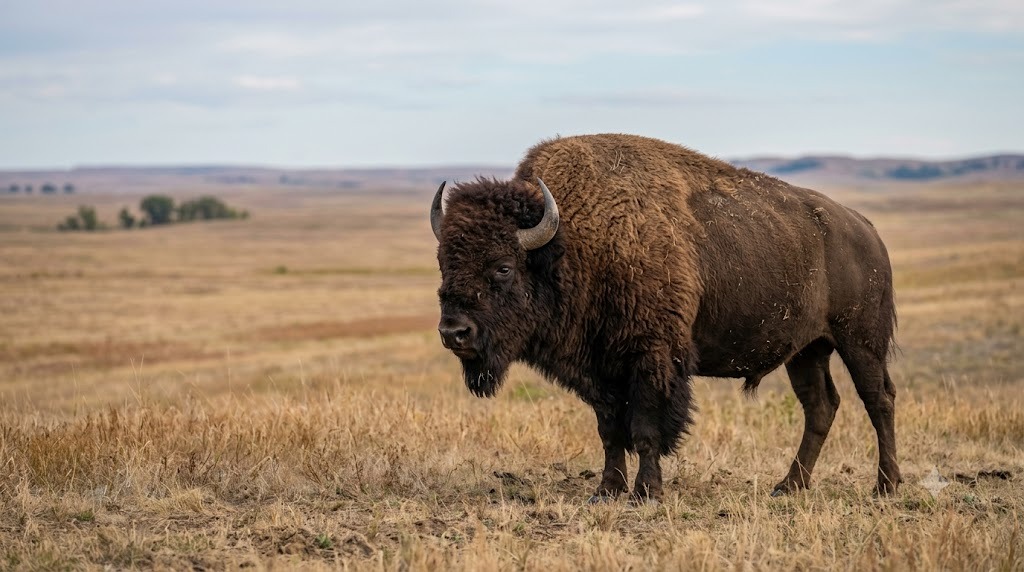
Bison are unmistakable and immense. A mature bull stands six feet at the shoulder and can weigh 1,800 to well over 2,000 pounds; cows are smaller but still formidable at 700 to 1,200 pounds. The body is defined by a massive forequarter - a tall shoulder hump supported by elongated vertebrae and powered by heavy muscle - tapering to leaner hindquarters.
The head is large and carried low, framed by a thick, dark, shaggy mane and a beard, with a curly cap of hair on the forehead and crown. Both bulls and cows carry short, curved black horns; a bull's horns are heavier-based and the bull's overall front end is far more massive. The coat is dark brown, longer and woollier on the front of the body, shorter and smoother behind. Despite their bulk, bison are surprisingly agile and can run faster than a person.
Range & Habitat (US)
Wild and free-ranging bison are far less widespread than their historic range. In the United States, huntable wild herds exist in places such as the Henry Mountains and Book Cliffs of Utah, the Antelope Island and other Utah herds, parts of Arizona (the House Rock and North Kaibab areas), Wyoming near the Greater Yellowstone region, the Delta and Farewell herds of Alaska, and certain other managed populations. Many other "bison hunts" advertised commercially take place on private ranches and game farms and are a different proposition than hunting a truly wild, free-ranging herd.
Wild bison habitat varies by herd: open shortgrass and sagebrush plains and high plateaus, mixed grasslands and timber, river valleys, and forested mountain country. Bison are grazers, living primarily on grasses and sedges, and they need large landscapes with abundant forage.
Behavior & Sign
Bison are herd animals with a strong social structure. Cows, calves, and young animals form the main herds, while mature bulls are often solitary or in small bachelor groups, joining the herds during the summer breeding season, or rut.
Bison are not difficult to locate - they are huge, dark, and often in groups in open country - but they are wary, have a good sense of smell, and can move surprising distances. They are also genuinely dangerous: a bison that feels threatened or cornered can charge with astonishing speed and power, and hunters must always maintain a safe distance and a clear escape plan.
Sign is obvious where bison range: large, rounded tracks; substantial "chips" of dung scattered across the range; wallows - bare, dished-out depressions in the soil where bison roll; rubbed and polished trees, rocks, and posts; shed clumps of woolly hair caught on brush; and well-worn trails. Wallows and rubs are classic, long-recognized bison sign.
Hunting Seasons & Timing
Wild bison seasons vary widely by state and herd, but generally fall in autumn and into winter, often running from roughly September or October through December or January.
- Autumn: The most common window. Weather is workable, bulls are in good condition after the rut, and access is generally good.
- Late fall and winter: Some hunts run into winter, when snow can concentrate herds at lower elevations and make tracking easier, but cold and access become serious factors.
Because a bison tag is so rare and the seasons are often long, hunters typically have flexibility within their season and should plan around access, weather, and the practical challenge of recovering an enormous animal.
Hunting Methods
Bison hunting is primarily a spot-and-stalk pursuit, though it is shaped less by the difficulty of getting close and more by the responsibilities that come with the animal's size.
The method is to glass open country and locate a herd or a target animal, then plan an approach that closes the distance using terrain and wind while keeping a safe margin from these large, potentially dangerous animals. Because bison are big and often in open habitat, the stalk itself is frequently straightforward - the harder questions are which animal to take, where it is standing relative to roads or trails for recovery, and how to position for a clean, ethical shot.
A critical and often-overlooked part of bison hunting is recovery planning. Hunters routinely think through, before the shot, how an animal of one ton or more will be reached with a vehicle, ATV, packhorses, or quartered and packed out. Many bison hunters take an animal close to where it can be reached for processing, and most enlist help - the labor of breaking down and moving a bison is far beyond a typical deer or elk.
Where to Find Them - Reading the Terrain
Look for good grazing country with water and space - open grasslands, sagebrush flats, high plateaus, mountain parks, and river valleys, depending on the herd. Bison concentrate where forage is best.
Wallows, heavily worn trails, fresh dung, and grazed areas indicate current bison use. In open country, high vantage points let a hunter glass large areas and locate herds at distance. In timbered or broken country, watch the parks, meadows, and trail systems.
Equally important is reading the terrain for recovery: identifying which areas are reachable by road or with horses, and factoring that into where a hunter is willing to take an animal. This practical terrain reading is as much a part of a bison hunt as locating the animal.
Gear & Optics Needed
Optics: a good pair of 10x binoculars for locating and evaluating animals, and often a spotting scope for judging at distance.
A bison's size dictates a substantial cartridge. Most authorities recommend a heavy, hard-hitting rifle - cartridges in the .338, .375, or larger class are common choices, with .30 caliber magnums considered a practical minimum, paired with stout, deep-penetrating bullets. Adequate power and bullet construction are essential for a clean, humane harvest on such a heavy-bodied animal.
For the recovery, hunters need serious equipment: large, sharp knives and a saw or bone tools, plenty of heavy game bags, a meat pack or - more often - vehicle, ATV, sled, or pack-stock access, a means to hang or move quarters, and plenty of cooler space or cold storage. Cold-weather clothing for late-season hunts is also important.
Shot Placement & Field-Dressing
Bison are extremely tough, heavy-boned animals, and shot placement is critical. The recommended aim point on a broadside bison is the heart-lung area low and just behind the front leg - not centered on the massive shoulder hump, which is largely muscle and bone over the spine, well above the vitals. Take only a steady, well-supported shot at a moderate range you have practiced, with an adequate cartridge and a quality bullet. Be prepared for a follow-up shot, and always maintain a safe distance and escape route from a wounded animal.
Field-dressing a bison is a major undertaking. The animal is too large to handle alone; hunters quarter it in place, often using the gutless method, and the meat - many hundreds of pounds - must be moved promptly to keep it cool and clean. This is why recovery access and extra help are planned before the shot, not after.
Meat & Eating Quality
Bison meat is outstanding - lean, rich, slightly sweet, and tender, widely prized and broadly considered among the finest red meat available, wild or domestic. A single wild bison yields an extraordinary quantity of premium meat, often several hundred pounds, enough to fill a freezer for a long time. Because the volume is so large, prompt cooling, clean handling, and a clear plan for processing and storage are essential. Properly cared for, a wild bison provides a remarkable amount of healthy, excellent table fare.
Common Mistakes
- Underestimating the recovery. The shot is the easy part. Failing to plan how to reach, break down, and transport a one-ton animal is the most common and costly mistake.
- Using too light a rifle. Bison are heavy-boned and tough; an underpowered cartridge or poor bullet risks a non-ideal outcome.
- Aiming for the hump. The shoulder hump is not the vitals. Aim low behind the front leg for the heart-lung area.
- Disrespecting the danger. Bison can charge and are deceptively fast; never crowd them or approach a downed animal carelessly.
- Confusing a ranch shoot with a wild hunt. Hunters should know the difference between a fair-chase wild-herd hunt and a commercial game-farm operation.
Regulations & Conservation Note
Wild bison hunting is almost entirely draw-only, with very limited tags and often extremely low draw odds; in many states a wild bison is a once-in-a-lifetime tag. Public hunts on herds such as Utah's Henry Mountains or Arizona's House Rock herd are among the most coveted draws in the country. Some hunts occur near Yellowstone as part of population and disease-management efforts and carry their own specific rules.
The bison's conservation story is central. The species was reduced from tens of millions to a few hundred animals before being saved by early conservationists, ranchers, and the first wave of the American conservation movement. Today, regulated hunting helps manage free-ranging herds within the limited habitat available, and tag fees support wildlife management. Hunters should also understand the distinction between truly wild, free-ranging public-land bison and commercially raised animals. Always verify the specific draw rules, regulations, and management context for the herd you hope to hunt.
Best Suited For
A wild bison hunt suits the hunter who values a rare, historically resonant opportunity and is fully prepared for the work and logistics that follow the shot. The stalk itself is rarely the hard part, so it is accessible to hunters of varied experience - but everyone who draws a tag should organize adequate help, equipment, and recovery access. It best suits hunters who appreciate the conservation legacy and want to participate in the modern, science-based management of America's iconic animal.
FAQ
How do I get to hunt a wild bison? Through a state draw. Wild bison tags are very limited and the draw odds for herds like Utah's Henry Mountains are among the lowest in the country; many are once-in-a-lifetime tags.
What rifle do I need? A powerful one. Cartridges in the .338, .375, or larger class with stout, deep-penetrating bullets are common; .30 magnums are often considered a practical minimum. Bison are heavy-boned and tough.
Where do I aim on a bison? Low and just behind the front leg, into the heart-lung area - not on the big shoulder hump, which sits well above the vitals.
Is the hunt physically hard? The stalk usually is not. The recovery is - moving a one-ton animal demands help, equipment, and access. Plan that before you ever take the shot.
Is wild bison different from ranch bison hunts? Yes. Commercially advertised hunts often take place on private ranches and game farms. A wild, free-ranging public-herd hunt is a true fair-chase pursuit and a far rarer opportunity.