Caribou
The caribou is the great wanderer of the North American big-game world - a member of the deer family uniquely adapted to the open tundra, taiga, and Arctic mountains.
🗓️ Last reviewed: June 2026
Overview
The caribou is the great wanderer of the North American big-game world - a member of the deer family uniquely adapted to the open tundra, taiga, and Arctic mountains. Caribou are famous for their long migrations, their broad antlers carried by both sexes, and their habit of moving in herds across vast, treeless country. For hunters, a caribou hunt is a chance to experience the immense scale of the North: Alaska's Arctic and subarctic landscapes, where the horizon seems to go on forever.
In the United States, caribou hunting is centered in Alaska, which offers some of the most accessible wilderness big-game hunting on the continent. Several large herds provide generous opportunity, and many caribou hunts are over-the-counter rather than draw-only. A caribou hunt is part adventure, part lesson in patience, since these animals are always on the move and a herd that is here today can be many miles away tomorrow.
Identification & Appearance
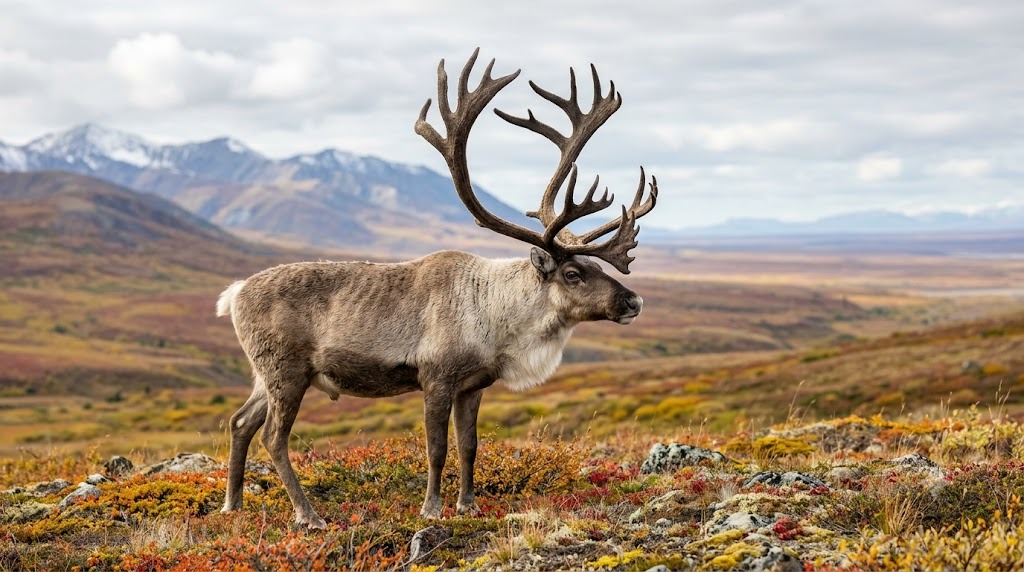
Caribou are medium-to-large members of the deer family. A mature bull weighs roughly 350 to 450 pounds, sometimes more depending on the herd; cows run 175 to 250 pounds. The body is stocky and well-insulated, with a thick coat that ranges from brown to grayish, a pale neck and mane, and a white rump and belly.
The most distinctive feature is the antlers - caribou are the only members of the deer family in which both bulls and cows grow antlers, though bull antlers are far larger. A mature bull carries tall, sweeping, often asymmetrical antlers with a characteristic forward-pointing brow shovel above the nose. The antlers are unmistakable in profile.
Caribou hooves are large, broad, and crescent-shaped - adapted to spread the animal's weight on snow and soft tundra and to function like paddles when swimming. Their feet make a distinctive clicking sound as they walk, caused by a tendon slipping over a bone.
Range & Habitat (US)
In the United States, caribou are found almost exclusively in Alaska, home to numerous herds including the very large Western Arctic Herd and the Mulchatna Herd, among others. (A small caribou population historically occurred in the northern lower 48, but Alaska is where caribou hunting takes place.)
Caribou habitat is open country: Arctic and alpine tundra, the rolling treeless hills of the North, taiga and subarctic forest edges, river valleys, and high mountain passes. They feed on lichens - especially the so-called reindeer lichen - as well as sedges, grasses, willow, and other tundra plants. The defining trait of caribou country is openness and scale, and the defining trait of caribou themselves is movement across it.
Behavior & Sign
Caribou are migratory and gregarious. Herds make seasonal movements that can cover hundreds of miles between calving grounds, summer range, and wintering areas. They move more or less constantly, grazing as they go, and a hunter must think in terms of intercepting moving animals rather than patterning stationary ones.
Caribou eyesight is modest, but their sense of smell is keen and they are wary of scent and unusual movement. The rut falls in autumn, generally late September into October, when bulls gather cows and their antlers are at their hard-horned best.
Sign is abundant where caribou have passed: crescent-shaped tracks, often clustered into broad braided trails worn across the tundra; pellet droppings; shed antlers; cropped lichen and grazed vegetation; and well-trodden river crossings and mountain passes. Fresh, heavily used trails point to the routes a herd is currently using.
Hunting Seasons & Timing
Caribou seasons in Alaska vary by herd and unit, but generally run from roughly August into September and again later in the fall and winter, with both bull and, in some herds, cow opportunity.
- August: Early-season hunts. Bull antlers are still in velvet or just clean; weather is milder; bulls are in excellent body condition.
- September: A prime window - antlers are hard and impressive, bulls are coloring up, and the migration often brings animals through.
- Late season: Some herds offer fall and winter hunts as caribou move to and occupy winter range.
Timing a caribou hunt around the migration is the central challenge. Migration timing shifts year to year with weather and snow, so flexibility is essential.
Hunting Methods
Caribou hunting blends spot-and-stalk with the art of intercepting a moving herd.
Spot-and-stalk: From a high vantage, glass the open tundra for caribou - their pale necks and the flash of antlers give them away at distance. Once a good bull is located, plan a stalk using the rolling terrain and the wind. Because the country is open, stalks rely on folds in the land, riverbanks, and brush.
Intercepting migration: When a herd is moving, the productive approach is to position along the route - a mountain pass, a river crossing, an esker, a saddle - and let the caribou come to you. Reading current trail use is key.
Fly-in float and base hunts: Many Alaskan caribou hunts begin with a bush plane to a remote lake, gravel bar, or strip, followed by backpack hunting or float hunting down a river that crosses migration routes. Patience and a willingness to move with the herd are the core skills.
Where to Find Them - Reading the Terrain
Think about movement. Caribou funnel through certain terrain features: mountain passes, low saddles, river crossings, lake narrows, and the gravel eskers that snake across the tundra. These are natural travel corridors, and a hunter who can identify them and read fresh sign can position effectively.
For feeding, look to lichen-rich tundra benches, river valleys, and rolling hills with good forage. Caribou often use breezy ridges and open ground to escape insects in late summer. High vantage points are essential - in open country a hunter can glass enormous areas, and a herd visible as distant specks can be watched and intercepted.
Above all, read the current sign. Tracks and trails tell you where the herd has been recently and which corridors are active this year.
Gear & Optics Needed
Good optics are central: 10x binoculars for scanning the vast open country and a spotting scope on a tripod for judging bulls at long range, plus a rangefinder.
Because caribou country is wet, open, and weather-exposed, gear matters. Quality rain gear, knee-high rubber boots for boggy tundra (with sturdier boots for mountain hunts), warm layers, a windproof shell, and a reliable shelter are all important. A capable backpack for hauling meat, plenty of game bags, a satellite communicator, and dependable navigation in featureless terrain round out the kit. Insect protection - a head net and repellent - is genuinely important in the early season.
A flat-shooting rifle in a cartridge such as .270, .308, 7mm magnum, or .30-06 suits caribou; shots range from moderate to long across open ground.
Shot Placement & Field-Dressing
Caribou are not especially hard to kill, but they are often moving, so patience for a stationary, broadside shot pays off. Aim for the heart-lung area behind the shoulder, taking only a steady, well-supported shot at a range you have practiced. If a herd is moving, wait for an animal to pause rather than rushing a shot at a walking bull.
After a clean shot, field-dress promptly. The gutless method works well for breaking the animal down into quarters, loins, and trim for the pack-out. Cool the meat in the open air and bag it to keep it clean. Alaska law requires the meat to be salvaged. Plan the pack-out carefully - caribou country can mean long carries across soft, wet tundra.
Meat & Eating Quality
Caribou is excellent table fare - lean, tender, fine-grained, and mild, often considered among the best wild meats in the North. The lichen-and-tundra diet produces clean-flavored meat that many hunters rank with the very best venison. Because it is so lean, caribou benefits from careful cooking to avoid drying it out. Properly field-cared-for and handled, it is a genuine reward of the hunt and a staple food for many northern hunters.
Common Mistakes
- Expecting caribou to stay put. They are migratory and constantly moving; a hunter who cannot adapt and follow the herd will struggle.
- Poor timing. Arriving before or after the migration moves through can mean empty country. Build flexibility into the trip.
- Underestimating insects and weather. Bugs and wet, cold conditions wear hunters down; proper protection matters.
- Rushing a shot at a moving animal. Wait for the bull to stop and offer a clean, standing shot.
- Misjudging the pack-out. Soft tundra and long distances make hauling meat hard work; plan loads and routes.
Regulations & Conservation Note
Caribou hunting in Alaska is, for several herds, relatively accessible - many hunts are general-season or registration hunts rather than draw-only, and bag limits in healthy herds can be generous, sometimes allowing more than one animal. Other herds, particularly those experiencing declines, are tightly restricted or closed, and rules change frequently as herds rise and fall.
Caribou populations are naturally cyclic and some herds have declined sharply in recent years, prompting reduced limits and closures. Caribou are an essential subsistence resource for many Alaskan communities, and management balances sport, subsistence, and conservation. Nonresidents should research guide and transporter requirements. Always verify the current regulations, herd-specific rules, season dates, and bag limits for the exact unit and herd you plan to hunt - this is an area where rules genuinely change year to year.
Best Suited For
A caribou hunt suits the adventurous hunter who wants an accessible, affordable taste of true Northern wilderness without a lottery tag or a five-figure budget. It rewards flexibility, patience, and a willingness to deal with bugs, weather, and bush-plane logistics. It is well within reach of beginners hunting with a guide or experienced partner, and it is an outstanding first big-game adventure in the North.
FAQ
Do I need to draw a tag to hunt caribou in Alaska? Often no - many herds are hunted on general-season or registration hunts. Some declining herds are restricted or closed. Always check the current rules for your specific herd.
Why is timing so important? Caribou migrate, and the herd's location changes constantly. Arriving when the migration is passing through your area is the difference between a great hunt and an empty one - and timing shifts with the weather each year.
Both bulls and cows have antlers - how do I pick a mature bull? A mature bull carries much larger, taller, sweeping antlers with a prominent forward brow shovel, and a heavier body and mane. Cow antlers are small and slender.
Is caribou good to eat? Yes - it is lean, mild, and tender, ranked among the finest wild meats. Because it is so lean, cook it carefully to keep it from drying out.
Do I need a guide? Resident hunters do not. Nonresidents do not legally need a guide for caribou (unlike sheep or goat), but many use a transporter or outfitter for access to remote country.