Columbia Blacktail Deer
The Columbia blacktail deer is the deer of the rainy Pacific coast - a coastal subspecies of the mule deer, adapted to the dense, dripping forests, clearcuts, and brushy mountains west of the Cascade crest.
🗓️ Last reviewed: June 2026
Overview
The Columbia blacktail deer is the deer of the rainy Pacific coast - a coastal subspecies of the mule deer, adapted to the dense, dripping forests, clearcuts, and brushy mountains west of the Cascade crest. Among Western hunters, the blacktail has a reputation as one of the most challenging deer to consistently kill, not because it lives in vast country like a mule deer, but because it lives in some of the thickest, most impenetrable cover of any North American deer. Hunting blacktails rewards woodsmanship, patience, and an intimate knowledge of small pieces of ground. It is a hunter's deer, prized by those who live with it year-round and learn to pick a mature buck out of the timber and brush of the coastal mountains.
Identification & Appearance
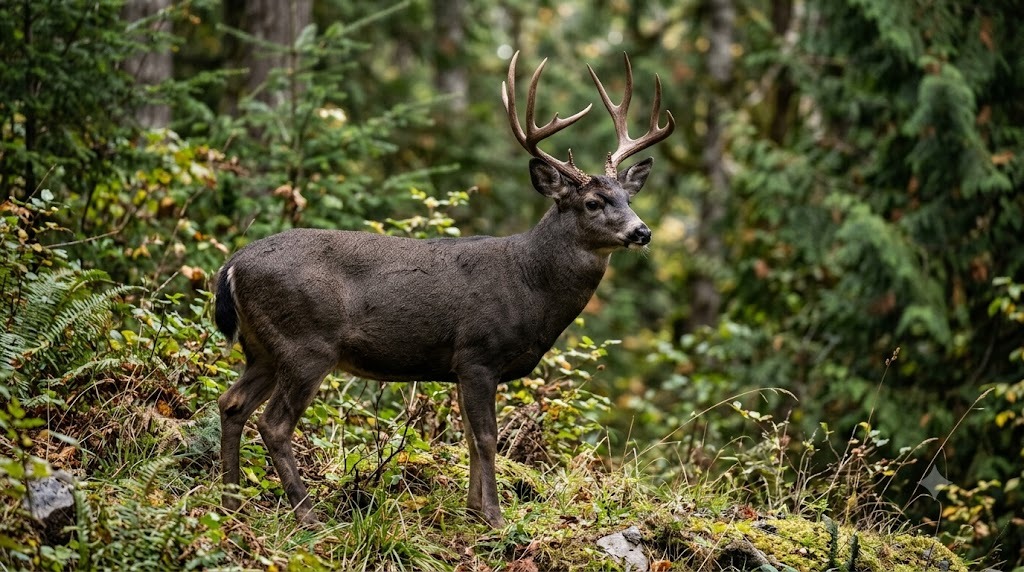
The Columbia blacktail looks like a smaller, darker mule deer - which, biologically, is essentially what it is. The name comes from the tail: broad, with a dark or black upper surface and a white underside, intermediate in appearance between the rope-like black-tipped tail of a Rocky Mountain mule deer and the broad white flag of a whitetail. Antlers fork in the bifurcating mule-deer pattern rather than rising as single tines off a beam. The coat is a rich brown that runs darker than an interior mule deer's, suiting the shadowed coastal forest. Bucks are moderate in size - generally smaller than Rocky Mountain mule deer - with does smaller still. The ears are large, the build compact and sturdy.
Range & Habitat (US)
Columbia blacktail deer occupy the Pacific coastal region of the United States - western Oregon, western Washington, and the coastal and northern parts of California, generally west of the crest of the Cascade Range. This is a land of heavy rainfall, dense conifer forest, fog, and lush understory. Blacktails thrive in the patchwork created by timber management: regenerating clearcuts and young timber rich in browse, edged by mature forest for security and cover. They also use brushy mountainsides, coastal foothills, river valleys, and the dense understory of old forest. The defining trait of blacktail country is thick cover - these deer are rarely far from a place to disappear.
Behavior & Sign
Blacktail deer are secretive, cover-loving, and famously hard to pattern. They tend to occupy small home ranges and to be most active at dawn and dusk, and where pressured they become highly nocturnal, slipping through the brush in low light. Their hearing and sense of smell are excellent, and they use the dense vegetation masterfully to stay hidden. Many blacktails make modest seasonal elevation movements between higher summer range and lower winter range. The autumn rut, generally in November, is the great equalizer, when otherwise invisible bucks move more in daylight. Sign includes mule-deer-like tracks and droppings, browsed brush in clearcuts, beds in shaded cover, and rubs and scrapes during the rut.
Hunting Seasons & Timing
Oregon, Washington, and California manage blacktail deer with a mix of general and limited-entry tags across archery, muzzleloader, and modern firearm seasons, spanning roughly late summer through fall. Early-season hunts, often warm and dry, target deer on more predictable feeding patterns and can offer high-country opportunity. The pivotal timing for many blacktail hunters is the November rut, when mature bucks abandon some of their caution and move during daylight - the best window to catch a buck out of the brush. Late seasons can take advantage of deer concentrated on winter range. Always confirm the specific state and unit's seasons, tag type, and weapon rules before hunting.
Hunting Methods
Blacktail hunting demands methods suited to thick cover. Still-hunting - moving very slowly through timber and brush, pausing constantly to look and listen, often into the wind on damp, quiet ground - is a classic and effective approach in this terrain. Glassing clearcuts, burns, brushy slopes, and timber edges at first and last light works wherever the cover opens enough to see, and is a key early-season tactic. Stand or ambush hunting over travel routes, clearcut edges, and rut sign concentrates effort where deer move. Rattling and calling can draw rutting bucks. Tracking in snow or on soft ground is productive late season. Across all methods, slow, quiet, wind-conscious hunting in thick cover is the unifying theme.
Where to Find Them - Reading the Terrain
Read blacktail country as a mosaic of food and cover. The richest feeding is in regenerating clearcuts and young timber, where browse grows thick - and the edges where those cuts meet mature forest are prime, offering food beside instant security. Blacktails bed in dense cover: thick reprod, brushy draws, shaded benches. They travel timbered corridors, creek bottoms, and the seams between cover types. Glass the openings and clearcuts at the very edges of light, and still-hunt the timber and brush during the day. During the rut, focus on doe concentrations, because that is where the bucks will be. In wet, foggy weather, deer often move more freely.
Gear & Optics Needed
Blacktail hunting blends close-cover and open-glassing demands, so a versatile binocular - useful both for picking apart brush at close range and for glassing distant clearcuts - is the key optic, with a rangefinder valuable where shots open up. The defining gear consideration, though, is the coastal weather: this is wet country, and quality rain gear, waterproof boots, and warm layers that perform when soaked are essential. Quiet clothing matters for still-hunting in thick cover. Round out the kit with a sharp knife, game bags, a capable daypack, and a mapping app for e-scouting clearcuts and timber edges across the patchwork of the coastal mountains.
Shot Placement & Field-Dressing
Blacktail hunting in dense cover often presents close, quick opportunities in low light and thick brush, so a hunter must be ready, steady, and disciplined. Wait for a clear, unobstructed view of the deer - brush deflects and ruins shots - and place a calm, broadside shot into the heart-lung area, low and behind the front shoulder. Pass anything obscured, rushed, or marginal. After the shot, mark the spot carefully, because tracking in thick coastal cover and on wet ground can be difficult. Field-dress promptly, cool the meat, and keep it clean and dry - the damp climate makes prompt, careful field care especially important.
Meat & Eating Quality
Columbia blacktail venison is excellent - lean, mild, and fine-grained, on par with mule deer and whitetail venison. Because blacktails are a moderate-sized deer, a buck yields a modest but worthwhile quantity of high-quality meat. As always, the table quality comes down to field care: in the cool, wet coastal climate, the priorities are getting the meat cooled, kept clean, and kept dry, away from constant moisture. Backstraps and tenderloins are superb with quick cooking, and the rest of the deer makes fine steaks, roasts, and grind. A blacktail well cared for is as good as venison gets.
Common Mistakes
The most common mistake is hunting blacktails too fast and too loud - this is a deer of thick cover, and a hunter who still-hunts at a normal walking pace will push deer out unseen. Effective blacktail hunting is painstakingly slow. Other errors include ignoring the wind, hunting the middle of the day during the early season instead of focusing on the edges of light, and overlooking the rut, which is the single best chance at a mature buck. Hunters also underestimate how completely a blacktail uses cover, and how difficult tracking can be in dense, wet terrain - making a clean, well-placed shot all the more important.
Regulations & Conservation Note
Columbia blacktail deer are managed by Oregon, Washington, and California through season structures and tag systems calibrated to local herd health and habitat. Blacktail habitat is closely linked to forest management, since the regenerating clearcuts that produce abundant browse are a product of timber harvest cycles, and changes in forestry practices affect deer numbers over time. Hunter license dollars fund the surveys and habitat work that support these deer. Hunt only with the proper tags, follow all unit rules, bag limits, and reporting requirements, respect public and private land access, and follow carcass-handling and disease regulations. Legal, ethical hunting sustains the resource.
Best Suited For
Columbia blacktail hunting suits the patient, detail-oriented hunter who is willing to learn a piece of ground intimately and to hunt slowly and quietly in thick cover. It is ideal for hunters of the Pacific Northwest and Northern California who can hunt close to home throughout the season, and for those who relish a genuine woodsmanship challenge over a numbers game. The hunter who enjoys still-hunting damp timber, glassing clearcuts at first light, and outwitting a secretive deer will find the blacktail deeply rewarding.
FAQ
Is a blacktail deer the same as a mule deer? The Columbia blacktail is a coastal subspecies of the mule deer - smaller, darker, and adapted to the dense forests of the Pacific coast. It shares the mule deer's forked antler pattern but has its own distinctive dark-topped tail.
Why are blacktails considered so hard to hunt? They live in some of the thickest cover of any North American deer, occupy small home ranges, and are highly secretive and easily nocturnal under pressure. Consistently finding a mature buck takes patience and intimate knowledge of the ground.
When is the best time to hunt blacktails? The November rut is the prime window, when mature bucks move more during daylight. Early-season hunts on feeding patterns and late-season hunts on winter range can also produce.
What is the best method for hunting blacktail deer? Slow, quiet still-hunting through timber and brush is a classic approach, along with glassing clearcuts and brushy slopes at first and last light. Both demand patience and constant attention to the wind.
Is blacktail venison good to eat? Yes - it is lean, mild, and fine-grained, comparable to mule deer and whitetail venison. In the wet coastal climate, keeping the meat cooled, clean, and dry is the key to preserving that quality.