Coues Deer
The Coues deer - pronounced "cows" - is the diminutive desert whitetail of the American Southwest, a subspecies of the white-tailed deer adapted to rugged, arid mountains.
🗓️ Last reviewed: June 2026
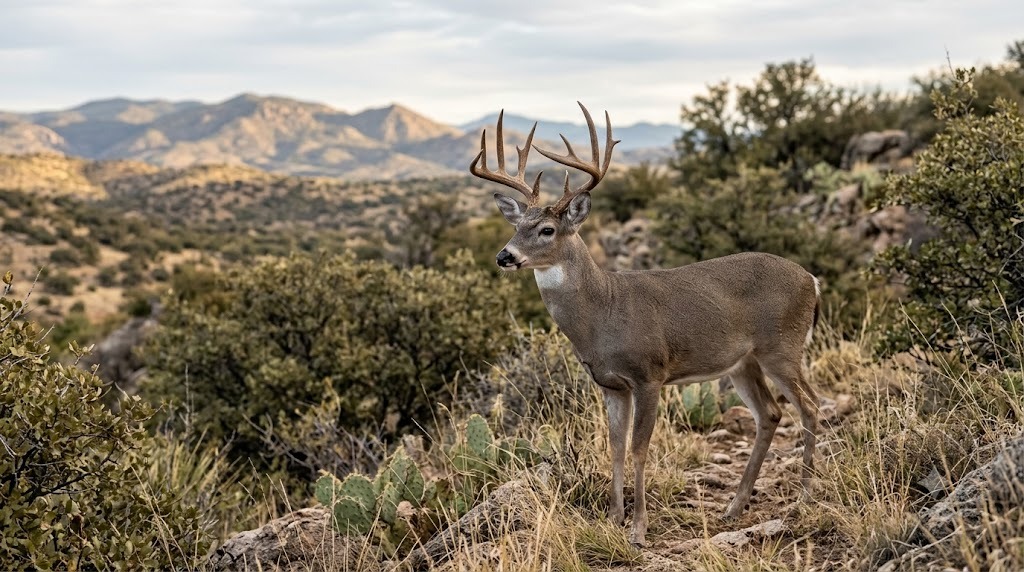
Overview
The Coues deer - pronounced "cows" - is the diminutive desert whitetail of the American Southwest, a subspecies of the white-tailed deer adapted to rugged, arid mountains. Among Western hunters it has earned a near-legendary reputation as the "gray ghost" for its ability to vanish into oak brush and rock at the slightest hint of danger. Coues deer hunting is a specialist's pursuit: it is a glassing-intensive, mountain-oriented hunt for a small, sharp-eyed, wary animal in tough country. Hunters who fall for Coues deer tend to fall hard, drawn by the challenge, the spectacular Southwestern terrain, and the satisfaction of outwitting one of North America's most difficult deer. A mature Coues buck, though small in body, is a genuine trophy of skill.
Identification & Appearance
The Coues deer is essentially a small, pale, big-eared whitetail. It carries the classic whitetail traits - a broad tail white underneath and flagged when alarmed, antlers branching as single tines off a forward-curving main beam - but everything is scaled down. A mature Coues buck often weighs only around 100 pounds or even less, with does smaller still; this is a markedly smaller deer than a northern whitetail. The coat is a grayish color well suited to blending into desert oak, brush, and rock, and the ears appear proportionally large for the body. Antlers are modest in size compared to other deer but finely formed. The overall impression is of a compact, alert, perfectly camouflaged animal.
Range & Habitat (US)
In the United States, Coues deer occupy the mountainous Southwest - primarily the high desert ranges of Arizona and the bootheel and southwestern country of New Mexico. They are an animal of the "sky islands" and rugged foothills: oak-studded slopes, chaparral and brush, juniper and pinyon, manzanita thickets, and the steep, broken canyons and ridges of desert mountains. They generally favor mid-elevation country with a mix of brushy cover, oak mast, and broken terrain, avoiding both the lowest desert flats and the highest peaks. Reliable forage and the security of rugged, vegetated terrain define good Coues country.
Behavior & Sign
Coues deer are famously wary, relying on sharp eyesight, excellent hearing, a keen nose, and an uncanny ability to use cover and terrain to disappear - hence "gray ghost." They are most active in the cool hours of dawn and dusk, feeding on the move and bedding through the heat of the day in shade on cool slopes. They tend to occupy relatively small home ranges within their rugged country. During the rut, which falls in winter, bucks become more visible and more vulnerable as they pursue does on the open slopes. Sign includes small whitetail-like tracks, droppings, browsed brush, beds in shaded pockets, and the rubs and scrapes typical of whitetails, scaled down.
Hunting Seasons & Timing
Coues deer are hunted through state draw tag systems in Arizona and New Mexico, with both archery and rifle opportunities. Seasons span roughly autumn into winter. A defining feature of Coues hunting is the late, winter rut hunt: rifle seasons that fall in roughly December into January coincide with the rut, when normally invisible bucks move on open slopes in daylight and become far more findable - making the rut the marquee timing for many Coues hunters. Earlier-season hunts target deer on more predictable feeding-and-bedding patterns. Because access depends on the draw, researching each state's application process, deadlines, and unit options well ahead is essential.
Hunting Methods
Coues deer hunting is, above all, a glassing game - arguably the most glassing-intensive deer hunt in North America. The core method is to find a high vantage before first light, set up quality optics on a tripod, and methodically pick apart the opposite slopes and canyons for the small gray shape of a deer. Once a buck is located, the hunter plans a spot-and-stalk approach, using the steep terrain and wind to close in on this hyper-alert animal. Patience is everything: watching a buck until he beds, then stalking him, is a classic tactic. Still-hunting through oak brush works in some terrain, but the hunter who outglasses the country outhunts everyone else.
Where to Find Them - Reading the Terrain
Think in terms of slopes, shade, food, and broken cover. Coues deer favor mid-elevation oak and brush country with rugged structure - canyons, ridges, benches, and draws that offer both cover and escape terrain. Glass shaded north- and east-facing slopes during the warmer hours, where deer bed, and feeding edges and openings at first and last light. Oak flats dropping mast are magnets. Look for the deer themselves rather than for heavy sign - in this open but broken country, finding deer is a visual search across great distances. During the winter rut, glass open slopes hard, where bucks chase does in daylight.
Gear & Optics Needed
No North American deer hunt is more optics-dependent than the Coues hunt. High-quality binoculars and, crucially, a spotting scope on a stable tripod are the central tools - and many dedicated Coues hunters run high-magnification binoculars on a tripod for hours of comfortable, detailed glassing. A reliable rangefinder is essential, since the country is steep and shots can be at extended range, which also makes honest practice off a solid rest important. Build the rest of the kit for steep, rocky desert mountains: sturdy boots with good grip, layered clothing for cold mornings and mild afternoons, sun protection, ample water, and a capable daypack. A tripod and a comfortable place to sit and glass are not luxuries here - they are core equipment.
Shot Placement & Field-Dressing
Coues deer are small animals often hunted in steep country at longer-than-average distances, so shot discipline is paramount. Range the deer precisely, build the steadiest rest the terrain allows, account for angle and wind, and wait for a calm, broadside heart-lung opportunity, low and behind the front shoulder. Pass any shot that is rushed, unsteady, or beyond your honest, practiced range. Because the deer is small and the terrain steep, the recovery is manageable for one hunter, but field care still matters: dress the animal promptly, cool the meat, keep it clean, and protect it on the pack-out, especially during warmer early-season hunts.
Meat & Eating Quality
Coues deer venison is excellent - lean, mild, and fine-textured, true whitetail-quality meat, simply in a smaller package. Because the animal is small, a Coues deer yields a modest quantity of meat compared to an elk or a northern whitetail, but the quality is high and the meat is prized by those who hunt these deer. As with all venison, eating quality depends on prompt field care: cool the meat quickly, handle it cleanly, and avoid overcooking the lean cuts. Backstraps and tenderloins are superb, and the rest of the deer makes fine steaks, roasts, and grind.
Common Mistakes
The defining mistake in Coues hunting is not glassing enough or not glassing well - hunters who walk too much and look too little simply never see the "gray ghost." Effective Coues hunting means hours of patient, methodical glassing with a tripod. Other errors include stalking too fast on a hyper-alert animal, skylining on ridgelines, ignoring thermals in the steep terrain, and taking shots beyond honest range without a solid rest. Hunters also frequently underestimate how completely a Coues deer can hide in seemingly open country, and how quickly one will vanish at any sign of a careless approach.
Regulations & Conservation Note
Coues deer populations are managed by Arizona and New Mexico through draw-based tag systems calibrated to herd health and habitat conditions, which in the arid Southwest are strongly tied to rainfall and forage. Hunter license dollars fund the surveys, water developments, and habitat work that support desert deer. Hunt only with a legal drawn tag, follow all unit rules, bag limits, and reporting requirements, and respect access rules across the mix of public and private land in the Southwest. As with all big game, following carcass-handling and disease regulations and hunting within fair-chase principles keeps the resource healthy.
Best Suited For
Coues deer hunting suits the dedicated glasser - the hunter who can sit behind a tripod for hours, methodically search rugged country, and savor the patient hunt. It is ideal for those who love Southwestern desert mountains, who relish a genuine challenge, and who measure a trophy in difficulty rather than body size. The winter rut hunt particularly appeals to hunters who want their season to extend into December and January. It is a specialist's hunt, less about covering ground than about seeing what others cannot.
FAQ
Why is the Coues deer called the "gray ghost"? Because its gray coat blends perfectly into desert oak, brush, and rock, and because it is extraordinarily skilled at using terrain and cover to disappear. Coues deer can be remarkably hard to spot even in fairly open country.
Is a Coues deer just a small whitetail? Essentially, yes - it is a subspecies of white-tailed deer adapted to the arid Southwest, much smaller in body, paler, and big-eared, but carrying the classic whitetail traits like the flagged white tail and forward-curving antlers.
When is the best time to hunt Coues deer? The winter rut, with rifle seasons falling roughly December into January in parts of the Southwest, is the marquee timing, because normally invisible bucks move on open slopes in daylight and become much easier to find.
Do I really need a spotting scope? Yes. Coues deer hunting is the most glassing-intensive deer hunt in North America. A spotting scope on a tripod, and often high-magnification tripod-mounted binoculars, are central to finding and judging these deer.
Is Coues deer meat good? Yes - it is true whitetail-quality venison: lean, mild, and fine-textured. There is simply less of it because the deer is small. Prompt field care preserves the quality.