Dall Sheep
The Dall sheep is the white wild sheep of the far north - a striking, snow-colored animal of Alaska's and the Yukon's high mountains.
🗓️ Last reviewed: June 2026
Overview
The Dall sheep is the white wild sheep of the far north - a striking, snow-colored animal of Alaska's and the Yukon's high mountains. For many hunters the Dall sheep hunt represents the purest expression of mountain hunting: remote wilderness, no roads, an animal that lives near the top of the world, and a pursuit that demands genuine fitness and self-reliance. It is also, importantly, the most accessible of North America's wild sheep - Alaska offers Dall sheep tags to residents over the counter and through general nonresident permits in many areas, unlike the lottery-only bighorns.
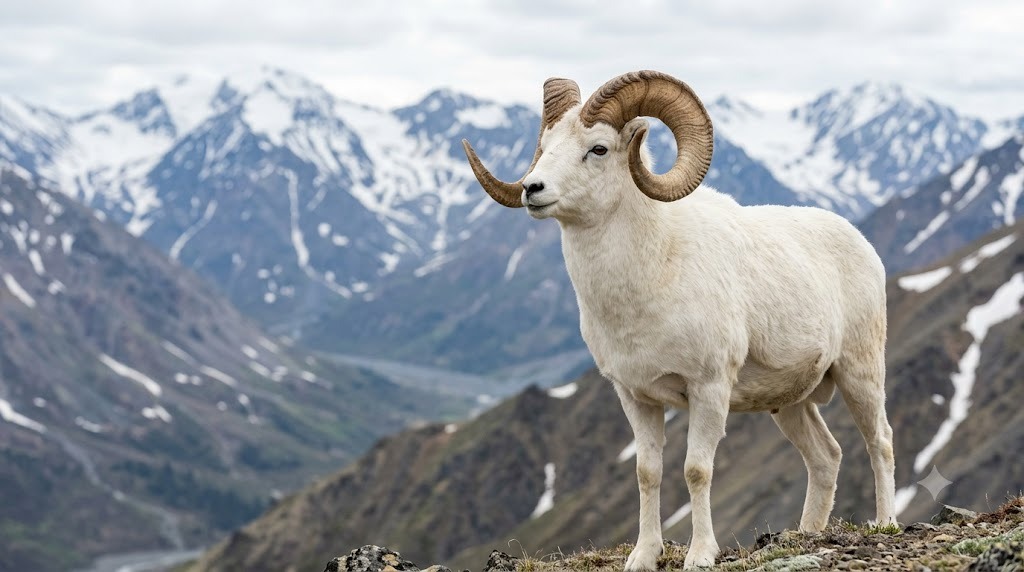
A Dall sheep hunt is a true backcountry expedition, often a ten-day push by bush plane into trackless mountains. The white ram standing against gray rock and blue sky is one of the iconic images of North American hunting, and earning one is a milestone many mountain hunters set their sights on.
Identification & Appearance
Dall sheep are unmistakable - pure white from nose to tail, the only all-white wild sheep. A mature ram weighs roughly 160 to 220 pounds; ewes are smaller, around 100 to 150 pounds. They are leaner and lighter-framed than bighorns, built for the cold and the steep.
The horns are the trophy. Unlike the dark, blunt horns of bighorns, Dall ram horns are amber to yellowish, more slender, and they spiral outward in a graceful flare rather than tucking in tight - many full-curl Dall rams carry horns that flare wide of the face. Horns grow annual rings for field aging. Ewes have short, slender, slightly curved horns.
The all-white coat provides camouflage against snow and, paradoxically, makes rams stand out clearly against bare summer rock - a fact hunters use to their advantage when glassing.
Range & Habitat (US)
In the United States, Dall sheep live in Alaska's mountain ranges - the Alaska Range, the Brooks Range, the Wrangell and Chugach Mountains, the Kenai Mountains, and the Tanana hills among them. They occupy dry alpine and subalpine country: high ridges, rugged peaks, alpine meadows, and the broken rock above timberline.
As with all wild sheep, escape terrain is essential - Dall sheep stay near steep, broken cliffs and rocky bluffs. They feed on alpine grasses, sedges, and forbs on open slopes and benches, and they favor dry, windswept ground. Many populations make seasonal elevational movements but generally remain high.
Behavior & Sign
Dall sheep are social and live in bands - rams in bachelor groups, ewes and lambs separate - joining for the autumn rut, which peaks roughly in November and December, after most hunting seasons close. Their eyesight is excellent, their hearing and smell good, and they rely on terrain and vigilance for safety.
Rams are creatures of habit, returning to favored bedding ridges and feeding basins. They feed in the cool of morning and evening and bed during the day on prominent points and ledges with a wide view.
Sign includes tracks and pellet droppings concentrated on bedding ledges and feeding benches; well-worn trails contouring the slopes; and dusty, hollowed-out beds on points commanding the country below. Because rams use the same ground repeatedly, locating fresh sign and a good vantage can let a hunter pattern a particular ram over several days.
Hunting Seasons & Timing
Dall sheep seasons in Alaska generally run from August 10 through mid-September, one of the most consistent and well-known season windows in mountain hunting.
- Early season (around August 10): Opening day is prized. Rams are unpressured and predictable, weather is at its mildest, and the high country is still green and snow-free.
- Late August-September: Hunting pressure has spread rams out somewhat; weather grows colder and snow becomes possible, though the country remains beautiful.
The short, fixed season concentrates effort. Many hunters and guides aim for the opening days, when rams have not yet been disturbed and conditions are best for the long climbs the hunt requires.
Hunting Methods
Dall sheep hunting is classic spot-and-stalk, backpack-style mountain hunting. A typical hunt begins with a bush plane flying the hunter into a remote strip or gravel bar, after which the hunter is entirely self-supported.
The method is to gain elevation, glass for hours from high vantage points, and pick white rams out against the gray rock - their color makes them easier to spot than darker sheep. Once a legal ram is located, the hunter judges its horns carefully, then plans a stalk that uses ridgelines, terrain folds, and the wind to close within range without being seen.
Hunts are mobile and demanding: hunters carry everything, spike out high, and may climb thousands of feet per day. Patience matters as much as fitness - finding and confirming a legal ram often takes days. Nonresidents in Alaska are required to hunt sheep with a licensed guide or a qualifying close relative who is a resident.
Where to Find Them - Reading the Terrain
Look for the combination of escape terrain and alpine feed: steep, broken cliffs adjacent to grassy benches and basins. Dall rams live in that mix of safety and forage.
Dry, windswept ridges and south-facing slopes that stay snow-free and green are productive feeding ground. Rams bed midday on prominent points and ledges with a commanding view, often where they can watch both their backtrail and the slopes below. Saddles and ridge spines concentrate travel between feeding and bedding areas.
Glass at first and last light when rams move and feed and the low sun makes their white coats glow against the rock. High basins at the heads of drainages, ringed by cliffs, are classic ram country. Methodical glassing of every ledge and bench is the key skill.
Gear & Optics Needed
Optics carry the hunt: a quality spotting scope on a sturdy, lightweight tripod for finding and judging rams, plus 10x or 12x binoculars and a long-range rangefinder.
Because this is a self-supported backcountry expedition, the rest of the kit matters enormously: a quality multi-day backpack capable of hauling meat, stiff broken-in mountain boots, trekking poles, a lightweight four-season-capable tent, a warm sleeping bag and pad, layered clothing for warm days and freezing nights, a stove, and roughly ten days of lightweight food. Reliable navigation and a means of emergency communication (satellite messenger) are essential in roadless country.
A flat-shooting, reasonably light rifle in a cartridge such as .270, 7mm magnum, or .280 Ackley, with quality glass and confirmed at extended range, fits the open alpine where shots can be long.
Shot Placement & Field-Dressing
Take only a steady, well-supported shot at a distance you have proven on the range. Aim for the heart-lung area behind the shoulder on a broadside ram, accounting for the steep up and downhill angles common in sheep country. Never take a shot that risks the ram falling into terrain you cannot safely reach - wait for it to move onto better ground.
After a clean shot, photograph the ram, then field-dress promptly using the gutless method to remove quarters, loins, and trim. Cool the meat in the alpine air and bag it to keep it clean. In Alaska, hunters are legally required to salvage the meat, and the horns and skull are kept; learn and follow the sealing and reporting requirements. The pack-out is hard work - plan multiple loads or trips.
Meat & Eating Quality
Dall sheep meat is among the best wild game available - mild, tender, fine-grained, and clean-tasting, the product of a diet of alpine grasses and forbs in cold, clear country. Hunters who make the effort to reach a Dall ram universally take care with the meat, and properly handled it is superb table fare. Alaska law requires the meat to be salvaged and packed out, and rightly so - it is a genuine reward of the hunt.
Common Mistakes
- Arriving unfit. Dall sheep country demands real mountain fitness; undertrained hunters fail before they find a ram.
- Hiking instead of glassing. Rams are found with the spotting scope, not the boots. Hours of patient glassing pay off.
- Misjudging horn maturity. Field-judging a full-curl or legal ram takes practice; study reference material beforehand.
- Underpacking for weather. Even in August the high country can turn cold, wet, and windy fast.
- Poor shot selection. A ram lost into a cliff or chasm wastes a hard-earned hunt.
Regulations & Conservation Note
Dall sheep are the most accessible of North America's wild sheep. In Alaska, residents may hunt sheep over the counter in general-season units, and nonresidents can hunt many areas with a guide and a harvest ticket rather than a lottery tag - though some premium areas are draw-only. Legal rams are defined by a full-curl horn standard (or a minimum age or broomed-horn allowance) in most areas; hunters must be able to judge legality accurately in the field. Nonresidents are required by law to hunt with a licensed guide or qualifying resident relative.
Dall sheep populations are generally healthy and are managed conservatively through the full-curl standard, which protects younger rams and ensures most harvested rams have already bred. Weather, deep-snow winters, and predation drive natural population swings. Always confirm the current regulations, legal-ram definition, and sealing requirements for your specific Alaska unit.
Best Suited For
A Dall sheep hunt suits the fit, self-reliant hunter who wants a genuine wilderness backpack adventure and is willing to train hard for it. It is more attainable than a bighorn hunt - no lottery required - but the physical and logistical demands are real. Beginners can succeed with a strong guide and serious conditioning; it is an outstanding goal for the intermediate hunter ready to step up to true mountain hunting.
FAQ
Do I need to draw a tag to hunt Dall sheep? In Alaska, generally no for general-season units - residents hunt over the counter and nonresidents hunt with a guide and harvest ticket. Some premium units are draw-only, so check the specific area.
Do nonresidents need a guide? Yes. Alaska law requires nonresident sheep hunters to be accompanied by a licensed guide or a qualifying resident relative within the second degree of kindred.
How fit do I need to be? Very fit. Expect to carry a heavy pack, climb thousands of feet a day, and spike out high for up to ten days. Train for months with weighted hikes.
What makes a ram legal? Most areas use a full-curl horn standard, with allowances for rams of a minimum age or with broomed horn tips. Learn the exact definition and practice field-judging.
When should I go? The season opens around August 10, and the opening days are prized - unpressured rams and the mildest weather of the season.