Feral Hog
The feral hog is unlike any other big-game animal an American hunter will pursue.
🗓️ Last reviewed: June 2026
Overview
The feral hog is unlike any other big-game animal an American hunter will pursue. It is not native, it is not a conservation success story, and in much of the country it is actively destructive - which makes hunting it both a sporting challenge and a genuine service to the land. Feral hogs are intelligent, adaptable, prolific, and they cause enormous agricultural and ecological damage across the South and beyond. For hunters, they offer a year-round, high-opportunity quarry, often with generous bag limits and few seasonal restrictions. They are wary, fast, and surprisingly tough, and a successful hog hunt rewards stealth, marksmanship, and woodsmanship. Done right, hog hunting also yields excellent table fare.
Identification & Appearance
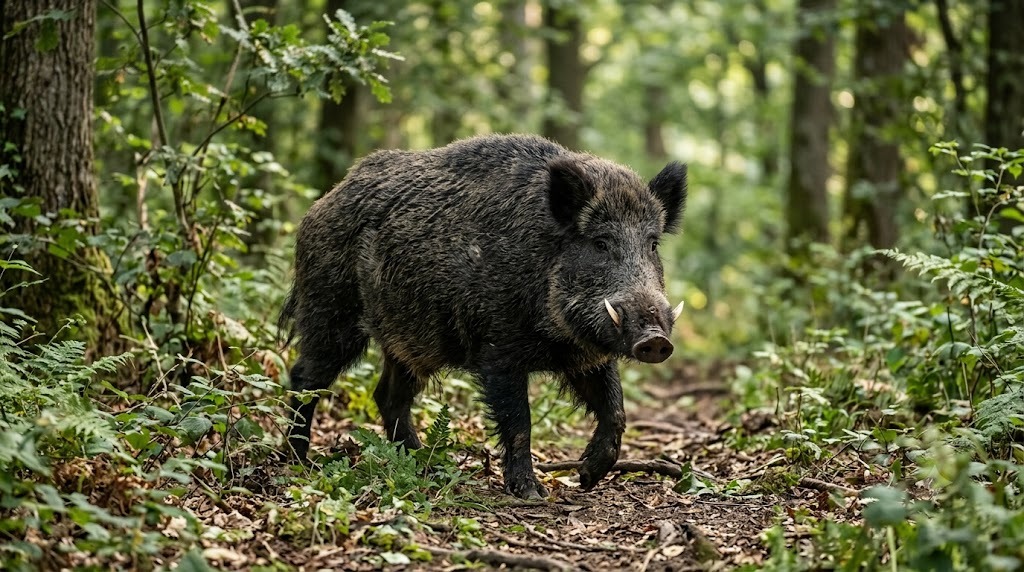
Feral hogs are descended from escaped domestic pigs and introduced Eurasian wild boar, so appearance varies enormously. They may be black, brown, reddish, blond, spotted, or belted; coats range from sparse to a dense bristly hide with a coarse mane along the spine. Mature boars commonly weigh 150 to 250 pounds, though some grow far larger; sows are generally smaller. Boars develop continuously growing tusks and a thick, gristly "shield" of cartilage over the shoulders. Hogs have small eyes, large mobile ears, a long snout built for rooting, and a heavy, low-slung, muscular body. Their tracks resemble a deer's but are blunter and rounder, and groups often leave a churned mess of disturbed earth.
Range & Habitat (US)
Feral hogs are established across much of the southern United States - Texas holds the largest population by far - and across the Southeast, parts of California, and a growing number of other states. They are habitat generalists, thriving in river bottoms, brush country, swamps, agricultural land, pine plantations, and oak woodlands. The constants they require are food, water, and thick cover. Hogs gravitate to creek and river corridors, wet thickets, and the edges of crop fields. Their range continues to expand, partly because they reproduce so quickly and partly through illegal transport, which is why most states urge aggressive harvest.
Behavior & Sign
Feral hogs are social, intelligent, and primarily nocturnal, especially where pressured - they often feed under cover of darkness and bed in thick cover by day. Sows and young travel in family groups called sounders, while mature boars are frequently solitary. They have a superb sense of smell, good hearing, and relatively poor eyesight. Hogs are omnivorous and opportunistic, eating roots, mast, crops, insects, and more. Their sign is unmistakable: extensive "rooting" that churns the soil like a tiller, muddy wallows, rubs on trees and posts coated in dried mud, well-worn trails, and tracks. Fresh rooting and warm wallows mean hogs are close.
Hunting Seasons & Timing
Because feral hogs are a non-native, destructive species, most states impose few or no seasonal restrictions - many allow year-round hunting with liberal or unlimited bag limits, and some classify them as nuisance rather than game animals. This makes hogs one of the most accessible big-game pursuits in the country. That said, regulations on hunting hours, weapons, hunting at night, and the use of lights or thermal optics vary significantly by state and even by property type. Practically, hunting is often most productive in cooler months and around the cooler hours of day, since hogs move less in extreme heat. Always confirm local rules before hunting.
Hunting Methods
Hog hunting accommodates many approaches. Spot-and-stalk works well in open brush and agricultural country, glassing for feeding hogs at dawn and dusk and closing in with the wind in your favor. Stand or blind hunting over rooting areas, wallows, crop edges, and feeders (where legal) intercepts hogs on their patterns. Still-hunting through river-bottom cover suits the patient hunter. Because hogs are heavily nocturnal under pressure, night hunting with thermal or night-vision optics is popular and effective where legal. Hunting with trained dogs is practiced in some regions. Across all methods, the hog's exceptional nose makes the wind the deciding factor.
Where to Find Them - Reading the Terrain
Water and cover are the keys. Start at creeks, rivers, sloughs, and stock ponds, then look for the thickest, nastiest cover nearby - cane, brush, briar, and bottomland thickets - where hogs bed and stay cool. Connect those bedding areas to food: crop fields, oak flats dropping mast, and lush rooting ground. Hogs hammer soft, moist soil, so muddy field edges and creek bottoms show fresh sign first. Wallows along water tell you a sounder is using the area. In hot weather, focus tight on shade and water; in cooler weather, hogs range more widely toward food.
Gear & Optics Needed
Hog hunting gear scales to the method. A solid binocular helps for spot-and-stalk and for picking hogs out of brush at dusk. Where night hunting is legal, thermal or night-vision optics dramatically increase success, since that is when pressured hogs move most. A rangefinder is useful in open country. Build the rest around the environment: durable, briar-resistant clothing, snake-aware footwear in southern bottoms, insect protection, and a capable pack. For field care, a sharp knife and game bags are essential, along with the means to cool meat quickly in often-warm conditions.
Shot Placement & Field-Dressing
A feral hog's anatomy differs from a deer's: the vital heart-lung area sits lower and farther forward, tucked behind the front leg, and a mature boar's gristly shoulder shield can deflect a poorly placed shot. Wait for a calm, broadside or slightly quartering presentation, aim tight behind the front leg and low in the body, and pass marginal shots. Field care must be prompt because hogs are usually hunted in warm weather: dress the animal quickly, cool the meat fast, and keep it clean. Always wear gloves when handling feral hogs, as they can carry diseases transmissible to humans.
Meat & Eating Quality
Properly handled, feral hog is excellent eating - essentially wild pork, leaner and more flavorful than store-bought, and best from younger animals and sows. Hams, shoulders, loins, and ribs all cook well, and hog is outstanding ground, smoked, or slow-cooked. Two firm rules apply. First, always wear gloves while field-dressing, because feral hogs can carry diseases such as brucellosis. Second, always cook feral hog thoroughly to a safe internal temperature, as the meat can carry trichinella and other parasites. Never eat it undercooked. Within those rules, hog is a genuinely rewarding wild food.
Common Mistakes
The most common mistake is ignoring the wind - a hog's nose is its best defense, and a sounder will vanish at the first whiff of a hunter. Beginners also misjudge hog anatomy, aiming as they would for a deer and hitting too high or too far back. Other errors include hunting the wrong hours in hot weather, making too much noise in dry cover, and underestimating how quickly hogs abandon a pressured area. On the field-care side, failing to wear gloves and failing to cool meat quickly in warm weather are serious and avoidable mistakes.
Regulations & Conservation Note
The feral hog is an invasive species, and hunting them is part of a broader management effort, not a conservation tradition. Hogs damage crops, erode soil, foul water, compete with and prey on native wildlife, and spread disease, so most states encourage aggressive harvest with liberal limits. Hunters can play a real role in reducing that damage. The flip side: never transport live feral hogs or release them, which is illegal in most places and the main driver of their spread. Hunt legally, follow your state's rules on methods and hours, and treat hog hunting as both sport and stewardship.
Best Suited For
Feral hog hunting suits hunters who want year-round opportunity, generous limits, and a challenging, fast-paced quarry - and who like the idea of hunting that benefits the land. It is well suited to those willing to learn hog behavior and anatomy, to spot-and-stalk hunters in brush country, and to hunters interested in night hunting where it is legal. Because seasons are open and access is often easier than for trophy species, it is also a great way for newer hunters to gain field experience.
FAQ
Do I need a license to hunt feral hogs? It depends entirely on the state and property. Some states require a standard hunting license; others have special provisions for this invasive species. Always check local regulations before you hunt.
Is feral hog meat safe to eat? Yes, when handled and cooked properly. Always wear gloves when field-dressing, because hogs can carry diseases like brucellosis, and always cook the meat thoroughly to a safe internal temperature to eliminate parasites such as trichinella.
When is the best time to hunt hogs? Hogs move most in cooler weather and around dawn and dusk; under pressure they become heavily nocturnal. Cooler months and the cooler hours of the day are generally most productive.
Where should I look for feral hogs? Start at water - creeks, rivers, ponds - and the thick cover nearby, then connect that to food sources like crop fields and oak flats. Fresh rooting and muddy wallows tell you hogs are using the area.
Can I move hogs to a new property to hunt them? No. Transporting or releasing live feral hogs is illegal in most states and is a major reason the species keeps spreading. Hunt them, but never relocate them.