Grizzly Bear
The grizzly bear is one of North America's most iconic and powerful big-game animals - and also one of the most legally restricted to hunt.
🗓️ Last reviewed: June 2026
Overview
The grizzly bear is one of North America's most iconic and powerful big-game animals - and also one of the most legally restricted to hunt. Before reading any further, understand the most important fact about grizzly hunting in the United States: it is closed across the entire lower 48 states, where grizzlies are protected under the Endangered Species Act. The only place a U.S. hunter can legally pursue a grizzly is in parts of Alaska, and even there it is tightly regulated by unit, season, quota, and draw or registration permit.
This guide treats the grizzly honestly and respectfully. For most American hunters, the grizzly will be an animal they study, glass for fun, and admire from a distance - not one they harvest. For the small number who do hunt Alaska, a grizzly hunt is a serious, demanding, conservation-funded undertaking that should never be entered into casually. Fair chase, deep preparation, and respect for a slow-reproducing species are non-negotiable.
Identification & Appearance
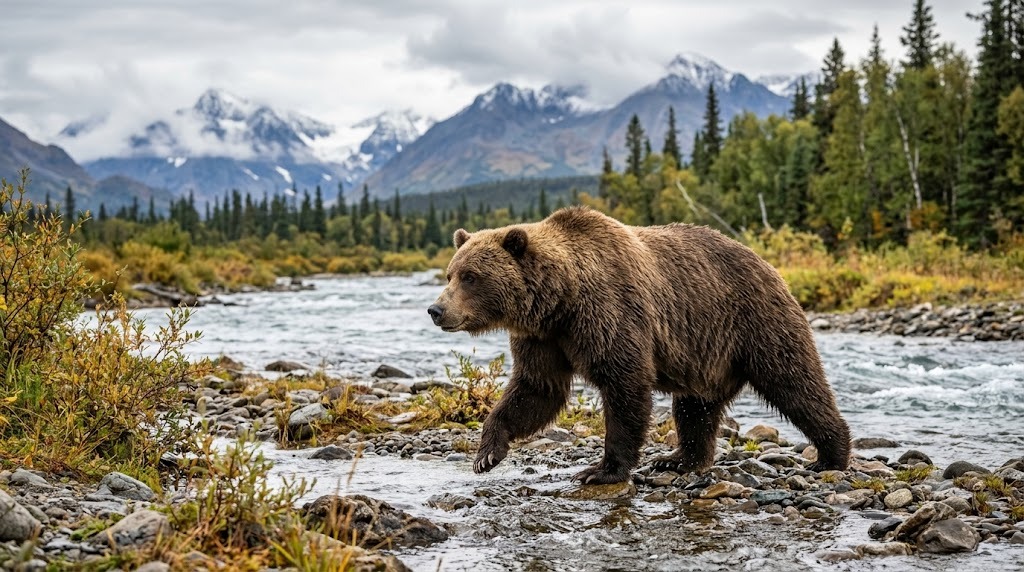
Grizzlies are a subspecies of the brown bear. Adults stand 3-3.5 feet at the shoulder on all fours and can reach 6.5-8 feet standing. Interior grizzlies typically weigh 350-600 pounds for males and 200-400 for females; coastal brown bears, which feed on salmon, grow far larger.
Key field marks separate grizzlies from black bears, which overlap in range:
- A pronounced shoulder hump of muscle, used for digging.
- A dished, concave facial profile rather than the straight "Roman nose" of a black bear.
- Long front claws (2-4 inches), often visible and lighter colored.
- Smaller, rounder ears set well apart, and shorter ears relative to head size.
Coat color ranges from blonde and cinnamon to dark chocolate brown, often with silver-tipped ("grizzled") guard hairs over the back and shoulders. Color alone never identifies a bear - black bears can be brown and grizzlies can be dark. Hunters in mixed-species country must use body shape, hump, and profile.
Range & Habitat (US)
In the lower 48, grizzlies persist in the Greater Yellowstone ecosystem, the Northern Continental Divide (Glacier/Bob Marshall country), and small populations in the Cabinet-Yaak, Selkirk, and North Cascades areas. All of these populations are protected; there is no hunting season.
Huntable grizzly populations exist only in Alaska, where the bear occupies an enormous range - coastal rainforest, interior boreal forest, alpine tundra, and treeless arctic slopes. They favor areas with seasonal food concentrations: salmon streams, berry fields, alpine meadows green-up, and big-game calving grounds.
Behavior & Sign
Grizzlies are intelligent, wide-ranging omnivores. They are most active at dawn and dusk but may move any time, especially in remote country. They are not true hibernators but den through the harshest months, emerging lean and hungry in spring.
Sign is large and unmistakable. Tracks show five toes with claw marks well ahead of the toe pads; a front pad can span 5-6 inches or more. Scat is voluminous and reflects the season - fibrous and berry-filled in late summer, hair-and-bone-laden after scavenging. Other sign includes dug-up hillsides where bears excavate ground squirrels and roots, clawed and rubbed trees, overturned rocks and logs, and day beds scraped into cool brush or snow patches.
Hunting Seasons & Timing
Where legal in Alaska, grizzly seasons fall in spring (roughly April-May, when bears emerge and hides are prime) and fall (August-October). Specific dates, bag limits, and permit types vary dramatically by Game Management Unit; some units require a competitive drawing, others a registration permit, and many are open only to residents or require a guide for non-residents. Non-resident hunters are legally required to use a registered Alaska guide for brown/grizzly bear.
Hunting Methods
- Spot-and-stalk is the primary fair-chase method. Hunters glass open hillsides, river bars, and avalanche chutes for hours, then plan a careful stalk using wind and terrain.
- Spring hunts often focus on south-facing slopes where the first green growth pulls bears into the open.
- Boat-based hunts access coastal and river country, glassing from the water.
- Baiting and hounds are not legal for grizzly in Alaska. This is a glassing-intensive, patience-driven hunt.
Where to Find Them - Reading the Terrain
Think in terms of food and travel. In spring, glass the first green-up: south slopes, avalanche paths, and sedge flats. In summer and fall, shift to berry-covered hillsides and salmon streams. Look at the edges - where alpine meadow meets brush, where a river bar meets timber. Bears often travel ridge systems and drainage bottoms. Early and late light is prime; midday bears bed in shade or brush. Glass distant, open country thoroughly before moving, because a stalk that bumps a bear rarely gets a second chance.
Gear & Optics Needed
Grizzly country is unforgiving, so gear leans heavy and reliable. A flat-shooting rifle in .300 Win Mag, .338 Win Mag, or similar with premium controlled-expansion bullets is standard. Quality 10x42 or 12x binoculars and a spotting scope are essential for the long glassing sessions this hunt demands. Add a sturdy tripod, a rangefinder, layered weatherproof clothing, a reliable backpack, and a tent capable of handling wind and rain. Bear-proof food storage and bear spray are mandatory safety equipment. A satellite communicator is strongly advised in remote units.
Shot Placement & Field-Dressing
A grizzly should only be taken with a broadside or quartering-away shot at a range the hunter has practiced extensively. The aim point is the near-shoulder/heart-lung area - low and tight behind the shoulder crease. A solid, well-placed shot followed by an immediate, ready follow-up is the responsible standard; a wounded grizzly is dangerous to everyone in the area. After the harvest, field care focuses on caping the hide carefully (claws and skull included for sealing requirements) and cooling the meat. Alaska law requires mandatory sealing of the hide and skull by a state official within a set time, and salvage rules vary by unit.
Meat & Eating Quality
Grizzly meat is edible but coarse and strongly flavored, and it is far less desirable than elk, moose, or caribou. It must always be thoroughly cooked because bear meat can carry trichinella parasites - never serve it rare. Many hunters use bear meat in slow-cooked, ground, or sausage preparations. The hide and skull are the primary trophies, and ethical hunters make use of what is salvageable.
Common Mistakes
- Assuming a grizzly can be hunted in the lower 48 - it cannot.
- Misidentifying a black bear as a grizzly (or vice versa) in mixed country.
- Underestimating the physical and logistical demands of a remote Alaska hunt.
- Stalking with poor wind discipline - a grizzly's nose ends most failed hunts.
- Skimping on optics and rushing the glassing.
- Treating bear safety casually around food, camp, and a downed animal.
Regulations & Conservation Note
Grizzly management is a conservation success story still in progress. Lower-48 populations remain federally protected, and recovery is monitored closely. In Alaska, regulated hunting is one tool wildlife managers use within a science-based framework - quotas, sealing, and unit closures keep harvest sustainable. Always confirm current Alaska Department of Fish and Game regulations for your exact unit, secure the proper permits and guide, and recognize that grizzlies reproduce slowly, making conservative management essential. Never hunt a sow with cubs.
Best Suited For
The grizzly is suited for the experienced, physically prepared big-game hunter willing to travel to Alaska, hire a guide, invest significant money and time, and accept that they may glass dozens of bears without taking one. It is not a beginner hunt. For most hunters, the grizzly is best appreciated as a wild symbol of intact ecosystems - something to study, respect, and protect.
FAQ
Can I hunt grizzly bears in Montana, Wyoming, or Idaho? No. Grizzlies in the lower 48 states are protected under the Endangered Species Act, and there is no hunting season anywhere in those states.
Where can a U.S. hunter legally hunt a grizzly? Only in parts of Alaska, under tightly regulated seasons, quotas, and permit systems. Non-residents must hunt with a registered Alaska guide.
How do I tell a grizzly from a black bear? Look for the shoulder hump, a dished facial profile, long front claws, and smaller rounded ears. Color is unreliable - both species vary widely.
Is grizzly meat good to eat? It is edible but coarse and strongly flavored, and must be fully cooked to kill trichinella parasites. Most hunters consider the hide and skull the primary trophy.
Do I need a guide? Non-resident hunters in Alaska are legally required to use a registered guide for brown/grizzly bear. Even residents benefit from experience in this demanding country.