Mountain Goat
The mountain goat is North America's true alpine specialist - a shaggy, white, sure-footed climber that lives higher and on steeper ground than almost any other big-game animal.
🗓️ Last reviewed: July 2026
Overview
The mountain goat is North America's true alpine specialist - a shaggy, white, sure-footed climber that lives higher and on steeper ground than almost any other big-game animal. It is not a true goat at all but one of the goat-antelopes, more closely related to the chamois and serows than to domestic goats. For hunters, the mountain goat offers one of the most physically demanding and visually spectacular hunts on the continent, set among cliffs, glaciers, and the highest reaches of the western mountains.
A mountain goat hunt is a serious undertaking. The country is steep enough to be genuinely dangerous, the weather is unforgiving, and the animals live in places that test both nerve and fitness. Tags are limited and, in most states, draw-only. But for the hunter who earns one, standing in goat country - among the cliffs and the clouds - is an experience few other hunts can match.
Identification & Appearance
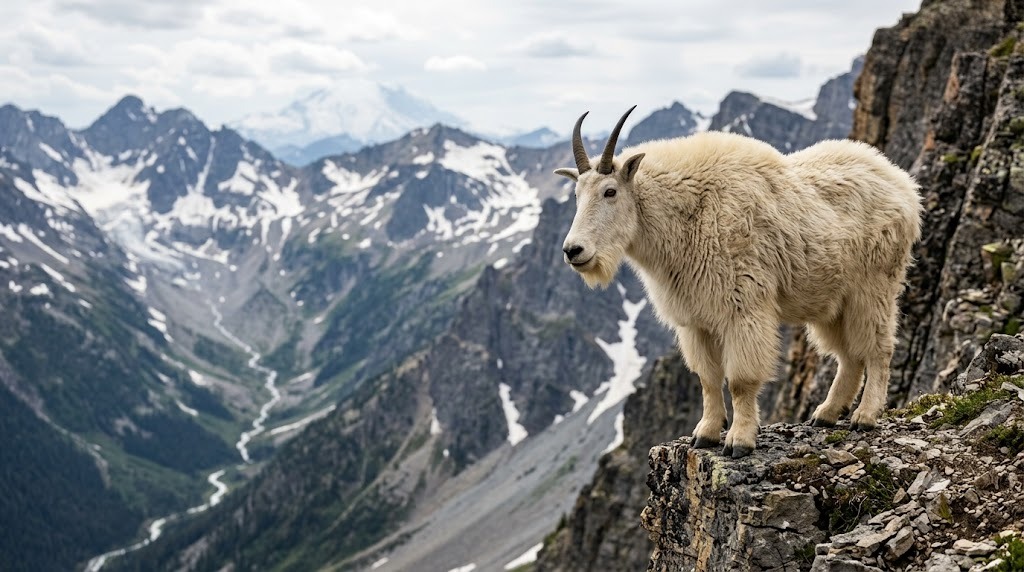
Mountain goats are unmistakable: stocky, white-coated animals with a deep, heavy chest, a pronounced shoulder hump, and a thick double coat that gives them a bulky, almost square profile. A mature billy weighs roughly 200 to 300 pounds; nannies are smaller, generally 125 to 200 pounds.
Both sexes carry slender, black, slightly backward-curved horns roughly 9 to 12 inches long - a notable point for hunters, because billies and nannies look very similar. Distinguishing them in the field requires care: billies tend to have heavier horn bases, a more massive body and front end, a different urination posture, and often a solitary habit, while nannies are frequently accompanied by kids. Misidentifying and taking a nanny with a dependent kid is a serious ethical concern that hunters must work hard to avoid.
The brilliant white coat, black horns, hooves, nose, and eyes complete the distinctive look. Their hooves have hard outer rims and soft, grippy inner pads - an adaptation that makes them astonishing climbers.
Range & Habitat (US)
In the United States, mountain goats inhabit the steep alpine country of the northern Rockies, the Cascades, and coastal Alaska. Native and introduced populations occur in Alaska, Washington, Montana, Idaho, Wyoming, Colorado, Utah, Nevada, South Dakota, and Oregon.
Goats live in the most rugged terrain imaginable: cliff faces, broken rock, alpine ledges, glaciated basins, and the steep slopes above timberline. They feed on alpine grasses, sedges, forbs, mosses, and lichens, and they will use small ledges and chutes that no other big-game animal would attempt. Many goats stay near or above timberline year-round, descending only in the harshest winter conditions.
Behavior & Sign
Mountain goats are generally sedentary and tied to specific cliff systems, often using the same terrain year-round. They are most active feeding in the cooler hours and bed on ledges through the day. They are not herd animals in the way sheep are - billies are often solitary or in small groups, while nannies, kids, and younger goats form loose bands.
Goats tolerate weather that pins down other animals, and their eyesight, while good, is less of a defense than their sheer inaccessibility. The breeding season, or rut, falls in late autumn, generally November.
Sign includes tracks with a distinctive splayed, blocky shape; pellet droppings concentrated on bedding ledges; shed white hair caught on rocks and brush, especially in early summer; and dust wallows and worn beds on ledges. Trails contour cliff faces and lead to favored feeding and mineral areas.
Hunting Seasons & Timing
Mountain goat seasons generally run from roughly September through November, varying by state and unit.
- September: Early-season hunts in milder weather. Goats are predictable and the high country is more accessible.
- October: Cooler temperatures; the goats' coats grow longer and more impressive, making for a better trophy hide.
- November: Late hunts can be brutal but offer the heaviest, most spectacular coats; snow may push goats lower and concentrate them.
Many hunters favor the later end of the season for the prime coat, balanced against worsening and increasingly dangerous weather. Early-season hunts trade coat quality for safer, more comfortable conditions.
Hunting Methods
Mountain goat hunting is spot-and-stalk, but the defining challenge is not finding goats - their white bodies stand out against rock - but reaching them safely and identifying a mature billy.
The method is to glass cliff systems and alpine basins from a distance, locate goats, and then carefully study them to confirm a billy rather than a nanny. This identification step is the most important part of the hunt and should never be rushed. Once a billy is confirmed, the hunter plans an access route that is both safe and gets within range.
The terrain is the real obstacle. Stalks often involve genuine climbing, navigating around cliff bands and chutes. Backpack hunts are common, as are guided hunts; many states require nonresidents to use a guide. Hunters frequently spend days picking apart a basin and choosing the one goat that is both clearly a billy and standing somewhere a clean shot and a safe recovery are possible.
Where to Find Them - Reading the Terrain
Look for the steepest, most broken cliff country on a mountain - that is where goats live. They favor cliff faces with feeding ledges, grassy benches tucked among rock, and basins ringed by broken terrain.
Goats often bed on ledges with overhead protection or a commanding view, and feed on the grassy slopes and benches at the edges of the cliffs. Mineral licks draw goats and can be productive places to watch. Saddles and ridge spines connect feeding and bedding areas.
In summer and early fall, goats may use shaded north-facing slopes and snowfields to escape heat and insects. Glass methodically - even though goats are visible, picking a mature billy out of a scattered group across a basin takes time and good optics.
Gear & Optics Needed
Optics are essential: a spotting scope on a tripod is critical not just for finding goats but for the careful billy-versus-nanny identification, plus 10x or 12x binoculars and a rangefinder.
Because the terrain is so steep and dangerous, footwear and safety gear are paramount. Stiff, well-broken-in mountain boots with aggressive soles, trekking poles, and for some hunts a helmet, harness, and even an ice axe or trekking crampons may be warranted. A capable multi-day backpack for hauling meat and a heavy hide, layered clothing for harsh alpine weather, a four-season-capable shelter, and reliable navigation and emergency communication are all needed.
A flat-shooting rifle in a cartridge such as .270, 7mm magnum, or .30-06 class, with quality glass confirmed at the ranges you may face, suits the open alpine.
Shot Placement & Field-Dressing
Mountain goats are tough, deceptively heavy-bodied animals, so shot placement and bullet choice matter. Take only a steady, supported shot at a proven range, and - critically - only when the goat is standing somewhere it can be safely reached after the shot. A goat that falls off a cliff is often unrecoverable and the trophy and meat are lost. Many experienced goat hunters wait, sometimes a long time, for the animal to move onto safer ground.
Aim for the heart-lung area behind the shoulder, accounting for steep angles. After a clean shot, photograph the goat, then field-dress using the gutless method, cool and bag the meat, and carefully cape the hide, which is a centerpiece of a goat mount. The pack-out down steep terrain is hard and must be done carefully.
Meat & Eating Quality
Mountain goat meat is good, mild table fare when handled properly, though it has a reputation for being tougher and coarser-grained than sheep - especially from older billies. The meat benefits from slow cooking, braising, grinding, and sausage-making rather than fast-cooked steaks. Younger animals eat better. With proper field care and the right preparation in the kitchen, goat is honest, worthwhile meat, and in many states salvaging it is legally required.
Common Mistakes
- Misidentifying a billy and a nanny. This is the most serious mistake in goat hunting. Always confirm a billy and never take a nanny with a kid.
- Taking a shot over bad terrain. Dropping a goat off a cliff can lose the entire animal. Wait for safe footing.
- Underestimating the danger. Goat country is genuinely hazardous; falls are a real risk. Climbing skill and caution matter.
- Arriving unfit or underprepared. The terrain punishes weak fitness and poor gear immediately.
- Expecting goats to behave like sheep. Goats are tied to cliffs and weather-tolerant; hunt the terrain, not the clock.
Regulations & Conservation Note
Mountain goat hunting is, in most states, draw-only, with limited tags and often low draw odds; many states treat goats as a once-in-a-lifetime species. Alaska offers some general-season and registration goat hunts in addition to draw permits. Nonresidents commonly must hunt with a licensed guide.
Mountain goats are sensitive to overharvest. They are slow to reproduce, populations recover slowly, and removing too many nannies can set a herd back for years - which is why correct sex identification is both an ethical and a management priority. Some goat populations are native; others were introduced and are managed differently. Always verify the specific regulations, tag rules, identification guidance, and reporting requirements for your state and unit, and study billy-versus-nanny identification thoroughly before the hunt.
Best Suited For
A mountain goat hunt suits the fit, experienced, careful mountain hunter who is comfortable on steep, exposed terrain and disciplined about animal identification and shot selection. It is among the more dangerous big-game hunts and is not a casual first hunt; a less-experienced hunter who draws a tag should hunt with a strong guide and prepare seriously. It best suits hunters who relish extreme alpine country and take pride in doing things correctly.
FAQ
How do I tell a billy from a nanny? Look for heavier horn bases, a more massive body and front end, solitary behavior, and urination posture. Nannies often have kids. Take your time and use a spotting scope; if unsure, do not shoot.
Do I need to draw a tag? In most states, yes - goat tags are limited and draw-only, often once-in-a-lifetime. Alaska has some general and registration hunts. Check your state's system.
How dangerous is goat hunting? It is genuinely one of the more hazardous big-game hunts because of the steep, exposed terrain. Climbing caution, good boots, and sometimes safety gear are important.
Why not just shoot a goat anywhere it stands? Because a goat that falls off a cliff is often unrecoverable. Wait for the animal to be on safe ground before shooting.
Is mountain goat meat good to eat? Yes, when handled well and cooked appropriately - it tends to be tougher than sheep, so braising, grinding, and sausage suit it better than quick-cooked steaks.