Mountain Lion
The mountain lion - also called cougar, puma, panther, or catamount - is North America's large, secretive cat and the continent's premier predator-management big-game species.
🗓️ Last reviewed: June 2026
Overview
The mountain lion - also called cougar, puma, panther, or catamount - is North America's large, secretive cat and the continent's premier predator-management big-game species. Solitary, far-ranging, and almost never seen by the people who share its country, the mountain lion is hunted very differently from deer, elk, or sheep. There is no glassing a lion on a hillside; success depends almost entirely on snow, tracks, and trained hounds.
Mountain lion hunting is a legitimate, regulated tool of wildlife management in the western states where it is permitted, helping balance predator and prey populations. It is a winter pursuit, demanding, weather-driven, and steeped in tradition. For the hunter, it offers a rare window into the world of an animal most people never glimpse, and a hunt that is as much about reading sign and covering country as it is about the shot itself.
Identification & Appearance
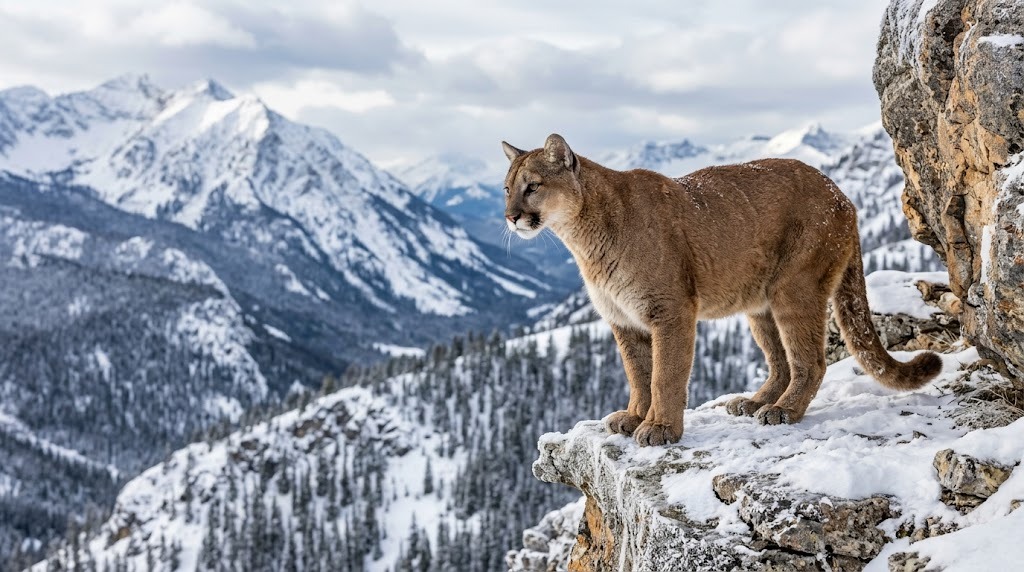
The mountain lion is a large, powerfully built cat with a small, rounded head, short muzzle, and a very long, heavy, dark-tipped tail that can make up roughly a third of its total length. The coat is unmarked and uniform - tawny, tan, or grayish - with paler underparts and dark markings on the muzzle, behind the ears, and at the tail tip. Kittens are spotted, but adults are plain.
A mature male, called a tom, typically weighs 120 to 180 pounds, with large individuals heavier; females are smaller, around 75 to 110 pounds. Toms are distinguished by their larger overall size, broader heads and necks, and proportionally bulkier build.
Mountain lion tracks are a key identification tool: roughly round, showing four toes and no claw marks (the claws are retractable), with a distinctive three-lobed rear edge on the heel pad. A lion's track is notably different from the symmetrical, claw-marked track of a dog or coyote.
Range & Habitat (US)
Mountain lions occupy a vast range across the western United States - including Colorado, Montana, Idaho, Wyoming, Utah, Arizona, New Mexico, Nevada, Oregon, Washington, and others - wherever regulated seasons exist. A separate, endangered population (the Florida panther) exists in the Southeast and is fully protected.
Lions are habitat generalists tied closely to their primary prey, deer. They use forested mountains, rugged canyon country, foothills, mesa and rimrock terrain, brushy breaks, and river bottoms. They favor broken, rugged ground with cover for stalking, and they range over enormous home areas - a single tom may patrol dozens of square miles. The constant is deer: where deer are plentiful and terrain is rugged, lions follow.
Behavior & Sign
Mountain lions are solitary, territorial, and primarily nocturnal and crepuscular, which is why they are so rarely seen. They are ambush hunters, relying on stealth and a short, explosive rush. After making a kill, a lion typically feeds, then covers the remains with dirt, leaves, and debris - a cache - and returns to feed over several days.
Lions travel constantly through their territory, often following ridgelines, canyon rims, saddles, and game trails. They mark territory with scrapes - small piles of scraped-up debris, often with scent.
Sign the hunter relies on includes tracks (especially in snow or soft ground), scrapes, cached kills, and droppings. Fresh tracks in snow are the foundation of nearly all lion hunting - they reveal a lion's presence, direction, size, and how recently it passed.
Hunting Seasons & Timing
Mountain lion seasons are set by each western state and most commonly run through the late fall and winter, often from roughly November or December into March or April, though dates and structures vary widely. Many states manage seasons with harvest quotas - closing a unit once a limit, including a female sub-limit, is reached.
- Early winter: First reliable snows make tracking possible.
- Mid-winter (the prime window): Consistent snow cover provides the fresh, trackable conditions most lion hunting depends on. This is when most lion hunting occurs.
- Late winter and spring: Hunting continues where seasons remain open and quotas are not yet filled.
The single biggest timing factor is snow. Lion hunting is overwhelmingly a snow-tracking pursuit, and a fresh overnight snowfall followed by a clear morning is the ideal condition.
Hunting Methods
The dominant and most effective method of mountain lion hunting is hunting with trained hounds. A houndsman covers country - by truck, on foot, on horseback, or by ATV or snowmobile depending on the terrain - searching roads, trails, and canyon rims for a fresh lion track in the snow. When a fresh track is cut, the hounds are released to follow the scent trail.
The hounds trail the lion until it is "treed" - driven up a tree or onto a rock ledge where it stops. The hunter then follows the dogs, often a long and physically demanding pursuit through rugged winter terrain, reaches the treed lion, and at that point can evaluate the animal - its size, sex, and whether it is a legal and appropriate animal to take. A defining feature of houndsman hunting is that the hunter can release a treed lion unharmed if it is a female, too small, or otherwise not the intended target.
Some states also permit calling - using predator calls that imitate prey or distressed animals - and a small amount of opportunistic spot-and-stalk, but hound hunting is by far the primary method. Many hunters who do not own hounds hire experienced houndsmen and guides.
Where to Find Them - Reading the Terrain
Find the deer, and you are in lion country. Beyond that, lions favor rugged, broken terrain: canyon rims and rimrock, ridgelines, saddles, brushy draws, timbered slopes, and river breaks. These features funnel lion travel.
After a fresh snow, a houndsman drives or works the network of roads, two-tracks, ridges, and canyon rims that cross likely terrain, looking to cut a track. Lions tend to travel established routes - they use ridges and rims as highways - so reading the terrain means knowing where a lion is likely to cross.
Areas with recent deer concentrations, and especially the discovery of a cached kill, indicate a lion is working the area and likely to return. Snow conditions and terrain access shape every day of the hunt.
Gear & Optics Needed
Mountain lion hunting depends less on optics than most big-game hunting and more on winter mobility and the hounds.
For the houndsman, the essentials are well-trained, conditioned hounds and the equipment to support them - tracking collars and GPS dog-tracking systems, durable kennels, and the means to cover snowy country (a capable four-wheel-drive truck, and often an ATV, snowmobile, or horses). The hunter needs cold-weather clothing layered for hard exertion, sturdy winter boots, and the fitness for steep, snowy climbs.
Optics are modest - binoculars are useful, and a rangefinder has limited use given the typically close ranges to a treed cat. For the shot, many hunters use a rifle in a standard deer cartridge, while others use a handgun or, where legal, a bow, since the shot at a treed lion is usually close and stationary. Reliable navigation and communication round out the kit.
Shot Placement & Field-Dressing
Because the shot is typically taken at a treed or bayed lion at close range, the priorities are a calm, deliberate, well-placed shot and safety - the hounds are nearby and must be kept clear. Hunters wait for a steady position and a clear, ethical shot into the heart-lung area, choosing a moment and angle that ensure a quick, humane result and that the cat does not fall onto the dogs.
Most states require the hunter to salvage the meat and to keep the hide and skull. After a clean harvest, the lion is field-dressed and skinned with care, as the hide is a centerpiece for many hunters. Mandatory check-in is the norm: most states require the carcass, skull, or hide to be presented to a wildlife official, often within a set number of days, for sealing, sex confirmation, and biological data collection.
Meat & Eating Quality
Mountain lion meat is, to the surprise of many, very good - mild, light-colored, fine-grained, and tender, frequently compared to pork or to other white meats rather than to red game meat. Lion has a long history as table fare in the West, and many houndsmen and hunters consider it excellent. Most states with lion seasons require the meat to be salvaged, recognizing it as a legitimate and worthwhile food. As with any wild game, lion meat should be cooked thoroughly. Properly handled and prepared, it is a genuine and pleasant reward of the hunt.
Common Mistakes
- Hunting without good snow. Lion hunting is built on fresh, trackable snow; trying to force a hunt in poor conditions wastes effort.
- Underestimating the physical demand. Following hounds to a treed cat can mean miles of hard climbing through deep snow and rough terrain.
- Not understanding hound work. Hunters new to lion hunting often underestimate the skill, training, and care behind a good hound pack.
- Failing to verify the animal. A key advantage of hound hunting is the chance to evaluate a treed lion; not taking the time to confirm sex and size is a missed responsibility.
- Overlooking regulations. Quotas, female sub-limits, and check-in deadlines are strict and vary by state and unit.
Regulations & Conservation Note
Mountain lion hunting is legal and regulated in many western states, where it functions as a managed tool for balancing predator and prey populations. It is, however, one of the more closely regulated and debated big-game pursuits. Many states manage lions with hard harvest quotas and separate female sub-limits, closing units immediately once a limit is reached; mandatory check-in within a set period is nearly universal. Hunting methods are also regulated - the use of hounds is permitted in many states but prohibited in some, and a few states have ended lion hunting entirely. The Florida panther is a separate, federally endangered population and is fully protected.
Where it is allowed, regulated lion hunting is supported by wildlife agencies as a science-based management practice, and license fees fund conservation. The mandatory reporting that comes with every harvested lion provides biologists with essential data on the population. Because rules differ so much from state to state and change over time, hunters must carefully verify the current regulations, quotas, legal methods, and check-in requirements for the exact state and unit they intend to hunt.
Best Suited For
A mountain lion hunt suits the physically fit hunter who is comfortable in winter conditions and is drawn to the tracking, the country, and the tradition of hound hunting. For the great majority of hunters - who do not own and train a hound pack - this is a guided hunt, and an outstanding one, hiring an experienced houndsman. It is accessible to beginners in that the houndsman manages the hounds and the strategy, but it rewards good fitness and a genuine interest in predator ecology and management.
FAQ
How are mountain lions hunted? Overwhelmingly with trained hounds. A houndsman cuts a fresh track in the snow, releases the dogs to trail the lion, and the lion is treed; the hunter then follows on foot to the treed cat. Some calling and limited spot-and-stalk also occur.
Do I need my own dogs? No. Most lion hunters hire an experienced houndsman or guide. Training and maintaining a capable hound pack is a serious, year-round commitment.
Why is snow so important? Fresh snow reveals lion tracks - their presence, size, direction, and how recent. Lion hunting is fundamentally a snow-tracking pursuit, so most hunting happens in mid-winter.
Is mountain lion meat good to eat? Yes - it is mild, light, and tender, often compared to pork, and has a long history as table fare. Most states require the meat to be salvaged; cook it thoroughly as with all wild game.
Is lion hunting legal everywhere? No. It is legal and regulated in many western states but prohibited or restricted in others, and rules on methods like hound use vary. Always verify current regulations, quotas, and check-in rules for your state and unit.