Pronghorn
The pronghorn - often called the "speed goat" or simply the antelope, though it is neither a goat nor a true antelope - is the unique sprinter of the American West.
🗓️ Last reviewed: June 2026
Overview
The pronghorn - often called the "speed goat" or simply the antelope, though it is neither a goat nor a true antelope - is the unique sprinter of the American West. It is the fastest land animal in the Western Hemisphere and the last surviving member of its biological family, an evolutionary relic that has roamed North America's grasslands for millions of years. For hunters, the pronghorn offers a fast-paced, visually open, accessible big-game hunt across the wide prairies and sagebrush flats of the West. Tags are often more attainable than for elk or mule deer, the country is huge and largely public, and the hunt itself - long-range glassing and patient stalking across open ground - is a pure test of fieldcraft. Pronghorn is also outstanding eating when cared for properly.
Identification & Appearance
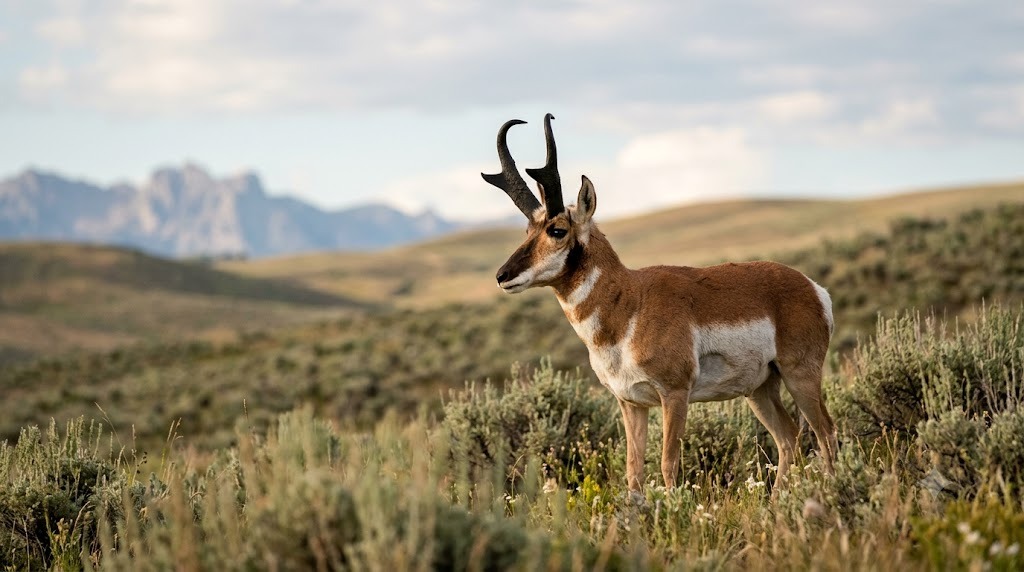
The pronghorn is unmistakable: a tan-and-white body with bold white patches on the sides, belly, and rump, a white throat marked by dark bands, and large, protruding eyes set for panoramic vision. Both sexes can carry horns, but bucks' are far larger - black, pronged horns with a forward-hooking point, made of a bony core sheathed in a keratin covering that is shed and regrown each year, a feature unique among horned animals. Bucks also show a black cheek patch and black horns; does are smaller with short, spike-like horns or none. Adults weigh roughly 90 to 130 pounds. Pronghorn are built for speed - light, deep-chested, and long-legged.
Range & Habitat (US)
Pronghorn inhabit the open country of the western United States - the high plains, sagebrush steppe, and grasslands of the Rocky Mountain and Great Plains states, with the largest numbers in Wyoming and Montana and strong populations in several neighboring states. They are animals of wide-open spaces, avoiding dense forest and rugged timber. Ideal pronghorn country is rolling sagebrush flats and prairie with good visibility, scattered forbs and grasses for forage, and reliable water. They make seasonal movements in response to weather and forage and can struggle with tall woven-wire fences, which they prefer to crawl under rather than jump.
Behavior & Sign
Pronghorn rely above all on their extraordinary eyesight - often compared to a hunter looking through binoculars with the naked eye - and on their blistering speed to escape danger. They live in open country precisely so they can see threats coming from far off. They are social, gathering in scattered groups; bucks tend territories or harems during the late-summer-into-fall rut. Most active in daylight, they feed and move across the flats and bed in slight depressions or on low rises. Sign includes small heart-shaped tracks, pellet droppings, and ground scrapes made by rutting bucks. Because the country is so open, hunters usually find pronghorn by glassing rather than by tracking sign.
Hunting Seasons & Timing
Western states manage pronghorn through draw-based tag systems, and in many units the draw odds are favorable, making pronghorn one of the more attainable Western big-game tags. Archery seasons commonly open in mid-to-late summer, when bucks can be hunted near water during hot weather. Rifle seasons typically fall in October. The rut, generally in September, brings increased buck activity and visibility. Hot early-season conditions concentrate pronghorn near water, while later hunts spread them across the forage. Always research the specific state and unit's draw process, dates, and weapon rules well ahead, since applications often close months before the season.
Hunting Methods
Spot-and-stalk is the defining pronghorn method and a true challenge in such open country. The hunter glasses across the flats, locates a buck, then uses every fold, ridge, draw, and dip in the seemingly flat terrain to close the distance unseen by those remarkable eyes. Decoying - using a pronghorn decoy to provoke a territorial rutting buck - is an exciting archery tactic. Ambushing water sources is highly effective in hot early seasons, when pronghorn must drink: hunters sit a blind near a stock tank or spring. Because cover is scarce and eyesight is the pronghorn's superpower, patience, terrain-reading, and sometimes a long, low crawl define the hunt.
Where to Find Them - Reading the Terrain
The country looks flat but never truly is - learning to read its subtle structure is the heart of pronghorn hunting. Glass from high points at first light to locate animals, then study the ground between you and them: shallow draws, low ridgelines, washes, and rolls that can hide an approach. Pronghorn favor expansive sagebrush and grassland with good forage and visibility, and in hot weather they orient to water - stock tanks, springs, reservoirs. They bed where they can see, often on slight rises. Plan stalks that use terrain to break the line of sight, and always keep the wind in mind even though sight is their primary defense.
Gear & Optics Needed
Pronghorn hunting is an optics-driven hunt. A high-quality binocular and especially a spotting scope on a tripod let you locate and judge bucks across miles of open country before committing to a stalk. A reliable rangefinder is essential, because distances on the open prairie are deceiving and pronghorn hunting can involve longer shots - which makes honest practice at field distances and a steady shooting rest equally important. Build the rest of the kit for sun and exposure: a brimmed hat, sun protection, plenty of water, and clothing suited to hot days and cool mornings. Lightweight knee and elbow pads make the inevitable crawling stalks far more bearable.
Shot Placement & Field-Dressing
Pronghorn are not large animals, but the open country often means longer shots, so know your limits and shoot only what you have practiced. Range the animal precisely, build the steadiest rest you can, and wait for a calm, broadside heart-lung opportunity, low and behind the front leg. Pass anything rushed or marginal. Field care matters greatly because pronghorn are usually hunted in warm weather: dress the animal promptly, get the hide off, and cool the meat as fast as possible. Keep the meat clean, dry, and out of the sun, and get it on ice quickly. Good, fast field care is the single biggest factor in pronghorn eating quality.
Meat & Eating Quality
Pronghorn has an undeserved reputation in some circles, and that reputation is almost entirely a field-care problem, not a meat problem. A pronghorn that is shot cleanly, field-dressed promptly, skinned, cooled fast, and kept clean is excellent - lean, fine-grained, and mild. A pronghorn left in the warm sun, hauled around all day, or handled carelessly will not be. Treat the meat with the same urgency you would give it in 80-degree weather, because you usually are in such weather. Cooked simply and not overdone, pronghorn backstrap and steaks are among the finer wild meats of the West.
Common Mistakes
The classic mistake is underestimating pronghorn eyesight and trying to walk straight at them across open ground - they will see a hunter from far away and simply leave. Another is failing to read the subtle terrain, missing the draws and rolls that allow a hidden approach. Hunters also commonly take shots beyond their honest range, skip building a solid rest, or fail to range carefully on the deceptive open prairie. The biggest meat-quality mistake is slow or careless field care in the heat. Finally, many hunters apply for tags too late or fail to research the draw.
Regulations & Conservation Note
The pronghorn is a North American conservation success story. Reduced to a small fraction of its historic numbers by the early twentieth century, it recovered through regulated hunting, habitat protection, and translocation - work funded substantially by hunters. Today, conservation concerns focus on habitat fragmentation and especially on barriers to pronghorn movement, such as certain fences and development across their traditional migration routes. Hunt with the proper draw tag, follow unit rules and bag limits, and support efforts to keep migration corridors and grasslands intact and wildlife-friendly. Legal, ethical hunting remains central to keeping pronghorn thriving on the plains.
Best Suited For
Pronghorn hunting suits hunters who want an accessible Western big-game hunt with good tag odds, who enjoy long-range glassing, and who relish the chess match of stalking an animal that can see almost everything. It is excellent for the do-it-yourself public-land hunter, for those wanting an introduction to Western hunting before tackling elk or mule deer, and for anyone willing to crawl, wait, and read terrain. It is less physically punishing than mountain hunting but every bit as much a test of fieldcraft.
FAQ
Why are pronghorn so hard to stalk? Their eyesight is extraordinary - comparable to a person scanning with binoculars at all times - and they live in open country specifically to see danger far off. Closing the distance requires using every subtle fold of terrain to stay hidden.
Are pronghorn tags hard to draw? Generally less so than elk or mule deer tags in many units, which makes pronghorn one of the more attainable Western big-game hunts. Draw odds still vary by state and unit, so research and apply early.
Is pronghorn meat actually good? Yes - when handled properly. The species' poor reputation comes almost entirely from slow field care in warm weather. Dress, skin, and cool the meat fast, keep it clean, and it is excellent.
What is the best way to hunt pronghorn? Spot-and-stalk is the classic method. In hot early seasons, ambushing water sources is very effective, and decoying territorial bucks during the rut is an exciting archery tactic.
Do I need long-range shooting skills? You need honest, practiced skills at whatever distance you intend to hunt. Open country can mean longer shots, so range carefully, use a solid rest, and never take a shot beyond your proven ability.