Rocky Mountain Bighorn Sheep
The Rocky Mountain bighorn sheep is the largest of North America's wild sheep and, for many hunters, the ultimate big-game trophy.
🗓️ Last reviewed: June 2026
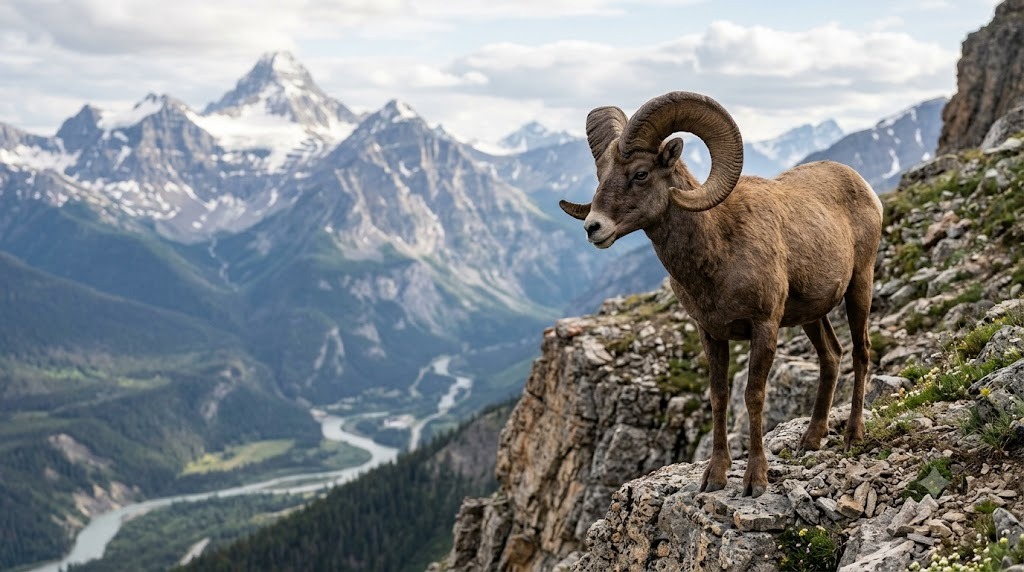
Overview
The Rocky Mountain bighorn sheep is the largest of North America's wild sheep and, for many hunters, the ultimate big-game trophy. A bighorn hunt is rarely a casual outing - most tags are drawn through highly competitive lotteries with odds measured in fractions of a percent, and a fortunate hunter may wait a lifetime, or never draw at all. That scarcity, combined with the sheep's spectacular high-country habitat, makes the bighorn one of the most revered and respected animals a hunter can pursue.
A bighorn hunt is as much a mountaineering expedition as a hunt. Success demands fitness, patience, sharp glassing skills, and a deep respect for both the animal and the alpine. The reward is not just the magnificent curl of a mature ram's horns but the experience of weeks spent in some of the most rugged and beautiful country in the lower 48 and the northern Rockies.
Identification & Appearance
A mature Rocky Mountain bighorn ram is an imposing animal - 250 to 300 pounds, occasionally larger, with a muscular, compact body built for climbing. Ewes are far smaller, 120 to 200 pounds.
The defining feature is the horns. Rams grow massive, brown, spiraling horns that can reach a full curl and beyond; a heavy mature ram may carry horns over 16 inches in base circumference and 35 to 40-plus inches along the curl. Horns grow throughout life and show annual growth rings, or annuli, which let a skilled hunter age a ram in the field. Ewes have short, slender, slightly curved horns.
The coat is grayish-brown with a distinctive white rump patch, white muzzle, and white on the back of the legs. The body is stockier and the legs shorter relative to the desert and thinhorn sheep.
Range & Habitat (US)
Rocky Mountain bighorns occupy the high country of the western United States - Colorado, Montana, Wyoming, Idaho, Utah, New Mexico, the Dakotas, and reintroduced populations in several other states. They favor steep, rugged terrain near or above timberline: alpine basins, grassy benches broken by cliffs, and rocky escape terrain.
The non-negotiable habitat feature is escape terrain - steep, broken cliffs where sheep can outclimb predators. Sheep are rarely far from it. They use open, grassy slopes for feeding and the adjacent rock for safety, bedding, and lambing. Many herds migrate seasonally between high summer range and lower, windswept winter range.
Behavior & Sign
Bighorns are herd animals with strong social structure. Rams band together in bachelor groups for much of the year, separate from ewe-lamb groups, joining them only for the autumn rut. Sheep have superb eyesight - arguably the best of any North American big-game animal - and use it as their primary defense, often spotting hunters at extreme distances.
The rut runs roughly November into December, when rams pursue ewes and engage in the famous horn-clashing dominance contests. Outside the rut, rams are predictable, returning to favored bedding and feeding areas day after day.
Sign includes heart-shaped tracks similar to a deer's but blockier; abundant pellet droppings on bedding ledges; well-worn trails contouring slopes; and worn, dusty beds on prominent points with commanding views. Rubbed and polished rock on bedding ledges marks long use.
Hunting Seasons & Timing
Bighorn seasons vary widely by state and hunt unit but generally fall between late August and December. Many states offer both early high-country hunts and later rut-period hunts.
- Late August-September: Rams are in the high alpine in bachelor groups, in peak condition, predictable, and findable with glassing.
- October: Pre-rut. Rams begin to drift toward ewe range; weather turns.
- November-December: The rut. Rams are with ewes and more mobile; some late hunts target winter range concentrations.
Because a bighorn tag may be a once-in-a-lifetime draw, most hunters and guides favor the earlier season, when rams are settled and the weather is more forgiving.
Hunting Methods
Bighorn hunting is overwhelmingly a spot-and-stalk pursuit built on glassing. The method is simple to describe and hard to execute: find a vantage point, glass methodically for hours, locate a legal ram, judge it carefully, then plan and execute a stalk that uses terrain and wind to close the distance.
Patience is the core skill. Hunters may spend entire days glassing distant basins, returning to the same ridges over multiple days to relocate and pattern a particular ram. Once a stalk begins, it may take many hours of careful climbing, often the better part of a day, to reach a shooting position without the sheep's exceptional eyes detecting the approach. Backpack hunting - camping high and staying mobile - is standard, as is hiring an experienced guide, which many states require for nonresidents.
Where to Find Them - Reading the Terrain
Look first for escape terrain: cliff bands, broken rock faces, and steep bluffs. Then look at the grassy slopes and benches immediately adjacent - that combination of food and safety is bighorn country.
Rams favor south and west-facing slopes that green up early and stay snow-free. Prominent points and ledges with a commanding view are classic bedding spots; rams bed where they can watch their backtrail and the terrain below. Feeding happens on the open grass at dawn and dusk; midday rams bed in the rocks.
Saddles and ridge benches connect feeding and bedding areas and concentrate travel. In windy alpine country, sheep often use leeward slopes. Glass at first and last light when sheep are moving and the low sun reveals their pale rump patches.
Gear & Optics Needed
Optics are the most important tools in sheep hunting. A high-quality spotting scope - 65mm or larger, with magnification to 60x - is essential for finding and judging rams at long range. Pair it with 10x or 12x42 binoculars and a sturdy tripod. A rangefinder good to 1,000-plus yards is standard.
Footwear and pack matter enormously: stiff, broken-in mountain boots and a capable backpack built for multi-day loads and meat hauling. Bring layered clothing for swings from warm afternoons to freezing nights, a quality four-season-capable shelter and sleeping bag, trekking poles, and trustworthy navigation.
A flat-shooting rifle in a cartridge such as .270, 7mm Remington Magnum, .280 Ackley, or .300 magnum, capped with quality glass and confirmed at extended range, suits the often-long shots of open alpine terrain.
Shot Placement & Field-Dressing
Bighorn rams are not especially hard to kill, but the terrain makes shot selection critical. Take only a stable, well-supported shot at a range you have practiced. The high-percentage aim point is the heart-lung area behind the shoulder on a broadside ram; for steep up- or downhill angles, account for the geometry and aim true to the vitals. Never take a shot that risks the ram tumbling into unrecoverable terrain - wait for it to stand on safer ground.
After a clean shot, photograph the moment, then field-dress promptly using the gutless method to remove quarters, loins, and trim. Cool the meat fast in the alpine air, bag it to keep it clean, and prepare for a hard pack-out. In most states the cape and full skull are kept; many require horn plugging or check-in.
Meat & Eating Quality
Bighorn sheep meat is excellent - mild, fine-grained, and free of strong flavor, often compared to high-quality lamb or venison from a clean alpine diet. Because a sheep tag is so hard-won, hunters take particular care with the meat, and properly handled bighorn is prized table fare. The animal is fully utilized: meat, cape, and horns each carry meaning for the hunter fortunate enough to fill the tag.
Common Mistakes
- Drawing the tag and not being ready. A once-in-a-lifetime tag deserves months of physical training; unfit hunters squander the opportunity.
- Underusing optics. Hunters who hike instead of glass walk past sheep. Hours behind the spotting scope find rams.
- Misjudging rams. Field-judging horn maturity and legality takes study; bring reference material and take your time.
- Skylining and careless movement. A sheep's eyesight punishes any silhouette on a ridge.
- Bad shot selection. Risking a ram falling into a chasm, or shooting beyond your proven range, can ruin a hunt of a lifetime.
Regulations & Conservation Note
Rocky Mountain bighorn hunting is almost entirely draw-only. Tags are allocated through state lottery systems with extremely low odds; some states sell bonus or preference points, and a small number of premium tags are auctioned or raffled to fund conservation, often raising six figures each. For many hunters this is a true once-in-a-lifetime tag, and several states restrict you to a single bighorn in your lifetime. Nonresidents commonly must hire a licensed guide.
Bighorns were nearly wiped out across much of their range by overhunting, habitat loss, and especially diseases transmitted from domestic sheep. Their recovery is one of conservation's great success stories, funded largely by hunters through license fees, auction tags, and groups like the Wild Sheep Foundation. Disease remains the herd's greatest threat. Always verify your state's specific regulations, tag rules, and check-in requirements.
Best Suited For
A bighorn hunt suits the fit, patient, experienced mountain hunter - though because the tag is so rare, any drawn hunter should commit fully to preparation regardless of background. It is not a beginner's first hunt, but a beginner who draws a tag can succeed with a strong guide and serious physical training. Above all it suits the hunter who values the alpine experience and the conservation legacy as much as the trophy.
FAQ
How hard is it to draw a bighorn tag? Very hard. Most state lotteries have odds well under one percent. Many hunters apply for decades; some never draw. Auction and raffle tags offer alternate routes but at significant cost.
Do I need a guide? Resident hunters generally do not. Most states require nonresidents to hunt with a licensed outfitter or guide for sheep.
How fit do I need to be? Very fit. Expect long days of climbing at altitude with a heavy pack, sometimes for two weeks. Train for months with weighted hikes and stair work.
Can I hunt bighorn more than once? In many states, no - a bighorn is a once-in-a-lifetime species. Rules vary, so check your state.
What makes a ram legal? Definitions vary - some units require a full-curl ram, others a minimum age or any ram. Learn the exact rule for your unit and practice field-judging before the hunt.