Roosevelt Elk
The Roosevelt elk is the largest-bodied of North America's elk subspecies - a heavy, dark, rainforest-dwelling animal that thrives in the dripping coastal timber of the Pacific Northwest.
🗓️ Last reviewed: June 2026
Overview
The Roosevelt elk is the largest-bodied of North America's elk subspecies - a heavy, dark, rainforest-dwelling animal that thrives in the dripping coastal timber of the Pacific Northwest. Named for President Theodore Roosevelt, it offers a hunt that feels worlds apart from the open-country Rocky Mountain elk hunting most people picture. Instead of glassing distant ridges, Roosevelt elk hunters work thick old-growth forest, brushy clearcuts, and fog-soaked benches where a 700-pound bull can vanish at 60 yards.
For beginner-to-intermediate hunters, the Roosevelt elk is a rewarding but demanding goal. The country is wet, steep, and brushy; shots are close; and patience matters more than long-range marksmanship. It is a hunt of woodcraft - reading wind, moving slowly, and learning to hunt animals you often hear before you see.
Identification & Appearance
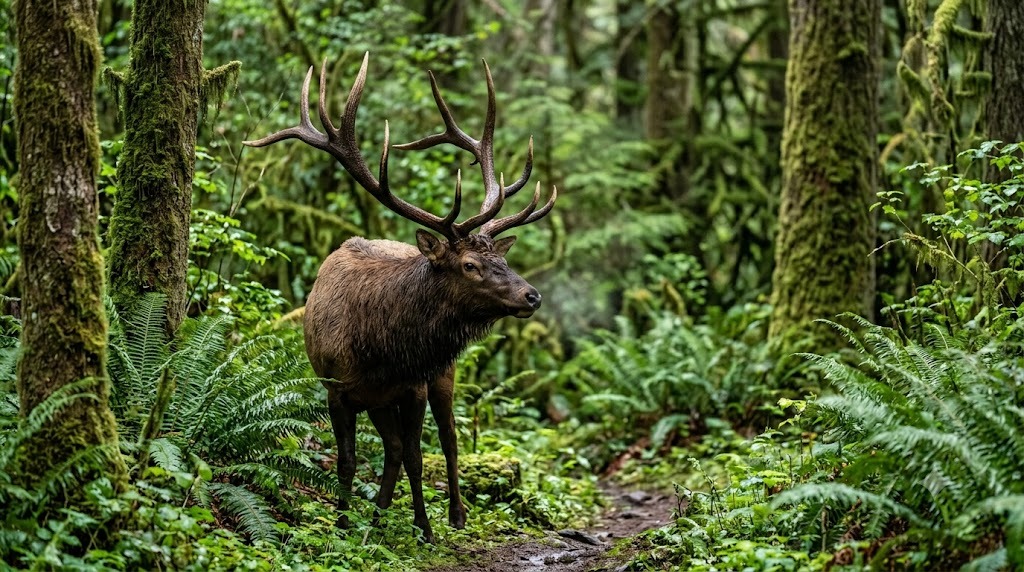
Roosevelt elk are stocky and dark. Mature bulls weigh 700-1,100 pounds, considerably heavier than Rocky Mountain bulls, with cows running 575-625 pounds. The body coat is dark brown, the neck and head darker still with a shaggy mane, and a pale tan rump patch stands out in dim forest light.
Antlers tell the subspecies story. Compared to Rocky Mountain elk, Roosevelt bulls grow antlers that are shorter and more massive, often with heavy "crowning" - clustered, cupped points at the antler tips rather than long sweeping main beams. This crowned, palmated look is a hallmark of mature Roosevelt bulls. Both sexes lack the long, rangy legs of mule deer; the elk is built blocky and powerful for shouldering through brush.
Range & Habitat (US)
Roosevelt elk inhabit the coastal Pacific Northwest - western Washington, western Oregon (including the Coast Range and parts of the Cascades), and far northwestern California (including the redwood country). They favor old-growth and second-growth conifer forest, brushy regenerating clearcuts, river bottoms, and the edge zones where dense timber meets openings. The defining habitat trait is moisture: this is a rainforest elk, comfortable in fog, drizzle, and deep shade.
Behavior & Sign
Roosevelt elk live in herds and are most active at dawn, dusk, and through the night, bedding in heavy cover during the day. They are quieter and less far-ranging than Rocky Mountain elk, often holding in relatively small home areas of thick timber and adjacent feed.
Sign is the hunter's roadmap in country where you rarely see far. Look for:
- Tracks - large, rounded, two-toed prints in muddy trails and old logging roads.
- Droppings - pellet groups, or soft "cow-pie" masses on lush spring/summer feed.
- Trails - well-worn elk highways punched through brush between bedding and feeding areas.
- Rubs - bark scraped from saplings by bulls polishing antlers.
- Wallows - muddy, urine-scented pits used by bulls in the rut.
- Tracks-in-clearcut browse lines on regenerating brush.
During the September rut, bulls bugle, though Roosevelt bugles are often shorter and less musical than the classic Rocky Mountain scream.
Hunting Seasons & Timing
Seasons are set by state and unit and typically include an archery season in September (overlapping the rut), followed by rifle seasons in October and into November. Many areas use limited-entry draw tags for bulls, with more general opportunity for antlerless or spike-only harvest. The September rut is prime for calling; later seasons rely more on still-hunting and pattern-hunting feeding areas. Always confirm current dates, weapon seasons, and tag types with Washington, Oregon, or California wildlife agencies for your specific unit.
Hunting Methods
- Still-hunting thick timber - moving a few quiet steps at a time, into the wind, glassing every opening.
- Calling during the rut - cow calls and bugles to locate and draw bulls; in dense cover, calling often brings animals to surprisingly close range.
- Pattern hunting feed - sitting or slipping the edges of clearcuts and meadows at first and last light.
- Tracking - following fresh sign in soft ground, common after rain.
- Glassing openings - limited but useful where clearcuts and burns offer a view.
Where to Find Them - Reading the Terrain
Roosevelt elk country rewards hunters who think in edges and elevation bands. Focus where dark, mature timber (security cover) sits next to brushy clearcuts or meadows (feed). Benches - flatter shelves on steep slopes - hold bedding elk. North-facing slopes stay cool and shaded. After rain, fresh tracks on muddy logging roads reveal travel routes. In the rut, follow bugles into the timber; outside the rut, hunt the feed edges at the margins of daylight and let wind dictate every move.
Gear & Optics Needed
Because shots are close and cover is thick, this is not a long-range hunt. A rifle in .270, .30-06, .308, or .300 Win Mag with quality bullets is plenty; many hunters favor low-magnification scopes for fast, close shooting. Archers do well with standard elk setups. 8x32 or 10x42 binoculars help pick apart shadowy timber more than long-range glass. Bring rain gear that actually works, quiet outerwear, sturdy waterproof boots, a cow call and bugle, a sharp knife and game bags, and a reliable pack for hauling meat out of steep, wet terrain. Trekking poles help on slick slopes.
Shot Placement & Field-Dressing
Wait for a broadside or quartering-away presentation and aim for the heart-lung area, low and tight behind the shoulder. In thick cover, pass on shots where brush or unclear angles could deflect a bullet or arrow. After the harvest, field-dress promptly, then quarter the animal and get the meat into game bags quickly - the coastal climate and steep terrain make fast, clean processing essential. The classic "gutless method" works well for packing meat off difficult ground. Keep the meat cool, shaded, and clean of debris during the pack-out.
Meat & Eating Quality
Roosevelt elk is excellent table fare - lean, mild, and fine-grained, widely considered among the best wild red meat in North America. Because the animals are large, a single elk yields a great deal of meat, so plan cooler space and processing time. Backstraps and tenderloins are prized; tougher cuts excel in roasts, stews, ground meat, and sausage. Cool the meat fast and keep it clean for the best quality.
Common Mistakes
- Hunting like it's the Rockies - expecting long glassing and long shots in country that offers neither.
- Moving too fast and too loud through thick timber.
- Ignoring the wind in swirling forest air currents.
- Skipping rain gear and getting cold, wet, and ineffective by midday.
- Calling too aggressively and pushing wary bulls away.
- Underestimating the pack-out and not planning meat care in advance.
Regulations & Conservation Note
Roosevelt elk are a conservation success, recovered from low historic numbers through habitat management and regulated hunting funded by hunter dollars. Populations are managed by unit with carefully set tag numbers. Always hunt with the proper tag, follow antler-point and season rules, and respect private timberland access agreements - much Roosevelt elk country is privately owned working forest. Practice fair chase and take only clean, ethical shots.
Best Suited For
The Roosevelt elk suits hunters who enjoy woodcraft over long-range shooting - those willing to move slowly, hunt close, endure wet weather, and learn to read sign in dense forest. It is an accessible big-game hunt for committed beginners and a deeply satisfying one for intermediate hunters who want to test their stalking and calling skills against a heavy, wary animal in beautiful coastal country.
FAQ
How is a Roosevelt elk different from a Rocky Mountain elk? Roosevelt elk are heavier-bodied with shorter, more massive, often "crowned" antlers, and they live in wet coastal rainforest rather than open mountains.
Do I need to shoot long range to hunt Roosevelt elk? No. Most shots in the thick coastal timber are well under 100 yards, so woodcraft and close-range marksmanship matter far more than long-range ability.
When is the best time to hunt them? The September rut is excellent for calling bulls, while October and November rifle seasons rely more on still-hunting and pattern-hunting feeding areas.
Is the meat good? Yes - Roosevelt elk is lean, mild, and among the finest wild red meat available, with a single animal yielding a large amount of meat.
Can a beginner hunt Roosevelt elk successfully? Yes, with preparation. The country is wet and steep, but the close-cover hunting style rewards patience and quiet movement more than expensive gear or long shots.