Sitka Blacktail Deer
The Sitka blacktail deer is a small, stocky subspecies of mule deer native to the wet coastal rainforests of Southeast Alaska and coastal British Columbia.
🗓️ Last reviewed: June 2026
Overview
The Sitka blacktail deer is a small, stocky subspecies of mule deer native to the wet coastal rainforests of Southeast Alaska and coastal British Columbia. For many hunters, the Sitka blacktail represents one of the most accessible and rewarding big-game hunts in the far north - generous bag limits, beautiful country, and meat widely regarded as the finest of any North American deer. Unlike the draw-only sheep and goat hunts of the same region, blacktail tags are typically available over the counter, making this a true everyman's adventure for those willing to deal with rain, brush, and saltwater logistics.
These deer thrive on islands such as Kodiak, Afognak, Prince of Wales, Baranof, and Chichagof, where they were introduced or are native. Populations rise and fall sharply with winter severity, but in good years the islands hold remarkable densities. A successful Sitka blacktail hunt blends mountain glassing, beach walking, and old-growth still-hunting - a varied, physically engaging pursuit in some of the most scenic terrain on the continent.
Identification & Appearance
Sitka blacktails are noticeably smaller than Rocky Mountain mule deer or whitetails. A mature buck weighs roughly 120 to 150 pounds, with some Kodiak bucks pushing larger; does run 80 to 110 pounds. The body is compact and well-muscled, an adaptation to steep terrain and harsh winters.
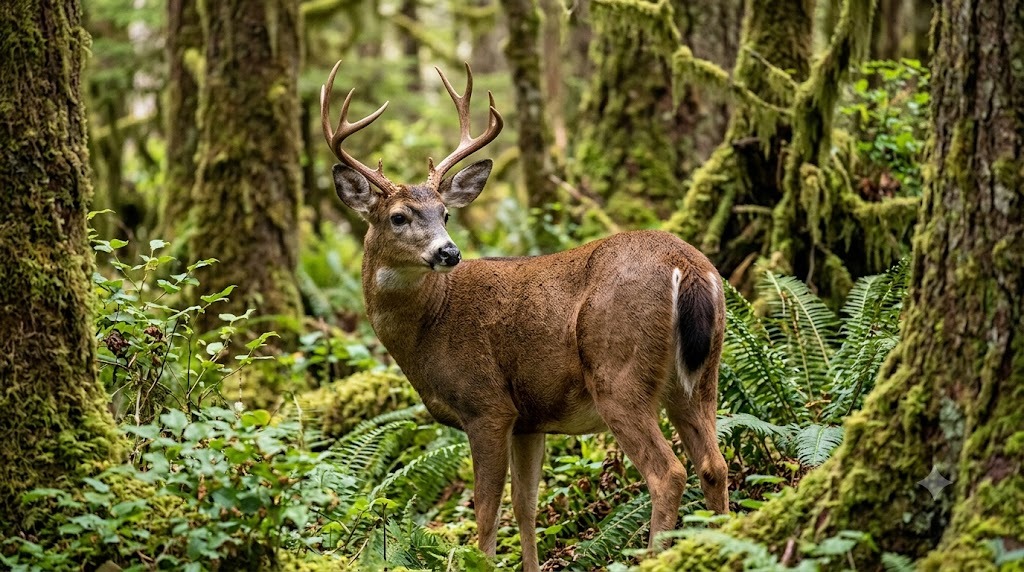
Summer coats are a warm reddish-brown, shifting to a darker brownish-gray in fall and winter. The tail is the signature feature - broad, dark brown to black on top, white underneath, very different from the rope-like black-tipped tail of a mule deer or the broad white flag of a whitetail. The face shows a dark forehead patch and white throat and muzzle markings.
Antlers are modest by lower-48 standards. A mature buck typically carries a forked-G2 mule-deer-style rack, with most good bucks scoring in the 90s to low 100s; a buck breaking 110 inches is exceptional. The metric here is maturity and meat, not inches.
Range & Habitat (US)
In the United States, Sitka blacktails are found almost entirely in Southeast Alaska and on the Kodiak Archipelago. Core areas include the islands of the Alexander Archipelago - Prince of Wales, Kupreanof, Kuiu, Baranof, Chichagof, Admiralty - and the introduced populations on Kodiak and Afognak.
Habitat is coastal temperate rainforest: dense Sitka spruce and western hemlock old growth, muskeg openings, alpine meadows above timberline, and shoreline fringe. Deer move seasonally with snow. In summer and early fall they feed in high alpine basins; as snow accumulates they descend through the timber toward the beaches, sometimes feeding on kelp and beach grasses in deep-snow winters.
Behavior & Sign
Sitka blacktails are crepuscular, most active at dawn and dusk, though weather drives movement as much as time of day. On calm, clear days deer often feed in the open alpine; during heavy rain or wind they retreat into old-growth timber where the canopy blocks weather.
The rut peaks in mid-November. Pre-rut and rut bucks become far more visible and respond well to calling. Outside the rut, bucks are reclusive and stick to thick cover.
Sign to look for: heart-shaped tracks roughly two to three inches long in mud or wet sand; pellet groups along game trails through muskeg and timber; rubs on small spruce and alder during the rut; and well-worn trails contouring hillsides and dropping toward beaches. Beach sand and tidal flats hold tracks beautifully and tell you which trails are active.
Hunting Seasons & Timing
Seasons vary by Game Management Unit but generally run from early August through December, one of the longest deer seasons in North America. Bag limits in productive units can be generous - multiple deer per hunter - though limits are reduced after hard winters.
- August-September: Alpine hunting at its best. Deer are in the high country, weather is comparatively mild, and glassing is productive.
- October: Transition period. Deer begin shifting downhill; weather worsens.
- November: The rut. Bucks are vulnerable and calling works well, but rain and early snow are constant.
- December: Deep-snow hunting near the beaches; weather is harsh but deer concentrate low.
Always confirm the current regulations for your specific unit before hunting; bag limits and antlerless allowances change year to year.
Hunting Methods
Alpine glassing: The classic early-season approach. Climb above timberline, find a vantage, and glass open meadows and basins at first and last light. Once you spot a buck, plan a stalk using terrain and wind.
Still-hunting old growth: When deer are in the timber, move slowly - a step or two, then a long pause - through the big trees, using the soft, wet forest floor to stay quiet. This is intimate, close-range hunting.
Calling: During the rut, a Sitka blacktail call (imitating a doe bleat or fawn distress) can pull curious bucks into the open. This works best in or near cover where a buck feels secure approaching.
Beach hunting: In late season, walking quiet beaches at dawn lets you cover ground and intercept deer feeding on the shoreline fringe.
Where to Find Them - Reading the Terrain
Early season, focus on alpine bowls and meadow edges between 1,500 and 3,000 feet, especially south-facing slopes that green up first. Look for the seam where muskeg meadow meets timber - deer bed in the timber and feed in the open.
As the season progresses, follow the snow line downhill. Deer will be just below it. Mid-elevation benches, avalanche chutes filling with brush, and timbered draws funnel movement. In late season, the productive country is the lowest 500 feet - beach fringe, tidal meadows, and old growth within sight of saltwater.
Wind in this country is treacherous and swirling near ridges; use the steadier thermals in the timber, rising in morning and falling in evening.
Gear & Optics Needed
Rain gear is the single most important item - genuinely waterproof jacket and pants, not water-resistant. Knee-high rubber boots (such as Xtratuf) are standard for beach work and muskeg; many hunters carry mountain boots for alpine days.
Optics: 8x or 10x42 binoculars are essential for picking deer out of brush; a spotting scope helps in the alpine but is optional given typically shorter ranges. A rangefinder is useful.
Rifle: anything from .243 to .30-06 is plenty; shots are often under 200 yards. A light, weather-sealed rifle you can carry through brush all day beats a heavy magnum. Bring a sturdy pack frame for hauling meat, game bags, a sharp knife, and a way to stay found - GPS or map and compass - because the timber disorients quickly.
Shot Placement & Field-Dressing
Aim for the high-percentage broadside shot through the heart-lung area, just behind the shoulder and a third of the way up the body. For quartering angles, adjust forward to drive through the vitals. Wait for a clean, ethical shot and pass on anything marginal - wounded deer in this terrain are hard to recover.
Field-dress promptly. The mild, wet climate makes cooling and keeping meat clean a priority. The gutless method works well for packing out: skin one side, remove the quarters and backstraps, then the other side. Bag the meat immediately to keep it clean and let air circulate. Pack it to a cool, shaded spot and get it onto a boat or into camp without delay.
Meat & Eating Quality
Sitka blacktail venison is widely considered the best-tasting deer meat in North America. The deer feed on a clean, varied diet of forbs, beach greens, and browse, producing fine-grained, mild, tender meat with none of the gaminess sometimes associated with deer. Properly handled - kept cool, clean, and dry - it is superb table fare. Many Alaskans regard a freezer of blacktail as a season's worth of premium food.
Common Mistakes
- Underestimating the weather. Hypothermia is the real danger here, not the terrain. Skimping on rain gear ends hunts fast.
- Hunting only mornings and evenings. Weather drives blacktail movement; a deer can be up and feeding midday under heavy cloud.
- Ignoring the wind in timber. Swirling thermals bust hunters constantly. Plan stalks around it.
- Poor meat care. The damp climate can spoil meat if it is not cooled and kept clean quickly.
- Logistics failures. Tides, weather windows for boats and planes, and overloaded packs derail more hunts than poor shooting.
Regulations & Conservation Note
Sitka blacktail hunting is, in most units, an over-the-counter opportunity - a rare unlimited big-game hunt in a region otherwise dominated by draw-only tags. Resident bag limits can be generous, but the Alaska Department of Fish and Game adjusts limits, season length, and antlerless allowances based on winter mortality, which can be severe. Always verify current regulations for your exact Game Management Unit. Nonresidents should research guide requirements and transport logistics well in advance. Sitka blacktail populations are healthy and well-managed; the boom-and-bust cycle is natural, and conservative regulations after hard winters protect the herd for the long term.
Best Suited For
This is an excellent hunt for the do-it-yourself hunter who wants a true Alaskan adventure without a five-figure price tag or a years-long draw wait. It rewards physical fitness, comfort in wet weather, and basic boat or bush-plane logistics. Beginners can succeed with a guide or experienced partner; intermediate hunters will find it a perfect introduction to mountain and island hunting.
FAQ
Do I need a guide to hunt Sitka blacktail in Alaska? Resident hunters do not. Nonresident hunters do not legally need a guide for deer (unlike sheep, goat, or brown bear), but many hire a transporter for boat or air access to the islands.
How hard is the hunt physically? It ranges from moderate beach walks to strenuous alpine climbs. You can choose your difficulty by season - early alpine hunts demand fitness, late beach hunts are far easier.
What is the best time to go? Early season (August-September) for pleasant weather and alpine glassing; November for the rut and the best chance at a mature buck, at the cost of harsh weather.
What rifle should I bring? Any standard deer cartridge from .243 to .30-06 is ideal. Shots are usually close, so a light, weatherproof rifle matters more than power.
Is the meat really that good? Yes - it is consistently rated the finest venison in North America, mild and tender, provided it is cooled and kept clean promptly.