Tule Elk
The tule elk is North America's smallest elk subspecies and a remarkable conservation comeback story.
🗓️ Last reviewed: June 2026
Overview
The tule elk is North America's smallest elk subspecies and a remarkable conservation comeback story. Found only in California, the tule elk was driven to the brink of extinction in the 1800s - at one low point, the entire subspecies may have descended from a tiny remnant herd. Today, careful management has restored tule elk to thousands of animals across the state, and a limited, highly regulated hunt exists for a small number of lucky tag holders.
For the U.S. hunter, the tule elk represents a rare and special opportunity. Tags are extremely limited and awarded mostly through a competitive draw, so most hunters who pursue tule elk wait many years for the chance. This guide treats the tule elk as the prized, conservation-funded hunt it is: a once-in-a-lifetime tag earned through patience, hunted in open California grasslands and oak country, and approached with deep respect for the subspecies' fragile history.
Identification & Appearance
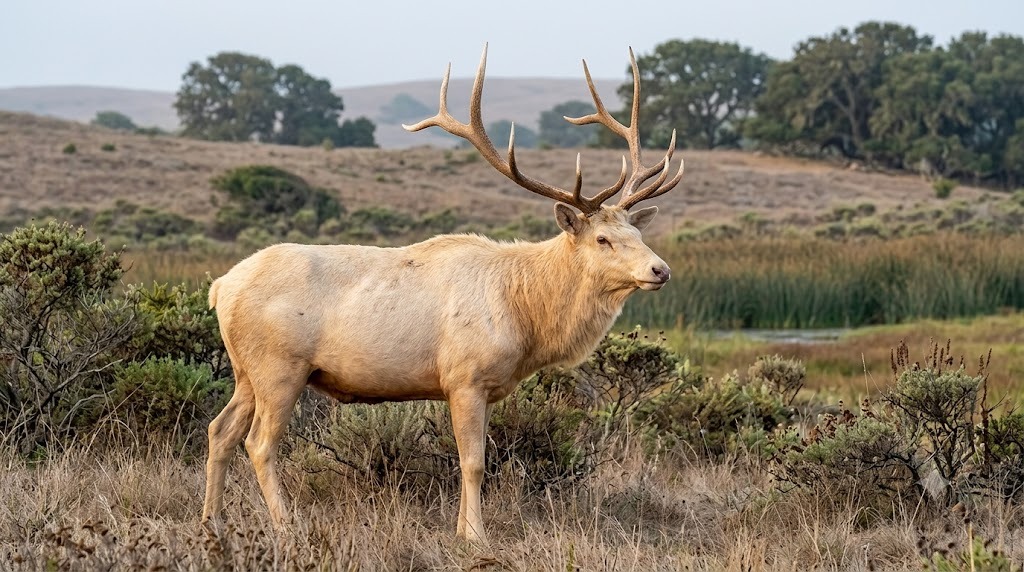
Tule elk are noticeably smaller than other elk. Mature bulls typically weigh 400-550 pounds, with cows around 300-425 pounds - far lighter than the heavy Roosevelt or Rocky Mountain elk. The coat is a pale, tawny-gray to light brown, often appearing washed-out compared to darker elk, an adaptation to California's sun-bleached grasslands. A pale rump patch and darker neck mane are present but subtle.
Bull antlers are smaller and more slender than other elk subspecies, in keeping with the smaller body, though a mature tule bull can still grow an impressive, well-proportioned rack. The overall impression is of a compact, lighter-colored elk built for hot, open country rather than deep timber or high mountains.
Range & Habitat (US)
Tule elk exist only in California. They occupy a patchwork of herds across the state - the Central Valley fringes, the Coast Range foothills, grassland and oak-savanna country, and parts of the southern Sierra foothills. Notable populations include herds at Point Reyes, the Owens Valley, and numerous interior valley and foothill ranges. Their preferred habitat is open: grasslands, marshy "tule" wetlands (the source of their name), oak woodland, and rolling foothill rangeland. They tolerate heat and dry conditions far better than mountain elk.
Behavior & Sign
Tule elk are herd animals, generally most active at dawn and dusk, bedding in shade or tall cover through the heat of the day. In open country they rely heavily on eyesight and tend to be wary, often visible at long distances feeding in valley bottoms and on grassy slopes. During the late-summer rut, bulls bugle and gather harems of cows.
Sign in open grassland and oak country includes:
- Tracks - elk-sized two-toed prints along trails, water edges, and dirt roads.
- Droppings - pellet groups, softer in spring on green feed.
- Trails - worn paths between bedding shade, water, and feed.
- Beds - matted oval depressions in tall grass or under oaks.
- Rubs and wallows - used by rutting bulls in late summer.
- Grazed grass lines showing where herds have been feeding.
Hunting Seasons & Timing
Tule elk hunts in California run roughly from August into autumn, with specific seasons and hunt zones set by the state. Tags are very limited and distributed mainly through a competitive public draw, with a small number of premium fundraising tags. The late-summer rut overlaps early seasons, making bugling bulls a feature of some hunts. Because regulations, zones, and draw odds change yearly, every prospective hunter must study current California Department of Fish and Wildlife rules carefully and apply through the official draw system.
Hunting Methods
- Spot-and-stalk is the primary method. In open grassland and oak savanna, hunters glass long distances, locate a herd, then plan a stalk using terrain folds, oak motts, and wind.
- Glassing from vantage points at first and last light to locate feeding herds.
- Calling during the rut - bugles and cow calls can locate and sometimes draw bulls in late summer.
- Ambushing water and travel routes in hot, dry country where elk must drink.
Where to Find Them - Reading the Terrain
Tule elk country is open, so terrain reading is about shade, water, and feed. In hot weather, elk feed early and late on grassy slopes and valley bottoms, then bed in oak shade or tall tule cover through midday. Glass the green pockets - irrigated edges, spring seeps, and creek bottoms hold feed longer into the dry season. Use the rolling terrain to your advantage: folds, draws, and oak clusters give a hunter cover to close the distance on animals that can see a long way. Water sources become magnets in late summer.
Gear & Optics Needed
Optics are critical in this glassing-heavy hunt. Quality 10x42 binoculars and a spotting scope on a tripod let you find and judge elk at long range across open country. A flat-shooting rifle in .270, .30-06, 6.5 Creedmoor, .308, or .300 Win Mag with good bullets handles the moderate-to-longer shots open terrain can present. Bring a rangefinder, shooting sticks or a tripod for a steady rest, lightweight breathable clothing for hot weather, plenty of water, sun protection, sturdy boots, game bags, and coolers - California's late-summer heat makes fast meat care essential.
Shot Placement & Field-Dressing
Take only a broadside or quartering-away shot, aiming for the heart-lung area behind the shoulder, at a distance you have practiced and can make cleanly. In open country, use a steady rest - sticks or a tripod - rather than rushing an offhand shot. Because tule elk are hunted in warm weather, speed of field care is vital: field-dress promptly, quarter the animal, get the meat into game bags, and into coolers as fast as possible. Keep meat shaded and clean throughout. The "gutless method" works well and helps cool meat quickly.
Meat & Eating Quality
Tule elk provides excellent, lean, mild table fare, comparable to other elk and widely prized. Because tule elk are smaller, the yield per animal is more modest than a big Roosevelt bull, but the quality is outstanding. Cool the meat fast in the heat to preserve flavor. Backstraps and tenderloins are exceptional; the rest makes superb roasts, steaks, ground meat, and sausage. Given how rare a tule elk tag is, hunters take particular care to use every bit of the harvest.
Common Mistakes
- Underestimating how wary elk are in open country with long sightlines.
- Skylining yourself on ridges during a stalk and being spotted.
- Poor wind discipline when closing across open ground.
- Rushing an unsupported shot instead of using a steady rest.
- Hunting midday heat hard instead of focusing effort on dawn and dusk.
- Failing to plan for fast meat care in late-summer temperatures.
Regulations & Conservation Note
The tule elk is one of California's proudest conservation achievements - recovered from near-extinction through reintroduction, habitat protection, and carefully limited regulated hunting funded by hunters and the public. Tag numbers are deliberately small and tied to herd-by-herd population goals. Every hunter must apply through the official draw, hunt only the assigned zone and tag, and follow all California regulations precisely. Hunting this subspecies is a privilege earned through a transparent, science-based management system.
Best Suited For
The tule elk suits the patient, dedicated hunter willing to apply for years in a competitive draw and to hunt smart in open, hot country. It rewards good glassing, careful stalking, and clean shooting from a rest. While the terrain is not as physically punishing as deep mountain elk hunting, the open-country challenge and the rarity of the tag make this a memorable, intermediate-level big-game pursuit - and a true once-in-a-lifetime opportunity for most who draw it.
FAQ
Where can I hunt tule elk? Only in California. Tule elk exist nowhere else, occupying grasslands, oak woodlands, and foothill country across the state.
How do I get a tag? Tags are very limited and awarded mostly through California's competitive public draw, with a few premium fundraising tags. Most hunters apply for many years before drawing.
How are tule elk different from other elk? They are the smallest elk subspecies, lighter in body and paler in color, adapted to hot, open California country rather than mountains or rainforest.
What is the best hunting method? Spot-and-stalk - glassing open country to find herds, then using terrain and wind to close the distance. Calling can work during the late-summer rut.
Is the meat good? Yes, excellent - lean and mild like other elk. Because the animals are smaller the yield is modest, and fast cooling in the heat is essential to quality.