How to Cook Wild Duck & Goose
Wild waterfowl is lean, dark, and iron-rich, not the fatty supermarket bird. Here is how to render the fat, cook the breast medium-rare, and slow-cook the legs.
Most people who try wild duck or goose for the first time cook it like a turkey breast or a Peking duck, and end up with a gray, livery, shoe-leather result that confirms every bad thing they ever heard. The problem is almost never the bird. It is the method. Wild waterfowl is a lean, dark, fast-twitch muscle that has almost nothing in common with the fatty farm duck you see in a grocery case.
Part of our Field & Kitchen series - what happens after the shot: the handling, butchering and cooking that turn a tag into good eating.
Get two ideas straight - cook the breast hot and fast to medium-rare, cook the legs low and slow - and you will eat better than most restaurants serve. The rest is detail.
Understand What You Are Actually Cooking
A mallard or a wild Canada goose spends its life flying hundreds of miles. The breast is dense, dark red, and worked hard. That dark color comes from myoglobin, the same iron-rich protein that makes the meat taste mineral and, when overcooked, faintly of liver. This is not spoilage and it is not a flaw - it is the flavor of a wild animal that earned its muscle.
A few things follow from that:
- The breast is a steak, not a roast. Treat a duck or goose breast the way you would treat a duck-sized piece of venison backstrap or a beef sirloin. Hot, fast, rare-ish, rested.
- The legs are not steaks. They are full of tendon and connective tissue that only breaks down with long, gentle, moist heat.
- There is almost no internal fat. What fat exists sits in a thin cap under the skin. That is your friend, and the single biggest reason not to skin the bird if you can avoid it.
Pluck It If You Can - the Skin Is the Fat
Skinning a duck is fast and tempting, especially when you have a pile of birds to clean. But the skin and its fat cap are exactly what keep lean waterfowl from drying out. Plucked, skin-on breast renders into something rich and self-basting. Skinned, it is a bare lean muscle with no buffer against the heat.
Pluck when:
- The bird is in good shape and not badly shot up.
- You have time, or a few people to help. Dry plucking a duck takes a couple of minutes once you get a rhythm; a quick scald in near-boiling water (not a hard boil) loosens feathers further.
- You plan to pan-sear or roast the breast, where rendered skin makes the dish.
Skin when the bird is shredded, when you are processing a big limit fast, or when the meat is destined for grinding, sausage, or a braise where skin would not survive anyway. There is no shame in skinning - just know what you are giving up.
Render the Fat Cap, Then Cook the Breast Medium-Rare
This is the technique that converts skeptics. For a skin-on breast:
- Score the skin in a shallow crosshatch, cutting through the skin and fat but not into the meat. This lets fat escape and renders faster.
- Start in a cold, dry pan. Lay the breast skin-side down in an unheated skillet, then turn the heat to medium. Starting cold gives the fat time to render slowly instead of seizing and burning.
- Be patient on the skin side. Let it sit, mostly undisturbed, for 4 to 7 minutes as the fat pools out and the skin turns deep golden and crisp. Pour off excess fat and save it - it is liquid gold for potatoes.
- Flip and finish briefly. Sear the meat side for a minute or two. You are aiming for an internal temperature around 130 to 135F (54 to 57C) for medium-rare. The center should be rosy red, never gray.
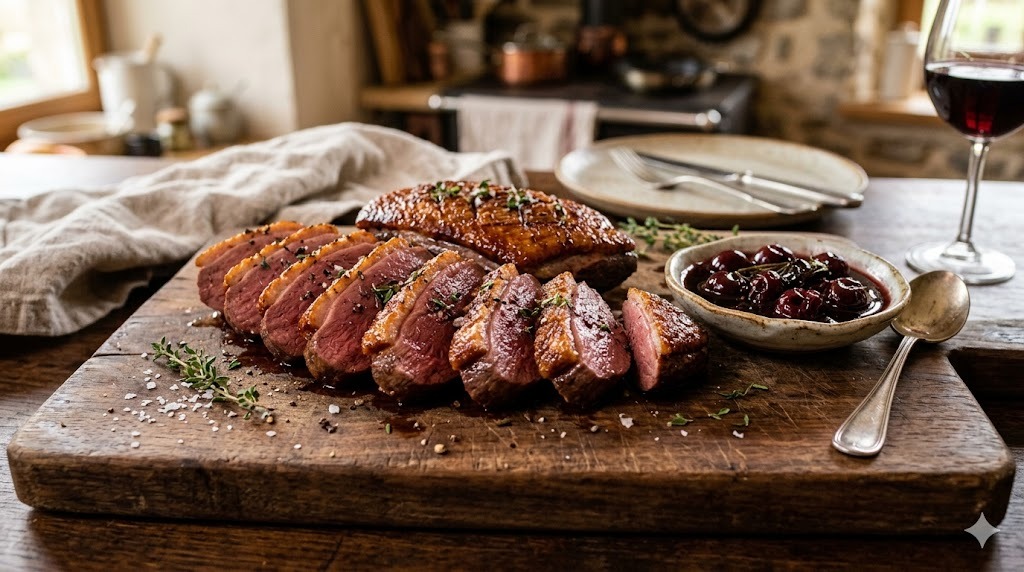
- Rest it. Pull it onto a board for 5 minutes before slicing. Resting lets the juices redistribute so they stay in the meat instead of running onto your cutting board. Slice thin, across the grain.
A goose breast is thicker, so it benefits from the same sear plus a short finish in a low oven (around 300F/150C) until it hits temperature. The doneness target does not change.
These temperatures are a cooking guideline for texture and taste, not a sterilization promise. The far more important food-safety step happens in the field - cool the meat fast and keep it cold. Our field-to-table venison guide covers the same cool-it-quick principle that applies to every animal you bring home.
Slow-Cook or Confit the Legs
Throwing duck and goose legs away because they are “tough” is the most common waste in a waterfowl kitchen. Tough is the point - those legs are built for braising.
Two reliable approaches:
- Braise. Brown the legs, then simmer them gently in stock, wine, or even just water with aromatics, covered, at a bare bubble for 1.5 to 2.5 hours until the meat surrenders off the bone. The shredded meat goes into tacos, ragu, pot pie, or a pasta sauce.
- Confit. Salt the legs overnight, then cook them fully submerged in rendered fat (duck fat is traditional, but lard works) at a low oven temperature around 200 to 250F (95 to 120C) for several hours. They keep for weeks under the fat and crisp up beautifully in a hot pan when you want them.
Goose legs are larger and even more sinewy, so lean toward the longer end of any braise. Patience does all the work here.
Taming the Livery, Mineral Flavor
If the iron-forward taste is too strong for your table - or you are feeding skeptics - you can soften it without masking the bird entirely:
- Soak the breasts in milk or buttermilk for several hours up to overnight in the fridge. The proteins bind some of the blood and mute the mineral edge. A simple saltwater brine does some of this too.
- Bleed and cool quickly in the field. Much of what people call “off” flavor is really blood left in warm meat. Clean handling at the truck does more than any kitchen trick.
- Lean into rich, sweet, or acidic partners. Cherry, orange, fig, balsamic, and red wine all flatter waterfowl. So does bacon fat.
- Trim hard. Cut away any blood-shot, bruised, or shot-damaged meat. It tastes bitter and cooks unevenly.
Common Mistakes to Avoid
- Overcooking the breast. This is the cardinal sin. Past medium, the iron concentrates and the texture turns to liver and rubber. When in doubt, pull it early.
- Skinning when you could have plucked. You strip away the fat that protects lean meat.
- Cooking breast and legs the same way. They are two different ingredients from the same animal. Treat them as such.
- Skipping the rest. Slicing straight off the heat dumps the juices you worked to keep in.
- Not trimming shot damage and silverskin. Five minutes with a sharp knife saves the dish.
Wild waterfowl rewards a little understanding. Cook the breast like a fine steak and the legs like a cheap, glorious braise, and you will stop apologizing for the bird and start asking for more tags. For the broader picture on handling and cooking everything you harvest, see our overview on cooking wild game.