Eurasian Collared-Dove
The Eurasian collared-dove is a large, pale gray dove that is not native to North America, and it has become one of the most accessible birds a new wingshooter can chase.
🗓️ Last reviewed: June 2026
Overview
The Eurasian collared-dove is a large, pale gray dove that is not native to North America, and it has become one of the most accessible birds a new wingshooter can chase. Introduced to the Bahamas in the 1970s and reaching Florida by the 1980s, it has spread explosively across nearly the entire United States in a few decades. Because it is non-native, many states place it outside the normal migratory-bird framework: there is often no closed season and no daily bag limit, and collared-doves do not count against your mourning-dove limit. That combination - abundant, legal year-round in many places, found near people, and good on the table - makes the collared-dove a near-perfect bird for practice, for new hunters, and for landowners managing farm pests. The one rule that matters most is correct identification, since collared-doves share country with native doves that are tightly regulated.
Identification & Appearance
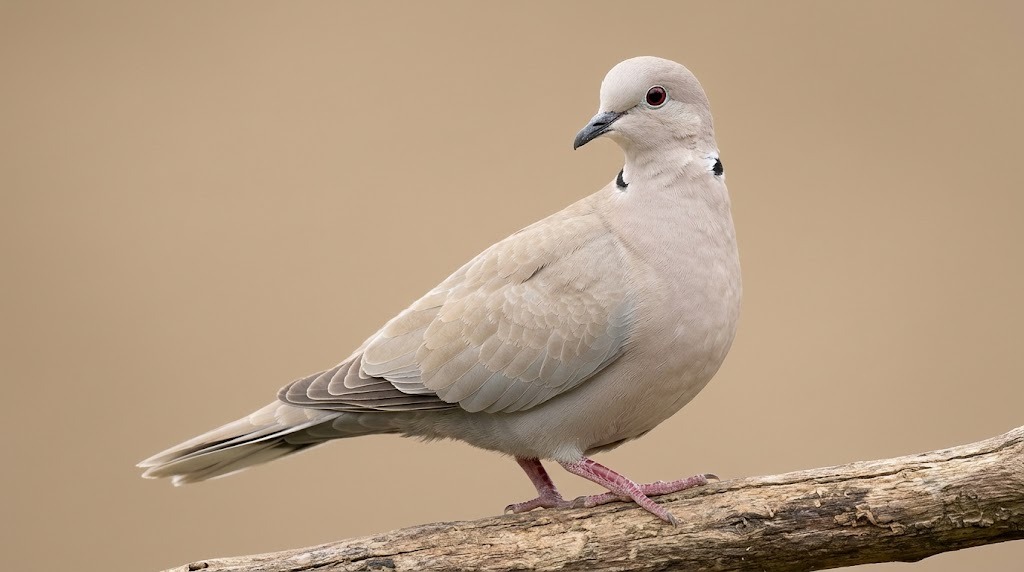
The Eurasian collared-dove is noticeably larger and chunkier than a mourning dove, with overall pale, sandy-gray plumage and a squared-off tail rather than the mourning dove's long, pointed one. Its signature mark is a thin black half-collar across the back of the neck, edged in white, which gives the bird its name. The wingtips are darker than the body, the underside of the tail shows a broad white band with a dark base, and the eye is dark red up close. In flight the bird looks bulky and pale with a blunt tail, and it often calls a repetitive three-note "coo-COO-coo." The key for hunters is to separate it from the native mourning dove (smaller, browner, slim with a long pointed tail and black spots on the wing, no neck collar) and from the smaller white-winged dove (bold white wing stripe). Confirming that collar and the squared tail before you shoot keeps you legal where native doves are regulated separately.
Range & Habitat (US)
From a Florida foothold, the Eurasian collared-dove has expanded across the South, the Great Plains, the Southwest, and much of the West, and it continues to push north and into new areas. It thrives in human-altered landscapes rather than wild country: farmsteads, grain operations, cattle feedlots, dairies, ranch yards, small towns, and suburban neighborhoods with backyard feeders. Anywhere there is spilled grain, livestock feed, and a few tall perches - barns, silos, power lines, shade trees - collared-doves tend to settle in and multiply. They are far more tied to agriculture and people than to natural habitat, which is exactly why they are so easy to find and why landowners often welcome hunting them. Their range overlaps native doves across most of the country, so the same field can hold both.
Behavior & Sign
Eurasian collared-doves are bold, social birds that loaf and feed in loose groups around reliable food. They perch conspicuously on power lines, barn roofs, dead snags, and silos, and they fly strong, direct, and fast on whistling wings between roost, water, and feed. Unlike the erratic, twisting mourning dove, a collared-dove's flight is heavier and straighter, though still quick enough to humble a shooter. They feed mostly on waste grain, seeds, and livestock feed on the ground, and they water at stock tanks, ponds, and puddles, especially in dry country. Sign is easy to read: birds lined up on wires and barn ridges, droppings and feathers under favored perches, and a steady morning and evening trade between roosting cover and a feed source. Their loud, repeated three-note coo from a high perch is often the first clue a farm holds them.
Hunting Seasons & Timing
In many states the Eurasian collared-dove, as a non-native invasive species, has no closed season, no daily bag limit, and no possession limit, and it does not count toward the native mourning-dove or white-winged dove bag. This means that in those states you can often hunt collared-doves year-round, including outside the regular dove season. That is a real advantage for practice and pest control - but the rules genuinely vary by state, and some require that collared-doves be left fully feathered for identification or fold them into the migratory-bird regulations. Always confirm your own state's current rules before you hunt, including license requirements, legal hunting hours, any identification or plumage rules, and whether your area treats the bird differently. As with all wingshooting, the best action is usually the first and last couple of hours of daylight, when birds move between roost, water, and feed.
Hunting Methods
Two simple approaches account for most collared-dove hunting: pass-shooting and hunting over decoys. For pass-shooting, find a travel route - a gap between a roost and a feed lot, a line of trees birds funnel past, or the airspace over a watering tank - and set up with good concealment to take birds as they fly through. Over decoys, a few dove decoys clipped to a fence, a wire, or a dead snag near a feed source pull these social birds within range, and a spinning-wing decoy can add visibility. Because collared-doves key on agriculture, getting permission to hunt a feedlot, grain spill, dairy, or harvested field is often the whole game. Stay still, keep low against a fence line or brush, and let birds commit. A close water source in dry country can concentrate birds into a tight, productive shoot.
Where to Find Them - Reading the Terrain
To find collared-doves, look for grain and livestock, not wilderness. Cattle feedlots, dairies, grain elevators, silos, ranch yards, harvested grain fields, and farmsteads with spilled feed are magnets, and small-town edges and suburbs with feeders hold them too. Scout for birds perched on power lines, barn ridges, and dead snags near a food source, and watch the morning and evening flight lines between roost trees and feed. In dry regions, stock tanks and ponds pull doves to water predictably. Pick a setup on the travel route - between roost and feed, or on the approach to water - rather than directly on top of birds, which only flares them. A quick evening of glassing a farm tells you where the trade lines run.
Gear & Optics Needed
Collared-dove hunting is light, simple, and cheap on gear. A 12, 20, or 28 gauge shotgun with an improved-cylinder or modified choke handles these strong-flying birds well; lead shot is generally legal for doves on upland ground (steel where required), and a field load of 7.5 or 8 shot is plenty. Bring more shells than you think you need, since dove shooting humbles everyone. A few dove decoys, a clip or two for fences and wires, and optionally a spinning-wing decoy round out the kit. Dress for the season and the often-open country, add eye and ear protection, and carry water. Optics are largely optional - a pair of compact binoculars only helps for scouting distant perched birds and reading flight lines before the shoot.
Shot Placement & Field-Dressing / Cleaning
Collared-doves are taken on the wing with a shotgun, so "placement" is really gun mount, swing, and lead. Their flight is fast but more direct than a mourning dove's, so a smooth, unhurried swing with proper lead and shots kept inside your patterned range does the work. After the hunt, most hunters simply breast out doves - remove the two breast fillets - which is quick and yields clean, dark meat; the birds can also be plucked whole if you prefer. Note that some states require collared-doves to be kept fully feathered until you reach home so the species can be identified, so check that rule before you clean birds in the field. In warm weather, get the meat cooled and kept clean promptly.
Meat & Eating Quality
Eurasian collared-doves are very good eating, and because they are larger than mourning doves each bird yields more meat. The breast is dark, lean, and mild, well suited to fast, hot cooking - grilled, pan-seared, or the classic bacon-wrapped jalapeno popper that doves are famous for. Like all lean wild game, the breasts cook quickly and turn dry if overcooked, so a hot, brief sear to a rosy medium is the way to go. With generous limits in many states, a good shoot can put a real meal on the table, and plenty of hunters rate collared-dove every bit as good as the native birds. That combination of abundance and quality is a big part of the appeal.
Common Mistakes
The biggest mistake is failing to identify the bird - shooting a mourning dove or white-winged dove thinking it is a collared-dove, which is both unethical and illegal where native doves are regulated separately. Assuming the generous "no season, no limit" rules apply everywhere is another error; they vary by state, so confirm yours. On the shooting side, beginners flock-shoot instead of picking one bird, mount too slowly, and stand up or move as birds approach, flaring them off. Setting up directly on top of feeding birds rather than on the travel line spoils the flight. And cleaning birds in the field where a state requires them kept feathered for identification can put a legal hunter on the wrong side of the rules. Slow down, confirm the collar and the squared tail, and know your local regulations.
Regulations & Conservation Note
The Eurasian collared-dove is a non-native, introduced species, and many states therefore exclude it from migratory-bird protections - often meaning no closed season, no bag limit, and no possession limit, with the bird not counting against native dove limits. That status reflects a conservation goal: limiting the spread of a non-native species while protecting native mourning and white-winged doves, which remain tightly regulated under the federal migratory bird framework. You still need a valid state hunting license, you must obey legal hunting hours, and you must follow any state-specific rules, including identification or feathered-plumage requirements. The single most important conservation duty here is accurate identification, so that native doves are never taken in mistake for the invasive one. Always check current state regulations before hunting.
Best Suited For
Eurasian collared-dove hunting is ideal for new wingshooters and for anyone who wants accessible, low-cost practice with real action. The often year-round opportunity in many states, the simple gear, the birds' habit of living around farms and towns, and the generous limits make it one of the easiest ways to log time behind a shotgun. It suits hunters who enjoy pass-shooting and decoying near agriculture, landowners managing a farm pest, and families who want a good wild bird on the table - provided they take identification and local rules seriously.
FAQ
Is there really no season or bag limit on Eurasian collared-doves? In many states there is no closed season and no daily or possession limit, because the bird is non-native and not protected under the migratory-bird framework. But this varies by state, so you must confirm your own state's current rules before hunting.
Do collared-doves count against my mourning-dove limit? In states that treat them as unprotected non-natives, no - they do not count against your native mourning-dove or white-winged dove bag. Where a state folds them into migratory-bird regulations, the rules differ, so check locally.
How do I tell a collared-dove from a mourning dove? The collared-dove is larger and paler gray with a squared tail and a thin black half-collar on the back of the neck. The mourning dove is smaller, browner, and slimmer with a long pointed tail, black wing spots, and no neck collar. Confirm the collar and squared tail before you shoot.
What gun and shot should I use? A 12, 20, or 28 gauge with an improved-cylinder or modified choke works well. Lead shot is generally legal for doves on upland ground (use steel where required), and a 7.5 or 8 field load is plenty for these birds.
Where is the best place to find them? Look around agriculture and people - cattle feedlots, dairies, grain elevators, harvested fields, ranch yards, farmsteads, and even town edges with feeders. Watch for birds on power lines and barn roofs, and set up on the flight lines between roost, water, and feed.