Gambel's Quail
The Gambel's quail is the signature upland gamebird of the American Southwest and one of the most enjoyable pursuits a new bird hunter can take up in desert country.
🗓️ Last reviewed: June 2026
Overview
The Gambel's quail is the signature upland gamebird of the American Southwest and one of the most enjoyable pursuits a new bird hunter can take up in desert country. A successful quail hunt is built on footwork and persistence: covering ground along washes and brush lines, reading the landscape, and being ready when a running covey finally boils up in a sudden, heart-stopping flush. These plump, topknotted birds are tied closely to the desert's rhythms, and their numbers rise and fall with the winter and spring rains. For beginners, a Gambel's quail hunt offers fast action, beautiful country, and an honest day of walking that rewards effort more than expensive equipment.
Identification & Appearance
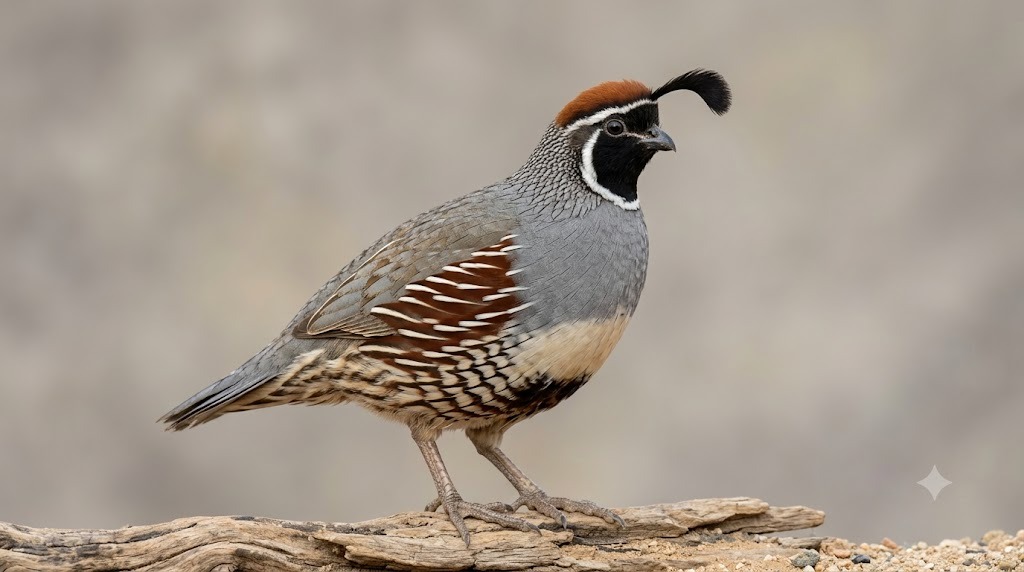
Gambel's quail are plump, round-bodied gamebirds with a distinctive teardrop-shaped black topknot, or plume, that curves forward from the crown and is present in both sexes (larger and more pronounced on the male). The male is the showpiece: a chestnut, rufous crown, a black face and throat outlined crisply in white, a pale gray breast, a creamy belly marked with a bold black central patch, and chestnut sides streaked with white. The female is grayer and plainer overall, carries a smaller plume, and lacks the black face mask and the black belly patch. Both sexes give a loud, distinctive "chi-CA-go-go" call along with a variety of clucks and chips that often betray a covey before you ever see it. Correct identification is straightforward once the topknot and the male's markings are learned.
Range & Habitat (US)
Gambel's quail are birds of the Sonoran and Mojave desert country, and Arizona is the heart of their range and the species' undisputed stronghold. They also occur in southern Nevada, southeastern California, southern New Mexico, southwestern Utah, and western Texas, as well as across northern Mexico. Ideal habitat blends mesquite thickets, desert washes, brushy arroyos, and riparian edges with creosote and cholla flats, almost always within reach of water. The classic Gambel's landscape is a network of dry washes lined with thick brush, cut through open desert, where the birds can feed in the open and dash into cover when pressed.
Behavior & Sign
Gambel's quail are largely runners rather than flyers, and coveys, which can sometimes be large, prefer to sprint through brush and along washes rather than take wing. When finally pressed, the whole group flushes together in a fast, noisy burst, and they are strong fliers in short bursts before pitching back into cover. They roost in low trees and shrubs at night and are most active in the cooler hours of morning and late afternoon. Key sign includes tracks and droppings in the sandy bottoms of washes, dusting bowls in soft dirt, scattered feathers, and the birds' own loud calling, which is one of the best ways to locate a covey. Listening for the "chi-CA-go-go" assembly call at first light is a high-value way to pin down where birds are working.
Hunting Seasons & Timing
Gambel's quail seasons run from fall into winter, roughly October through February depending on the state, and the cooler middle of the season is often the most comfortable and productive for both hunter and dog. Early-season hunts can be hot, so the first hours after sunrise and the last hours before sunset are prime, when birds are out feeding and moving. As the season progresses and temperatures drop, birds may be active over more of the day. Reproduction is strongly tied to winter and spring rainfall, so good rains mean a strong hatch and many young birds, while dry years produce poor reproduction and thinner coveys. Always confirm your state's exact dates, bag limits, and shooting hours before you go.
Hunting Methods
Hunting Gambel's quail is a walking, covey-busting pursuit. The method is to cover ground steadily along washes, arroyos, and brush lines, moving fast enough to stay with running birds and being ready at all times for a sudden group flush. Because the birds run, hunters must keep pressure on a located covey and try to push it toward thinner cover where it will hold and flush rather than simply outrun you. Pointing or flushing dogs are very useful for finding and pinning birds and for retrieving downed quail in thick desert cover, though they are optional and many hunters do well on foot alone. After the initial flush scatters a covey, singles will hold tighter and offer some of the best shooting of the day.
Where to Find Them - Reading the Terrain
Start with water and cover - Gambel's quail rarely stray far from both. Desert washes lined with mesquite, brushy arroyos, and riparian edges are the highways and dining rooms of these birds. Work the brushy margins where open feeding ground meets thick escape cover, and pay attention to creosote and cholla flats near water. Coveys often move out to feed in the cooler hours and retreat into the densest brush during the heat of the day. Listen as much as you look: the loud assembly and contact calls will often lead you straight to a covey running ahead through the brush. Edges, thickets along washes, and the heads of arroyos are classic places to concentrate your effort.
Gear & Optics Needed
Quail hunting rewards mobility and preparation more than expensive optics. A light upland shotgun in 20 or 12 gauge with an improved-cylinder choke and light loads of size 7.5 or 8 shot is the standard setup for these fast, close-flushing birds. Brush pants protect your legs from the desert's relentless thorns, and a comfortable upland vest carries shells, water, and birds. Carry plenty of water for both yourself and your dog, since the desert is unforgiving even in cooler months. Snake-aware footwear is wise because rattlesnakes can still be active early in the season. Blaze orange keeps you visible to other hunters, and a good pair of compact binoculars can help you spot coveys moving in the open at a distance.
Shot Placement & Field-Dressing / Cleaning
Gambel's quail are taken with a shotgun on the wing. Keep shots inside your pattern's effective range, swing through the bird on the flush, and pick out a single target rather than firing into the mass of a rising covey. Because the birds are small and fast, a smooth mount and a quick, deliberate swing matter more than a tight choke. After recovery, most hunters breast the birds out by removing the two breast fillets, though plucking whole birds is rewarding for roasting given their excellent meat. Cool the meat quickly, keep it clean, and protect it from the heat in your vest or a cooler as soon as practical.
Meat & Eating Quality
Gambel's quail are widely regarded as excellent eating, with mild, tender white meat that takes well to simple preparations. The breast is the prize and is easily overcooked because it is so lean, so quick, hot cooking such as grilling or pan-searing works best. Whole birds can be roasted or grilled, and the small size makes them ideal for appetizers or for several birds per plate. Few wild gamebirds are as approachable on the table, which makes the Gambel's quail a favorite for hunters who value the meal as much as the hunt.
Common Mistakes
New quail hunters often move too slowly and let running coveys slip away unseen, then are caught flat-footed when the birds finally flush. Others flock-shoot, firing into the whole rising covey instead of picking one bird, and connect with nothing. Forgetting to mark where singles land after a flush wastes the best follow-up shooting of the day. In the desert, underestimating heat and water needs for both hunter and dog is a serious and common error. Finally, neglecting snake-aware footwear early in the season, or failing to confirm bag limits and shooting hours, are avoidable mistakes that can end a hunt badly.
Regulations & Conservation Note
Gambel's quail are managed as upland game under standard small-game and upland regulations, and a valid hunting license is required along with adherence to state season dates and bag limits. Because reproduction swings so dramatically with winter and spring rainfall, populations are naturally cyclical, and following bag limits in lean years helps coveys recover when the rains return. Support habitat and water-source conservation, respect private land and tribal lands, and carry or wear blaze orange when other hunters may be present. Always check your state's current regulations, as bag limits and boundaries can change from year to year.
Best Suited For
Gambel's quail hunting is ideal for hunters who enjoy covering ground on foot in wild, open country and who like fast, reactive wingshooting over patient sitting. It demands fitness and quick handling more than long-range precision, making it a superb introduction to upland hunting for new and youth hunters who do not mind a good walk. With or without a dog, it offers accessible action and beautiful desert scenery, plus some of the finest eating in the uplands.
FAQ
Do I need a dog to hunt Gambel's quail? No. Many hunters take Gambel's quail on foot by walking washes and brush lines and busting coveys themselves. That said, a pointing or flushing dog is very helpful for locating running birds and retrieving downed quail in thick desert cover.
What is the single most important skill for a beginner? Footwork and readiness. These birds run, so you must move fast to stay with a covey and be prepared at every moment for a sudden, explosive group flush rather than expecting a polite single bird.
Why are some years so much better than others? Gambel's quail reproduction is strongly tied to winter and spring rainfall. Good rains produce abundant green feed and a strong hatch, while dry years lead to poor reproduction and thinner coveys.
What gauge and load should I use? A light 20 or 12 gauge with an improved-cylinder choke and size 7.5 or 8 shot is the classic choice for these small, fast, close-flushing birds.
Do I need to worry about snakes? Yes, early in the season. Rattlesnakes can still be active in the desert during the warmer parts of the fall, so snake-aware footwear and careful foot placement around brush are wise precautions.