Mountain Quail
The mountain quail is the largest quail in the United States and one of the most beautiful, wearing a long, straight head plume that sets it apart from every other American quail.
🗓️ Last reviewed: July 2026
Overview
The mountain quail is the largest quail in the United States and one of the most beautiful, wearing a long, straight head plume that sets it apart from every other American quail. It is also one of the most challenging to hunt. A bird of steep, brushy western mountains and chaparral, the mountain quail runs uphill on strong legs and holds in cover so thick that finding, flushing, and shooting one is a genuine accomplishment. For the hunter who loves rugged country and a hard-earned bird, it is a special pursuit.
Identification & Appearance
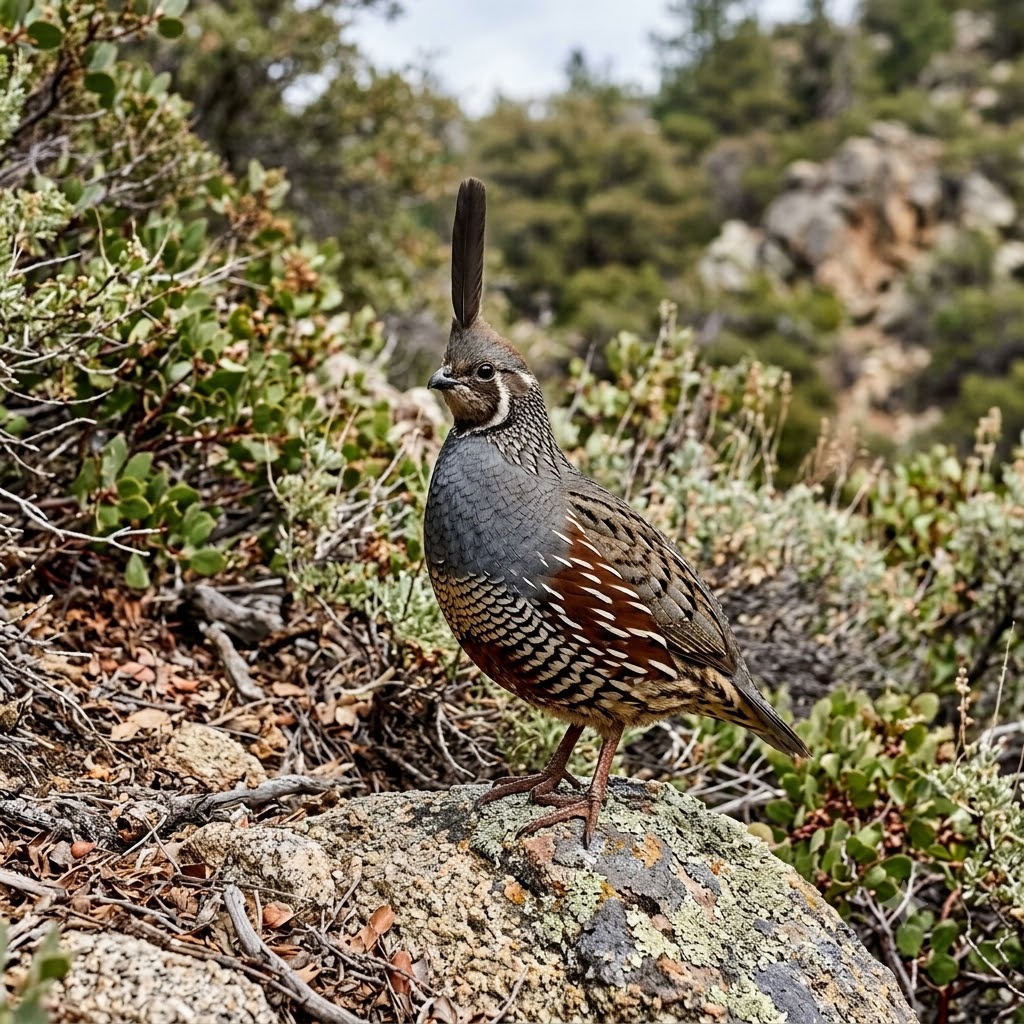
The mountain quail is a plump, handsome bird weighing around half a pound, noticeably larger than a California or bobwhite quail. Its most striking feature is a long, straight head plume, unlike the curved topknot of the California quail. The body shows a slate-blue breast, a rich chestnut throat patch bordered in white, and bold chestnut-and-white barring on the flanks. The sexes look similar, which is unusual among quail. In its steep brushy home the bird is far more often heard than seen, giving a loud, clear single-note call.
Range & Habitat (US)
Mountain quail are birds of the far West, found through the mountains of California, Oregon, Washington, western Nevada, and into parts of Idaho and Baja-adjacent ranges. They favor steep slopes cloaked in dense brush, chaparral, mountain shrub, and the edges of coniferous forest, often near water. They range from foothill canyons up to high elevations in summer, then drift downhill as snow deepens. Thick, tangled cover on broken terrain is the signature mountain quail landscape, and the birds rarely stray far from it.
Behavior & Sign
Mountain quail live in coveys for much of the year and prefer to escape danger by running uphill through cover rather than flushing. When pressed hard they burst into flight, but their first instinct is their legs. They feed on seeds, berries, bulbs, leaves, and insects, working the ground beneath brush. Useful sign includes tracks and scratchings in dust or soft soil near water, droppings under roosting cover, and the birds' own loud call echoing across a canyon. Following that call to its source is often the only way to locate a covey.
Hunting Seasons & Timing
Mountain quail seasons generally open in the fall and can run into winter where regulations allow, overlapping with other western quail and upland seasons. Early season finds coveys higher on the slopes in dense summer cover, while later hunts may find birds pushed lower by cold and snow. Because of the terrain and the birds' running habit, hunting is demanding at any time of year. Bag limits are typically modest. Always confirm your state's exact dates, zones, and limits before heading into the mountains.
Hunting Methods
Hunting mountain quail is a walk-up affair on steep ground, and locating birds by their call is often the key. Once a covey is found, the challenge is getting above or ahead of running birds before they scatter uphill. A well-trained flushing or pointing dog is enormously helpful, both for pinning running coveys and for recovering birds in thick brush. Without a dog, hunters try to work up-slope to cut off the birds' escape route. Expect covey flushes to be sudden, brief, and offered through heavy cover.
Where to Find Them - Reading the Terrain
Concentrate on steep, brushy slopes near water, especially spring seeps, creek bottoms, and green draws in otherwise dry country. Edges where chaparral meets timber or open ground are prime, as are old burns growing back into thick shrub. Listen for calling birds and let sound guide you across canyons. In early season, hunt higher slopes with dense summer cover; as cold sets in, work downhill toward foothill canyons where birds retreat. Broken, tangled terrain that looks too rough often holds the most birds.
Gear & Optics Needed
This is punishing terrain, so the priority is footwear and fitness: sturdy boots with good grip for steep, loose slopes. Brush pants or chaps protect the legs from chaparral. A light, quick-pointing shotgun suits the fast, close flushes in cover. Carry ample water, since you will climb hard, and pack a game bag to keep birds cool. Blaze orange improves safety in thick brush where hunters and dogs can be hard to see. Compact binoculars help you scan slopes and pick out cover and water sources across a canyon.
Shot Placement & Field-Dressing / Cleaning
Mountain quail are wingshooting birds taken on the flush with a shotgun, and shots are usually quick and through brush, so a smooth, fast swing matters more than a long lead. Keep shots within a sensible range in heavy cover. After recovery, most hunters breast the bird out, though the small whole birds also roast well. Keep the meat clean and dry, get it into a game bag out of the sun, and cool it promptly. On warm early-season days, prompt cooling protects the quality of the delicate meat.
Meat & Eating Quality
Mountain quail are considered excellent eating, with fine, mild, light-colored meat like other quail but from a larger bird, giving a more satisfying portion. The flavor is clean and delicate, and the meat is tender when not overcooked. Because the birds are lean, quick cooking methods that keep the meat moist work best. Many upland hunters rank the mountain quail among the finest of the western game birds on the table, a fitting reward for a hard hunt.
Common Mistakes
The biggest mistake is treating mountain quail like flushing bobwhites. These birds run uphill, so hunters who wait for a classic flush often watch the covey vanish through the brush on foot. Failing to get above running birds is a common frustration. Underestimating the terrain and running out of water or energy ends many hunts early. Shooting into thick brush at unseen birds is unsafe and unproductive. Finally, ignoring the birds' calls means passing right by coveys that could have been located by sound.
Regulations & Conservation Note
Mountain quail populations are generally stable across much of their range, though local numbers depend heavily on habitat quality and water. Always carry required licenses, follow bag limits, and check zone-specific rules, since seasons and boundaries vary across western states. Practice fair chase, respect private and public land rules, and avoid damaging fragile slopes and water sources. Supporting habitat and watershed conservation in western mountains helps sustain these birds. Wear blaze orange in brush where visibility is limited and other hunters or dogs may be near.
Best Suited For
Mountain quail hunting is best suited to fit, determined hunters who relish steep terrain and a real physical challenge. It rewards good boots, endurance, and the willingness to climb toward calling birds more than easy shooting. It is an ideal pursuit for the adventurous upland hunter who wants a wild, hard-earned bird in spectacular western country, and it pairs well with a capable brush-busting dog.
FAQ
Do I need a dog to hunt mountain quail? Not strictly, but a good flushing or pointing dog makes a huge difference. Mountain quail run and hide in thick brush, so a dog helps pin coveys and recover downed birds. Many hunters find the birds far harder without one.
Why are mountain quail so hard to hunt? They live on steep, brushy slopes and prefer to escape by running uphill rather than flushing. The combination of rugged terrain, dense cover, and running birds makes them one of the most challenging upland birds in the country.
How do I find a covey? Listen. Mountain quail give a loud, clear single-note call that carries across canyons. Following that sound, then trying to get above the birds, is often the most reliable way to locate and hunt a covey.
Are mountain quail good to eat? Yes, they are considered excellent. Being the largest US quail, they offer a more generous portion of fine, mild, light-colored meat. Quick cooking that keeps the lean meat moist gives the best results.
When is the best time to hunt them? Early season often finds coveys higher in dense summer cover, while colder weather pushes birds downhill toward foothill canyons and water. The terrain is demanding in any season, so timing often comes down to conditions and access.