Spruce Grouse
The spruce grouse is a bird of the deep northern conifer forest, and hunting it is as much about getting into wild country as it is about the shooting.
🗓️ Last reviewed: June 2026
Overview
The spruce grouse is a bird of the deep northern conifer forest, and hunting it is as much about getting into wild country as it is about the shooting. It lives in the spruce and fir of the boreal woods - across Alaska and Canada and reaching down into the northern United States in places like northern New England, the upper Great Lakes, and the high country of the Rockies. Its reputation precedes it: the spruce grouse is famously tame, so much so that old-timers called it the "fool hen." That tameness is not stupidity but strategy - the bird trusts its camouflage and sits tight rather than flushing. For a hunter, that changes the whole game. This is a walk-up bird in remote conifer country, often hunted on foot while covering ground for ruffed grouse, and it rewards a willingness to go where few others bother to.
Identification & Appearance
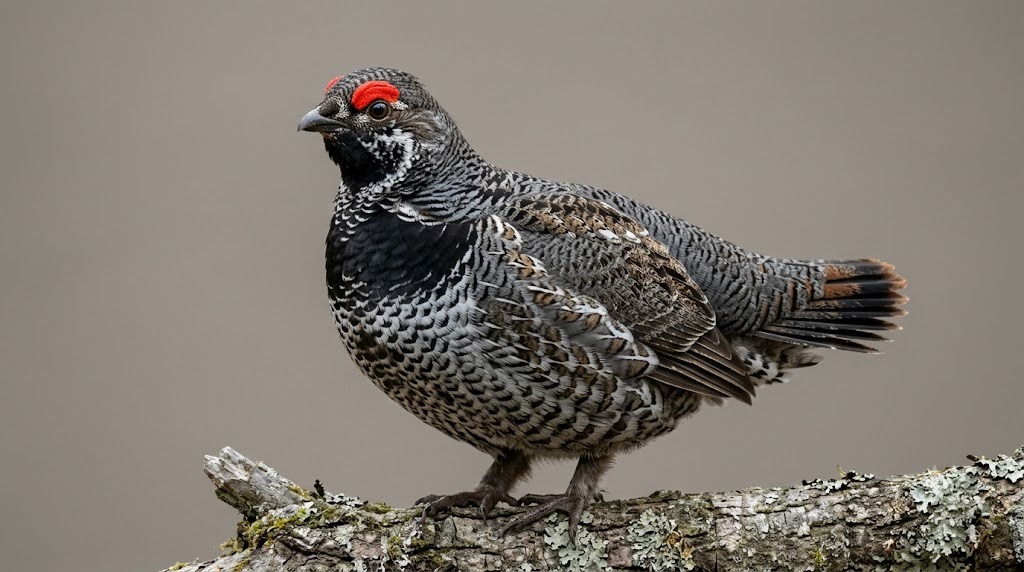
The spruce grouse is a compact, dark grouse, noticeably darker overall than the ruffed grouse it sometimes shares cover with. The male is slaty gray and black with a black throat and breast bordered by white-tipped feathers, fine barring along the flanks, and - the giveaway - a bare patch of red skin above each eye, the red comb, which becomes especially vivid in spring. The tail is dark, often tipped with a chestnut or rusty band depending on the population. The hen is mottled brown and gray, well barred, and built for disappearing against the forest floor and low conifer branches. Both sexes are well camouflaged in the dappled light of spruce and fir. Where ranges overlap with ruffed grouse, the spruce grouse's darker color, red eye comb on males, and habit of sitting tight rather than thundering off help tell them apart.
Range & Habitat (US)
In the United States the spruce grouse is a northern and high-country bird, tied closely to boreal and sub-boreal conifer forest. It is found in the northern reaches of New England - parts of Maine, New Hampshire, and Vermont - across the northern Great Lakes states such as Michigan, Wisconsin, and Minnesota, and in the conifer forests of the northern Rocky Mountains in Montana, Idaho, and into the high country farther west. North of the border and in Alaska it is far more widespread. Throughout its range it favors dense stands of spruce, fir, and sometimes pine, often near bogs, muskeg, and the edges of openings. It is rarely a bird of farmland or hardwoods. Because its US range is patchy and lies at the southern edge of a largely Canadian and Alaskan distribution, local populations can be thin, and the bird is protected or closed to hunting in some states - always check before you go.
Behavior & Sign
The spruce grouse is sedentary, quiet, and slow to flush, spending much of its time on the ground or perched low in conifers, where it feeds heavily on the needles of spruce, fir, and pine - especially in winter. This conifer diet is part of what shapes both its behavior and, later, its flavor at the table. Rather than exploding into flight like a ruffed grouse, a spruce grouse will often freeze, relying on its camouflage, or walk away quietly, or flush only a short distance to a nearby branch and sit there watching. Sign is subtle: look for droppings beneath favored roost conifers, often a scattering of fibrous, needle-rich droppings, and for dusting spots along sandy trails and road edges. Birds are frequently encountered along the edges of logging roads and trails through conifer country, picking grit. Quiet walking and a careful eye matter more than any noise-driven flush.
Hunting Seasons & Timing
Spruce grouse, where they may be hunted, are generally an upland bird taken in the fall, and seasons are set by each state - often overlapping with the ruffed grouse season in the same northern country. Timing is straightforward: fall, once seasons open, is the window, and many birds are taken incidentally while a hunter is working conifer edges for ruffed grouse. The critical point is that the spruce grouse is not legal to hunt everywhere within its US range. Some states protect it entirely, and others fold it into a grouse season with specific limits. Because populations at the southern edge can be sensitive, seasons and bag limits exist to keep harvest sustainable. Always confirm your specific state's rules - whether the bird is open at all, the dates, the bag limit, and any species-specific restrictions - before heading out.
Hunting Methods
This is a walk-up hunt, plain and simple. The standard method is to cover ground on foot through spruce and fir, along logging roads, trail edges, bog margins, and the seams between conifer stands and openings, watching closely for birds on the ground, picking grit on the road, or perched low in the trees. Because the spruce grouse sits tight and flushes reluctantly, the challenge is often spotting the bird before you are right on top of it. A flushing dog can help locate birds in thick cover, though many hunters simply still-hunt slowly and let their eyes do the work. When a bird does flush, it is usually a short, close flight to a nearby conifer, so shots tend to be quick and at modest range. Much of the day is spent walking good country, and the spruce grouse is frequently a bonus bird while hunting ruffed grouse in the same northern forest.
Where to Find Them - Reading the Terrain
Read the forest for conifers and you will find spruce grouse. Focus on dense stands of spruce and fir, the margins of bogs and muskeg, and the brushy edges where thick conifer cover meets a clearing, a cut, or a trail. Logging roads and sandy trail edges through conifer country are prime, because birds come out to pick grit and dust, especially morning and evening. Young, regenerating conifer stands and the low boughs of mature spruce both hold birds. Avoid open hardwoods and farmland - this is not their cover. In the mountains, look to the conifer zones at elevation; in the north woods, look to the spruce-fir flats and bog edges. The pattern to remember is simple: thick conifers for security and food, with grit-picking edges nearby.
Gear & Optics Needed
Spruce grouse hunting rewards simplicity and good legs over fancy gear. A light upland shotgun in 20 or 12 gauge with an open choke - improved cylinder or even skeet - suits the close, quick shooting in tight cover, paired with a light upland load in a size such as 6 or 7.5. Because much of the hunt is covering ground in remote conifer country, the most important kit is what keeps you comfortable and oriented on foot: sturdy boots, brush-resistant pants, layered clothing for cold northern days, and reliable navigation - a map and compass or GPS - since this is easy country to get turned around in. A blaze-orange hat or vest is wise and often required. Optics are minimal; you are hunting close, not glassing, though a small compass and a way to mark your truck are worth more than binoculars here.
Shot Placement & Field-Dressing / Cleaning
Spruce grouse are taken on the wing with a shotgun, so "placement" comes down to a clean gun mount and a quick, controlled swing on a bird that usually flushes close and flies a short distance to cover. Shots are typically quick and at modest range, so an open choke and a steady swing matter more than reach. After recovery, the bird is field-dressed and cleaned like other upland grouse: most hunters either breast out the bird - removing the two breast fillets - or pluck and draw it whole for the table. As always, cool and keep the meat clean once the bird is down. Because the spruce grouse winters on conifer needles, how you handle and cook the meat has a real bearing on how it eats, which is worth knowing before the hunt.
Meat & Eating Quality
Honesty matters here: the spruce grouse is an acquired taste. Its heavy diet of spruce and fir needles, especially in fall and winter, can give the dark meat a resinous, piney flavor that not everyone enjoys - a real contrast to the mild, prized meat of a ruffed grouse. Birds taken earlier in the fall, or those that have been feeding on berries rather than straight conifer needles, tend to be milder, and careful preparation - removing fat and skin, soaking, or cooking with strong accompaniments - can tame the flavor for those who want to try. Some hunters genuinely like it; others find it strong. None of this is a reason to waste the bird, but it is a reason to set expectations and handle the meat thoughtfully rather than expecting it to eat like a ruffed grouse.
Common Mistakes
The most common mistake is confusing tameness with a sure thing and getting careless. A spruce grouse that sits tight still has to be hunted ethically and taken cleanly on the wing, not treated as a target sitting on a branch. Another mistake is hunting the wrong cover - working hardwoods and open ground instead of the dense spruce and fir and the grit-picking road edges where the bird actually lives. Hunters new to the north woods also underestimate the country itself, heading into remote conifer flats without proper navigation, layers, or a plan, which is more dangerous than any difficulty the bird presents. And perhaps the biggest mistake of all is failing to check the regulations: the spruce grouse is protected in some states and open in others, and shooting one where it is closed is a serious error.
Regulations & Conservation Note
The spruce grouse is managed at the state level across its patchy US range, and its legal status varies significantly. In some states it is fully protected and may not be hunted; in others it is a legal upland bird with its own season and bag limit, often shared with ruffed grouse. Because the bird sits at the southern edge of a largely Canadian and Alaskan distribution, and because it depends on specific boreal conifer habitat that can be lost to logging and development, local populations can be sensitive. Hunters must hold a valid state hunting license and follow all season dates, shooting hours, and bag limits. The single most important step is simply to confirm whether the spruce grouse is open where you intend to hunt - and to leave it be where it is protected. Respecting these rules is what keeps fragile edge populations intact.
Best Suited For
Spruce grouse hunting is best suited to the hunter who values wild, remote country and a walk-up hunt on foot over fast action and a full game bag. It fits those already chasing ruffed grouse in northern conifer forest, who welcome a dark, tame, hard-to-spot bonus bird and the chance to hunt deep boreal cover. It rewards good legs, sharp eyes, and a willingness to learn the bird's quirks - including its strong, acquired-taste meat. It is a thoughtful, low-volume hunt for someone drawn to the north woods themselves as much as to the bird.
FAQ
Why is the spruce grouse called the "fool hen"? Because it is famously tame and reluctant to flush. Rather than exploding into flight, it tends to freeze, walk away, or fly only a short distance to a nearby branch and sit there, trusting its camouflage. That habit makes it seem fearless or foolish, but it is really a survival strategy built around hiding rather than fleeing.
Can I hunt spruce grouse everywhere it lives in the US? No. The spruce grouse is protected in some states and legal to hunt in others, often within a shared grouse season with its own limits. Its US range is patchy and lies at the southern edge of a mostly Canadian and Alaskan distribution, so always confirm your specific state's regulations before hunting.
How do I tell a spruce grouse from a ruffed grouse? The spruce grouse is darker overall, the male has a bare patch of red skin above each eye, and the bird tends to sit tight rather than flush explosively. A ruffed grouse is browner, lacks the red eye comb, and typically thunders off in a fast flush. Where ranges overlap in northern conifer country, color and behavior are your best clues.
What does spruce grouse taste like? It is an acquired taste. Its heavy winter diet of spruce and fir needles can give the dark meat a resinous, piney flavor that some hunters enjoy and others find strong. Birds taken earlier in fall or feeding on berries tend to be milder, and careful cleaning and cooking can help tame the flavor.
Do I need a dog to hunt spruce grouse? No. Many hunters simply still-hunt slowly through conifer cover and along trail edges, letting their eyes find birds on the ground or perched low. A flushing dog can help locate birds in thick cover, but it is not necessary for this walk-up hunt.