Coyote Night Hunting: Calls, Lights, Thermals
Most coyotes that die from a bullet die between dusk and dawn. Night hunting puts you on the predator's schedule - but it requires gear, calling tactics, and legal knowledge…
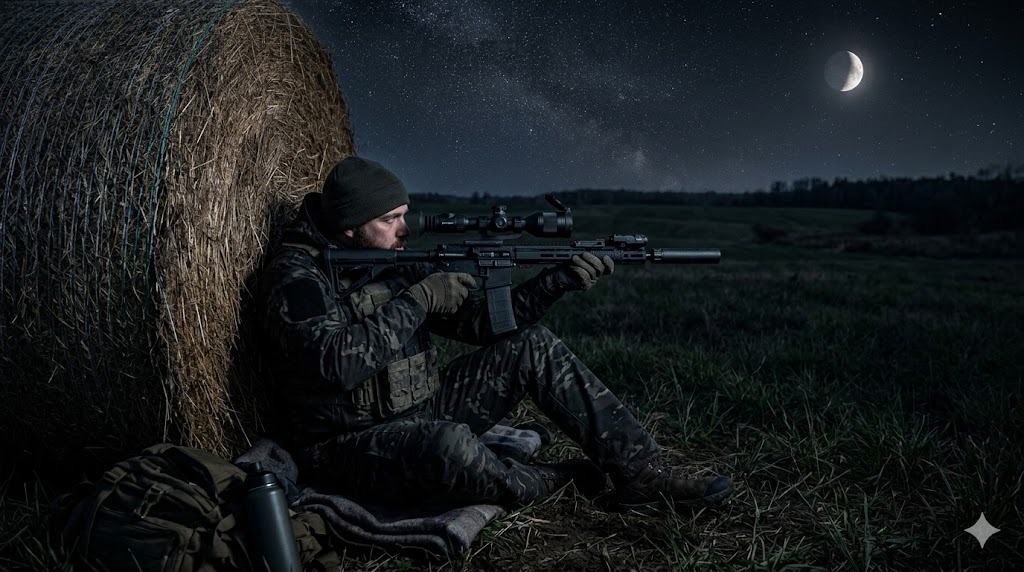
Most coyotes that die from a bullet die between dusk and dawn. They’ve learned daytime is dangerous, and they shift their movement, hunting, and mating behavior into the dark hours. Our coyote species profile breaks down that behavior in detail. Night hunting puts you on the predator’s schedule, dramatically increases response to calls, and is some of the most exciting hunting in North America. But it requires the right gear, calling tactics, and a careful read of your state’s regulations before you ever leave the truck.
Know the Law Before You Buy a Light
Night hunting regulations for coyotes vary wildly. In Texas, Arkansas, Louisiana, and large parts of the Southeast, year-round night hunting with lights or thermal is broadly legal on private land. Many Western states allow it during specific seasons or with a free permit. Some Northeastern states require headlamps only, ban thermal entirely, or require notification of the local game warden.
Before you spend a dollar, read your state’s regulations carefully, then call the wildlife agency to confirm. Rules change yearly, and “I didn’t know” is not a defense.
Two Optics Paths: Lights vs Thermal
There are two ways to see a coyote at night: artificial light or thermal imaging.
Lights are cheap and effective. A quality red or green hunting light (Cyclops, Wicked Lights, Predator Tactics) mounted on the rifle or a tripod throws 200-400 yards. Coyotes typically don’t spook from red or green light if you slowly raise the intensity. The advantage is cost - a complete light setup runs $150-400. The drawback is you can only see what the beam illuminates, and the coyote can see the beam too.
Thermal is a game changer. A thermal scope (Pulsar Thermion, ATN ThOR LT, AGM Rattler) sees heat signatures with no visible light at all. You can scan 400+ yards across pasture in any direction and spot a coyote bedded in cover. Entry-level thermal scopes start around $1,800; mid-tier rigs run $3,500-6,000. Add a thermal monocular (Pulsar Helion, AGM Asp) for scanning, and you’re looking at a serious investment - but the success rate is night and day.
For a beginner, start with a red light setup and graduate to thermal once you know you’ll stay with it.
Rifle and Cartridge Choices
Coyote night rifles overlap heavily with daytime predator rifles. The classics are still classics:
- .223 Remington / 5.56: cheap ammo, low recoil, plenty of energy out to 300 yards
- .22-250 Remington: flat-shooting, hard-hitting, fur-friendly with the right bullet
- 6mm ARC, 6.5 Grendel: newer chamberings with great ballistics in AR-15 platforms
- .243 Winchester: bolt-gun standard that doubles as a deer rifle
Pair with 40-55 grain hollow points or polymer-tipped varmint bullets, depending on whether fur recovery matters. AR-15s shine at night - fast follow-ups when doubles come in matter more than you’d think.
The Standard Calling Sequence
Coyotes respond to two main categories: prey-in-distress sounds (cottontail, jackrabbit, rodent) and coyote vocalizations (howls, challenges, pup distress). At night, vocalizations work better than they do during the day because coyotes are more vocal and territorial after dark.
A solid sequence:
- Locator howl - one long howl to make local coyotes answer or commit
- Wait 2 minutes - scan with thermal or sweep the area methodically
- Distress sounds - 30-45 seconds of jackrabbit distress, then pause
- Repeat distress - 2-3 cycles over 10-15 minutes
- Pup distress finisher - often pulls in coyotes that hung up at 300 yards
Stay on a stand 20-30 minutes minimum. Coyotes coming from a mile away need time.
Wind, Position, and Approach
The single biggest mistake in coyote hunting is ignoring wind. Coyotes circle downwind nearly every time. Set up so the open lane you’re calling into is crosswind or upwind, with a thermal-scanning lane downwind to catch the circler. Approach the stand against the wind, kill engine and lights well back from the call site, and walk in quietly with red headlamps only.
Elevate when possible - a low rise, irrigation berm, or pickup bed adds visibility and helps with thermal scanning over brush.
FAQ
What color light spooks coyotes least? Red is the traditional answer; green is now equally accepted. Both outperform white. Use the lowest intensity that lets you make the shot.
Do I need a suppressor for night hunting? No, but it’s a huge advantage. Suppressors reduce report, protect hearing, and often let you stay on a stand for a second coyote.
Can I use a regular rifle scope with a clip-on thermal? Yes. Clip-on thermals (Pulsar Krypton, AGM Rattler TC) attach in front of your daytime scope and turn it into a thermal at night, preserving your zero.
What about full moon nights? Full moons make calling tougher because prey species are more active and coyotes are less hungry. Dark moon phases generally outperform full moons.
Is thermal worth it for occasional hunters? If you hunt 5+ nights per season, yes. Below that, a quality red light setup makes more financial sense.
Conclusion
Night coyote hunting is the most exciting predator pursuit in North America. Verify your state regs, pick lights or thermal based on budget and frequency, and master a simple calling sequence before you spend on bells and whistles. Hunt the wind religiously, stay disciplined on the call, and you’ll fill a freezer of stretched fur faster than any daytime calling will deliver.
🛒 Recommended Gear on Amazon
- Red coyote hunting light - browse current options and reviews on Amazon.
- Electronic predator call - browse current options and reviews on Amazon.
- Shooting sticks - browse current options and reviews on Amazon.
As an Amazon Associate, we earn from qualifying purchases - at no extra cost to you. This helps us keep producing free, in-depth guides.