Game Carts for Retrieval
Dragging a 180-pound buck out of the woods is unnecessary punishment. A quality game cart turns a 90-minute drag into a 20-minute walk…
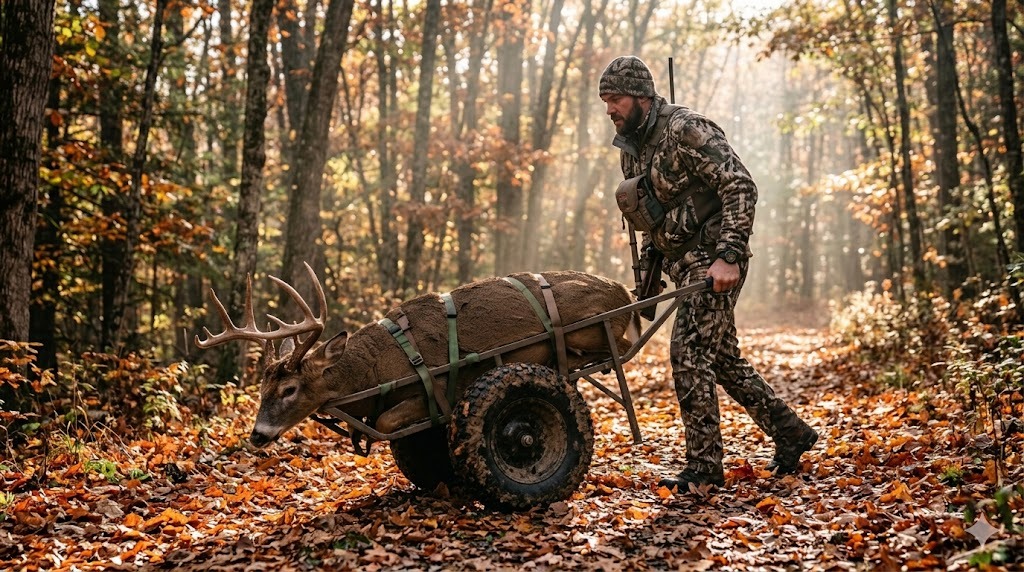
The best game cart is set by your terrain: a single-wheel cart for narrow, rocky trails, a two-wheel cart for roads and open ground, and an ATV-style carrier for moving multiple deer across flat country. On any of them, big pneumatic wheels are the single spec that matters most.
Dragging a 180-pound buck a mile through hardwoods is the kind of unnecessary suffering that ends with pulled backs, blown knees, and at least one season-ending injury per year. A quality game cart turns that 90-minute drag into a 20-minute walk and lets a single hunter recover game alone. This guide breaks down the categories, what wheels matter, and how to pick the right cart before you need it.
When You Actually Need a Cart
Game carts justify themselves when:
- You hunt alone more than occasionally
- You take deer/elk 1/4 mile or more from your vehicle
- Terrain is moderate - flat to rolling hills, established trails, logging roads
- You don’t always have ATV access to recovery sites
- Your back, knees, or shoulders aren’t 100%
For ridge-top mountain hunters or backcountry-only hunters who pack out boned meat, a cart is rarely useful - you’ll use packs and a solid backcountry pack-out checklist instead. For most eastern and midwestern whitetail hunters and many western mule deer hunters, a cart is one of the best investments in your gear closet.
Single-Wheel Game Carts
A single-wheel cart looks like a wheelbarrow with the load behind the wheel. Sometimes called a “deer cart” or “game cart wheelbarrow” - one operator pushes from behind, with the wheel directly under the center of the load.
Pros:
- Tracks through narrow trails - handles spaces too tight for a two-wheel cart
- Negotiates roots, ruts, deadfall by lifting one end at a time
- Lightweight - typically 25-40 lbs
Cons:
- Requires balance and continuous operator engagement
- Sidehill or wet conditions can cause tipover
- Limited capacity - typically 250-400 lbs
Best models:
- Maximal Game Cart - solid construction, removable wheels
- Hawk Crawler MOAB - premium, deep tire tread
- Big Game/Cabela’s Magnum - affordable, durable
Single-wheel carts are the ideal compromise for hunters in thick eastern woods with established trails.
Two-Wheel Game Carts
A two-wheel cart sits on two side-mounted wheels with a frame carrying the load between them. Some have handles like a wheelbarrow; others have a long pull bar.
Pros:
- Stable - won’t tip on flat ground
- Higher capacity - up to 600 lbs
- Easier on the operator - less balance work
- Can be towed behind ATV or bicycle in some designs
Cons:
- Wider - won’t fit through some trails
- Heavier - typically 35-60 lbs
- Harder over deadfall and stumps
Best models:
- Rambo R187 Game Hauler - premium with steel frame
- Tarter Farm Wagon - agricultural duty, hauls everything
- Cabela’s Trophy XL - practical, lightweight aluminum
Two-wheel carts dominate in open-country and farm-field hunting.
Wheels: The Most Important Spec
The wheels make or break the cart. Three primary types:
Pneumatic (inflatable) tires - rubber tires with air, like a wheelbarrow. Best ride quality, best rolling resistance on soft ground, but can puncture on thorns and deadfall. Most popular for casual use.
Solid/airless tires - foam-filled rubber. Heavier, slightly rougher ride, but immune to punctures. Worth the upgrade if you hunt thorny terrain.
Plastic/composite hub with rubber tread - cheapest, fine for grass and gravel, terrible on roots and rocks.
Tire diameter matters enormously. Larger wheels (16-20 inches) roll over obstacles cleanly; smaller wheels (10-13 inches) get stuck on every stick. For real terrain, 18+ inch wheels are mandatory.
Frame Material
Steel - heaviest, strongest, often cheapest. Rusts unless coated. Aluminum - light, expensive, doesn’t rust, can flex under heavy loads. Polymer composite - light, weatherproof, brittle on impact.
For most hunters, powder-coated steel with aluminum components is the sweet spot of durability vs weight.
ATV-Style and Wheeled Carriers
For flat-country hunters with frequent recoveries, towable wagons attached to ATVs or UTVs eliminate the human-powered cart problem entirely. Models from Polar, Rugged Terrain, and Yutrax handle 800-1,500 lbs easily.
A simple cargo trailer behind an ATV is the ultimate “game cart” for the right terrain - load a whole deer in one trip, drive home, done.
Specialty Carts
Snow sleds: For deep-snow recoveries, a plastic sled (Otter Sport, Jet Sled) hauls a whole deer over snow faster than any wheeled cart. Pull with a rope harness or carabiner to a pack.
Backpack frame haulers: For hunters who prefer pack work, a freight pack frame (Eberlestock, Kifaru, Mystery Ranch) carries a quartered deer or elk on your back. Not technically a cart but the same problem-solver.
E-bikes: Increasingly popular for accessing hunting areas. Quality electric hunting bikes (QuietKat, Rambo, Bakcou) carry hunter, gear, and even towed game carts through trails closed to ATVs. $2,500-6,000.
Loading Technique
Putting a 180-lb deer on a cart solo is its own skill. Process:
- Position cart parallel to deer, wheels chocked or against a tree
- Position deer with feet pointed up the cart slope
- Tilt cart down toward deer’s back
- Use legs and back position to roll deer onto frame
- Strap deer to cart with two ratchet straps minimum
For elk or larger game, quarter the animal first; loading a whole bull elk on a wheeled cart is impractical for one person.
Strap and Lash Selection
A poorly strapped deer falls off carts during the haul, often into mud. Use:
- Two 1-inch ratchet straps minimum - over body, around legs
- Bungee net as backup for small items (cape, organs)
- Game bag under the carcass to keep it clean
Storage and Maintenance
Most game carts assemble and disassemble for storage. Practice the disassembly before season - fumbling with quick-pins in cold weather after a long drag is a frustration multiplier.
- Hose off blood and mud after each use
- Lubricate axles annually
- Patch or replace tires that lose air
- Store dry - pneumatic tires deteriorate in sunlight
FAQ
What’s the average cost of a good cart? $120-250 for a quality single-wheel cart; $200-500 for a quality two-wheel cart; $400-1,500 for ATV-towable wagons.
Can a cart fit in my truck? Most disassemble to fit a pickup bed or even an SUV. Verify packed dimensions before buying.
Are folding/breakdown carts as strong? Quality breakdown carts are nearly as strong as fixed frames. Cheap folding carts fail under load - buy reputable brands.
Do game carts work in mud? Two-wheel carts struggle in deep mud. Single-wheel carts handle mud better with momentum. Tracked sled or ATV is best for swampy ground.
Can I use a kid’s wagon? For small game and short distances on flat ground, sure. For deer in the woods, no - wagon wheels and frames aren’t built for the loads or terrain.
Conclusion
For most hunters, a quality single-wheel cart with 18+ inch pneumatic or solid tires handles 90% of game recovery duties. Two-wheel carts win on open country and farm land. ATV wagons solve the problem entirely in flat country. Buy a cart before you need it, practice loading it before the season, and store it where you can grab it at 9pm in the rain. The recovery is the hardest part of any hunt - make it the easiest you can.
🛒 Recommended Gear on Amazon
- Deer game carts - browse current options and reviews on Amazon.
- Deer drag harness - browse current options and reviews on Amazon.
- Ratchet straps - browse current options and reviews on Amazon.
As an Amazon Associate, we earn from qualifying purchases - at no extra cost to you. This helps us keep producing free, in-depth guides.