Hunting Dog Training Basics
A well-trained hunting dog doubles your success and triples your enjoyment. Start with obedience, build to retrieves and finds, and avoid the rookie mistakes…
A well-trained hunting dog doubles your success rate and triples your enjoyment in the field. A poorly trained dog ruins hunts, embarrasses you in front of friends, and develops bad habits that take years to undo. The good news: 80% of a hunting dog’s value comes from foundation obedience that any owner can install at home with daily 15-minute sessions. This guide covers the training principles, drills, and milestones for retrievers, pointers, and flushing breeds - plus the mistakes that derail more pups than anything else.
Choose the Right Breed for Your Hunting
Match the breed to your bird:
Pointing breeds (English setter, German shorthaired pointer, English pointer, Brittany, Vizsla, Weimaraner): Range wide, find birds, point until you flush. Best for upland - pheasant, bobwhite quail, grouse, chukar.
Flushing breeds (English springer spaniel, cocker spaniel, Labrador retriever in flushing role): Work close, kick birds up in shotgun range, retrieve. Versatile and family-friendly.
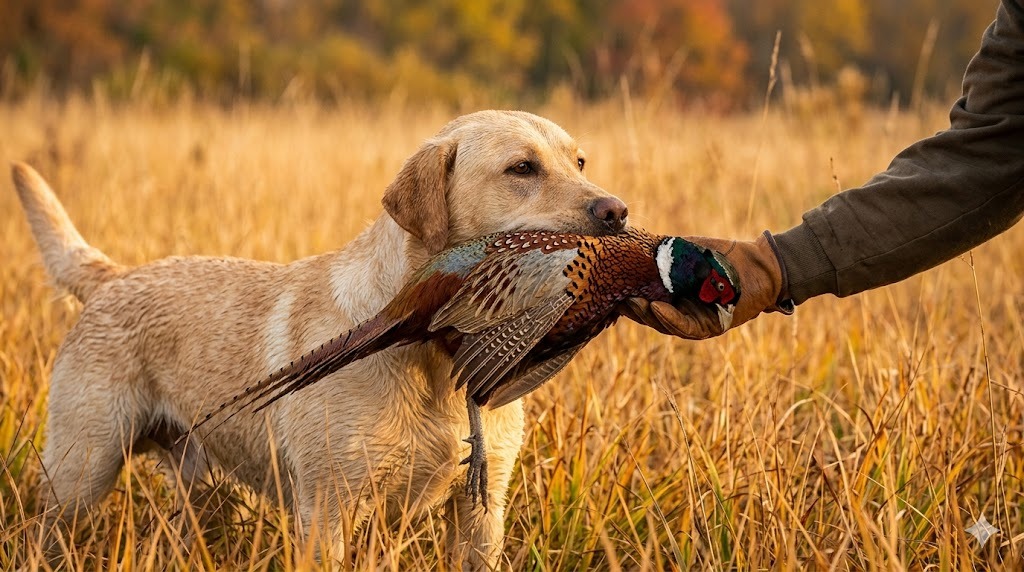
Retrievers (Labrador, golden retriever, Chesapeake Bay retriever): Wait at the blind or boat, then retrieve downed birds. Waterfowl specialists built for mallards and divers; many also flush upland.
Versatile breeds (German wirehaired pointer, Drahthaar, Pudelpointer, Spinone Italiano): Point, retrieve, water work. Great for hunters who do everything.
Pick a breed that matches your hunting style - a wide-ranging GSP frustrates a thick-cover whitetail hunter; a close-working Lab disappoints a quail walker. Browsing the upland bird guides is a good way to see which species your prospective dog will actually work.
Start with Obedience, Not Hunting
The biggest mistake new dog owners make is rushing to hunt before the dog can sit, come, and wait reliably. Without obedience, no advanced training works.
Master these four commands by 4 months of age:
- Sit - stays sitting until released
- Here (or “come”) - returns instantly to a whistle or voice command
- Heel - walks at your side off-leash
- No or leave it - stops a behavior immediately
15 minutes a day, every day, for three months. Use treats, toys, and praise. Avoid harsh corrections at this age - you’re building trust, not fear.
Introduce Birds Early but Carefully
By 8-12 weeks, expose the puppy to bird scent and feathers. Use a frozen pigeon wing on a string, a dead pigeon to nose-test, and dummy birds with quail or pheasant scent.
Critical: Never let the puppy chew, mouth roughly, or chase birds aggressively. Mouthing breaks bird-handling instincts and creates “hard-mouth” dogs that destroy retrieves.
Keep early bird exposure short, positive, and exciting. A frantic 90-second introduction to a fresh pigeon followed by lavish praise builds drive without bad habits.
Force-Fetch (Trained Retrieve)
For dedicated retrievers and versatile breeds, force-fetch (also called “trained retrieve”) teaches the dog that fetching is a command, not a choice. It’s the most controversial part of hunting dog training - done correctly it produces utterly reliable retrievers; done poorly it breaks dogs.
The classic methodology:
- Hold conditioning - dog learns to hold an object in its mouth without dropping until released
- Reach - dog reaches forward to take an object from your hand
- Fetch - dog steps forward and picks up an object on command
- Pile work - dog retrieves objects from a pile at varying distances
- Marked retrieves - dog watches an object fall and retrieves it
Most owners hire a professional trainer ($800-2,500) for force-fetch. The 6-8 week program with a pro produces a finished retriever that can’t be replicated by amateur effort.
Pointing Breed Training
Pointers need different drills:
Standing the bird: Use a check cord and homing pigeons to teach the dog to point and hold, not bust the bird. When the dog points, you walk past and flush the bird - the dog should remain on point throughout.
Whoa command: Teach the dog to stop immediately and stand still. The “whoa” command stops a dog mid-charge and is the foundation of bird-broken pointing.
Steady to wing and shot: Advanced - the dog stays on point through bird flush, gun fire, and bird fall. Only then is the dog released to retrieve.
Pointing breed work usually takes 12+ months from puppy to bird-broken hunter. Many owners use a professional trainer for the final polish.
E-Collar Use
Electronic training collars (Garmin Sport Pro, Dogtra, SportDog) are essential tools for serious hunting dog training. They are not torture devices when used correctly - they’re remote reinforcement that lets you communicate at distance.
Rules:
- Introduce collar correctly - start at the lowest stimulation level the dog feels, never use high settings on first exposure
- Pair collar with known commands - use stim only on commands the dog already knows
- Never use to vent frustration
- Combine with positive reinforcement - collars correct, treats and praise reward
Get help from a competent trainer for first collar use. A bad first experience can ruin a dog permanently.
Water Introduction
For retrievers, water training is foundational. Introduce water in summer when temperature is comfortable:
- Walk into shallow water with the puppy following you naturally - wade, splash, play
- Toss a floating bumper a short distance - let the dog retrieve
- Gradually extend distance over weeks
- Add cover, current, decoys, and gunfire progressively
Never force a puppy into deep water. Bad first experiences create water-shy dogs.
Gunfire Introduction
This is where many dogs are ruined. Gun shyness happens when a puppy is exposed to loud bangs without conditioning.
Correct method:
- Start with a cap gun or starter pistol at 100+ yards while the puppy eats a meal
- Gradually move closer over weeks - only if puppy continues eating happily
- Progress to 20-gauge at 50 yards, then 12-gauge
- Always pair gunfire with positive outcomes - birds, food, retrieves
Never fire a shotgun near a puppy’s head. Never assume “she’ll get used to it.”
Field Conditioning
Hunting dogs need physical conditioning before season. Build up gradually:
- Pre-season (8 weeks out): 30-minute walks, swimming, easy retrieves
- 6 weeks out: 45-minute runs, water work, bird drills
- 4 weeks out: Full-day hunting simulation, multiple retrieves
- 2 weeks out: Tapering, recovery, joint health
An out-of-shape dog injures easily and tires fast. Pad and footpad conditioning takes weeks of natural ground work - start early.
Common Mistakes
- Hunting before obedience is solid - every bad habit cements in the field
- Letting the dog chase non-game (rabbits, deer, songbirds) - kills focus on game birds
- Inconsistent commands - different family members using different words
- Skipping force-fetch on retrievers - leads to lost birds
- Over-correcting young dogs - breaks confidence and drive
- Hunting alone with an untrained dog - bad behaviors lock in without correction
FAQ
How old should a dog be before hunting? Most breeds physically ready at 12-18 months. Pointers benefit from holding off until 18-24 months for steadiness work.
Can I train my dog myself? Yes, with consistent daily work and good books/videos (Hunt Smith, Bob West, Maurice Lindley). For force-fetch and advanced steady work, a pro saves months.
What’s the best treat for training? Small, smelly, high-value: liver bits, cheese cubes, hot dog rounds. Cut to pea-size.
My dog won’t fetch - what do I do? Build natural retrieve drive with chasing games. If that fails, force-fetch with a pro.
How much exercise does a hunting dog need? At least 60 minutes daily of vigorous activity during pre-season and season. Off-season, 45 minutes minimum.
Conclusion
Build obedience first, introduce birds carefully, force-fetch retrievers, condition steadily, and use a pro for the high-leverage stuff. A trained hunting dog is the most enjoyable hunting partner you’ll ever have - one that finds birds you’d never flush, retrieves cripples you’d lose, and rides home next to you for 12 seasons. Start the training, stay consistent, and the field results take care of themselves.
🛒 Recommended Gear on Amazon
- Dog training dummies - browse current options and reviews on Amazon.
- Dog training whistle - browse current options and reviews on Amazon.
- Check cord - browse current options and reviews on Amazon.
As an Amazon Associate, we earn from qualifying purchases - at no extra cost to you. This helps us keep producing free, in-depth guides.