How to Trap Striped Skunk
A practical, honest guide to trapping striped skunk for nuisance control and a modest pelt, with an emphasis on handling this rabies-vector animal safely and without a spraying.
🔴 Skunks are a leading rabies vector - never handle a live or odd-acting skunk, and treat any bite or scratch as a medical emergency. Wear gloves, work calmly, and know your local rules on relocating wildlife.
The striped skunk is one of the few furbearers most people meet before they ever set a trap. It turns up under sheds and porches, in barns and window wells, and its calling card lingers long after it has gone. For a lot of trappers, skunk work starts as a favour to a neighbour rather than a fur-run, and that shapes how you approach it. This is control work as much as it is trapping, and the animal deserves to be handled cleanly whichever way you frame it.
Skunks are honestly easy to catch. The hard part is everything that comes after the catch, and that difficulty is the one every beginner already knows about. A caught skunk that feels cornered will spray, and a caught skunk that is behaving oddly may be sick. Both problems are managed the same way: with the right kind of trap, a slow calm approach, and a firm rule that you never handle a live or strange-acting animal. Get those habits right and skunk trapping is straightforward. Get them wrong and you will remember it for a week, or worse.
Why trap striped skunk
Most striped skunk trapping is nuisance and predator control. They den under buildings, dig for grubs in lawns, raid poultry runs and ground-nesting bird sites, and their spray fouls dogs and outbuildings. On managed ground they are also a genuine predator on the nests of upland birds and waterfowl, so removing a few before the nesting season can matter more than the numbers suggest.
The pelt is a modest bonus rather than the main event. Skunk fur has a market, usually a small one, and the better prime pelts come from cold-weather animals with dense fur and a clean, glossy coat. If you are catching them anyway for control, it is worth handling the fur properly rather than wasting it. Just be honest with yourself about the value: you trap skunks mainly to solve a problem, and the pelt is what you make of the animal once the problem is solved.
Reading the sign and finding them
Skunks are slow, deliberate travellers that follow edges and easy ground. Look along the base of buildings, fence lines, ditches, brush edges and the margins where mown ground meets rough cover. Their tracks show five toes and long front claws, and the trail tends to wander rather than run straight.
The clearest sign is the digging. Skunks make small, neat, cone-shaped holes in lawns and soft soil where they have grubbed for insects, quite different from the larger diggings of a badger. You will also find droppings loaded with insect parts, and near a den you may find a well-used hole under a slab, woodpile or foundation with a faint musky smell around it. Around farms, follow the complaints: the poultry keeper, the gardener and the dog owner will usually point you straight to the animal. Fresh sign near an occupied den or along a repeated travel route is where you want your trap, not out in the open where a skunk has no reason to be.
Sets and gear
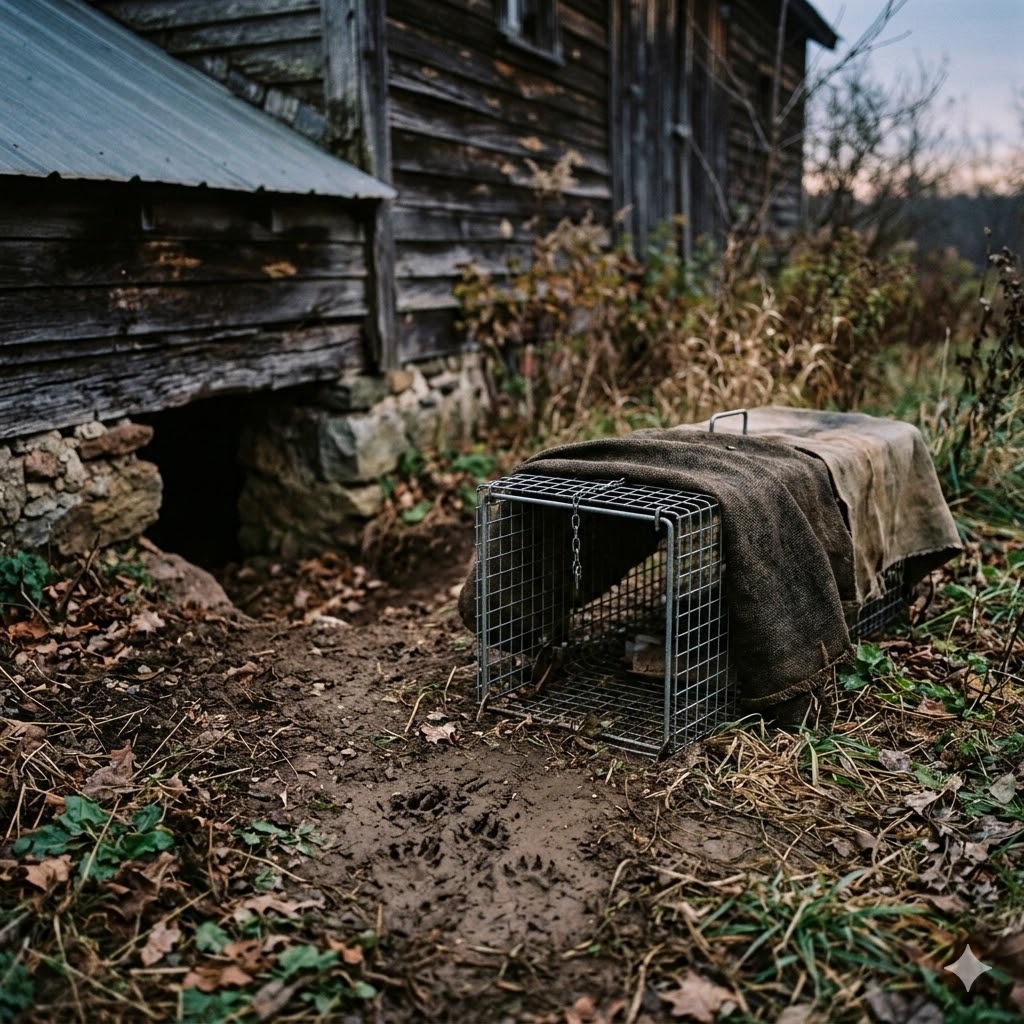
For skunk, the trap does most of the work of keeping you safe, so choose it deliberately. A covered box or cage trap is the standard tool and it earns its place: a skunk that cannot see a threat and feels enclosed will very rarely spray. You can buy solid-sided box traps made for the job, or cover a wire cage trap with sacking, a tarp or a fitted sleeve so the animal is in the dark once caught. Leave the covering in place from the moment you set it.
Site the trap right against the den entrance, along the travel route, or at the gap the skunk is using to get under a building, so it has to pass through. Bait with something greasy and smelly that a skunk will work for: fish, canned cat food, egg, or a scrap of chicken all pull well. Set the trap on firm level ground so it does not rock, and check local rules before using any live-cage set near a den or a building.
For the fur side and general kit, see the gear page. Whatever you use, the priority for skunk is a trap that holds the animal enclosed and out of sight, because that single choice prevents most of the trouble.
Handling, dispatch and fur
This is where care matters most. Approach a covered trap slowly and quietly, keep it covered, and keep your movements small. A skunk that stays calm and cannot see you is a skunk that does not spray. Do not jolt the trap, do not tip it, and do not peer in from close range.
Before you do anything else, look at how the animal is behaving through a small gap or from a safe distance. A healthy skunk is defensive but coordinated. An animal that is unsteady, aggressive for no reason, active in broad daylight, drooling or moving strangely may be rabid. If anything looks wrong, stop, keep well back, and contact your local wildlife or animal-health authority. Never handle a live or odd-acting skunk. Bites and scratches from a skunk are a medical emergency: skunks are one of the leading rabies vectors in North America, and any bite or scratch needs immediate medical attention and reporting.
Where dispatch is lawful and appropriate, it must be quick, certain and carried out with the animal kept covered and calm to avoid both spraying and suffering, following the methods your regulations allow. Always wear heavy gloves, keep your face away, and treat every skunk as a potential disease carrier regardless of how it looks. For a marketable pelt, skin and handle the fur promptly and keep the musk glands intact and undisturbed; rushing or crushing that area is how a good pelt and a bad afternoon happen together. If you only want the animal removed and not the fur, dispatch and disposal still have to follow the same legal and safety rules.
Ethics and the law
This is the most important part of the page. Trapping the striped skunk carries real responsibilities: a live disease risk to you, a spray risk to everyone downwind, and a duty to the animal to end things cleanly. Read the ethics page before you set a single trap, and treat it as the foundation for everything above.
The core principles are simple. Check your sets often, at least as often as the law requires and ideally daily, so no animal sits caught and stressed for longer than it must. Target the animal causing the problem and avoid catching pets and non-target wildlife, which is another reason covered box and cage sets are a good choice. Dispatch, where lawful, must be humane and immediate. And never let curiosity override safety with an animal that might be rabid.
On the legal side, rules for skunk vary widely and you must confirm the specifics for your area rather than assuming. Some places treat skunk as an unprotected nuisance species, others require a licence, set seasons, or restrict trap types and relocation. Rabies-management rules may forbid moving or releasing a live skunk at all. Check the current regulations for your jurisdiction, get any permission you need from the landowner, and make sure your traps and methods are legal where you are working. When you have the sign read, the right covered trap, and the law and safety squared away, come back to the wider trapping section to fit skunk control into the rest of your season.