Crossbow vs Compound Bow
How a crossbow's short power stroke compares with a compound bow's, range and noise, cocking, holding and shooting safely, crossbows in tree stands, uncocking, and checking whether your state allows crossbows in archery season, following the Nebraska and Alaska bowhunter safety courses.
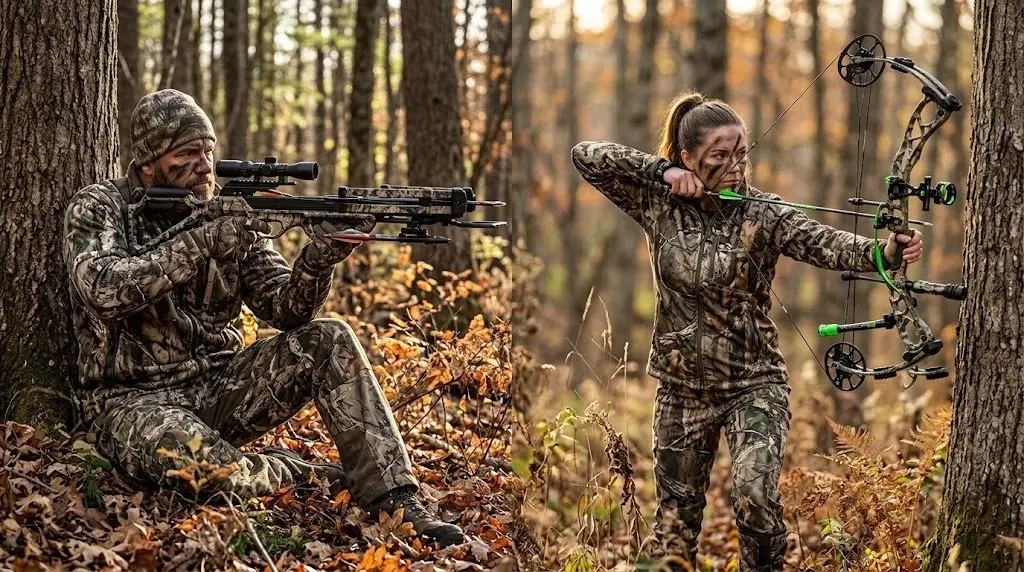
Crossbows and compound bows both shoot arrows (bolts) with broadheads, but they work and handle differently. This guide compares them, following the Nebraska and Alaska bowhunter safety courses on bowhunter-ed.com. Whether a crossbow is legal in a given season, and for whom, is set by your state, so check your regulations first.
The mechanical difference
The Nebraska course explains that a compound bow’s string pushes the arrow more than twice as far as a crossbow’s string does. So to match arrow speed, a crossbow needs more than twice the draw weight, with heavier limbs that travel a short distance and stop quickly. That short, heavy power stroke needs more mass to absorb the shock and makes a crossbow louder when it fires. Crossbows come with recurve limbs (longer limbs and barrel for a longer power stroke; many hunters choose them for simplicity) or compound limbs.
A compound bow’s wheels and cams, the Alaska course notes, cut the holding weight at full draw by 50% or more, and many compounds adjust for draw length and weight.
Range
The Nebraska course says that in range and power, a crossbow is equivalent to a longbow or compound bow of about half the crossbow’s draw weight, and both are short-range tools. The Alaska course puts a bow’s maximum hunting distance at 30 to 40 yards depending on circumstances, with most shots at about 15 yards. Our shot placement tool shows where to aim on a whitetail deer.
Handling and safety: the crossbow
From the Nebraska course:
- Cocking: put the safety on “fire”, place the ball of a foot in the cocking stirrup, and pull the string back evenly to the latch by hand or with a cocking device, centring it the same way each time for accuracy. Then engage the safety (some models do it automatically; check your manual). Keep a cocked crossbow pointed downrange.
- Fingers clear: use the finger and thumb guides on the forearm; a finger or thumb in the string’s path when it snaps forward causes serious injury.
- Limbs clear: make sure nothing is near the limb tips, which move forward hard enough to be damaged or to injure an observer.
- Follow through: keep aiming after pulling the trigger, or the arrow may hit low.
- Practice range: an open area at least 300 yards deep, targets typically at 20 yards, a solid backstop such as a high dirt bank, shooting glasses while cocking, loading and shooting, and check local ordinances before setting up a backyard range.
In a tree stand
The Nebraska course: carry arrows in a hooded quiver; cock the crossbow at the base of the tree but don’t load it; tie it to your haul line away from the trigger, climb up, then haul it up and load it. Cock it in the stand only with a device that doesn’t require leaning over, and never lean over to cock in a stand. Wear a fall-arrest system: most tree-stand falls happen climbing up or down.
Uncocking
The recommended way to uncock is to shoot an arrow into a safe backstop. From a stand, remove the arrow, keep the safety on, lower the crossbow, and shoot a practice arrow into a backstop on the ground. Don’t use uncocking devices or unloading arrows unless the manufacturer recommends them, and don’t leave a crossbow cocked for long periods; your owner’s manual gives the limits (Nebraska course).
Which suits you
- A compound bow asks you to draw and hold at full draw (made easier by its cams), and to practise form until it’s consistent.
- A crossbow is shouldered and aimed with the string latched, so there’s no holding at full draw, but it is heavier, louder and needs careful cocking and uncocking.
- Season access: check your state’s rules on where and when crossbows are allowed.
Our best crossbows guide covers choosing one.
Sources
- Nebraska Bowhunter Safety Course (bowhunter-ed.com): Comparing a conventional bow to a crossbow, Recurve vs. compound crossbow, Cocking the crossbow, Holding the crossbow, Shooting the crossbow, Crossbow hunting from an elevated stand, Range requirements and Uncocking a crossbow. Read 28 October 2026.
- Alaska Bowhunter Safety Course (bowhunter-ed.com): The compound bow and Bows are short-range hunting tools. Read 28 October 2026.
Recommended Gear on Amazon
- Crossbow packages - browse current options and reviews on Amazon.
- Compound bow packages - browse current options and reviews on Amazon.
- Fixed-blade broadheads - browse current options and reviews on Amazon.
As an Amazon Associate, we earn from qualifying purchases - at no extra cost to you. This helps us keep producing free, in-depth guides.