How to Care for Hunting Boots
Hunting boots last longer when they are cleaned, dried slowly at room temperature, conditioned or re-proofed with the right product for their leather, and stored somewhere stable. The routine for leather, membrane and rubber boots, following REI's leather-boot care guide and the Alaska Bowhunter Safety Course.
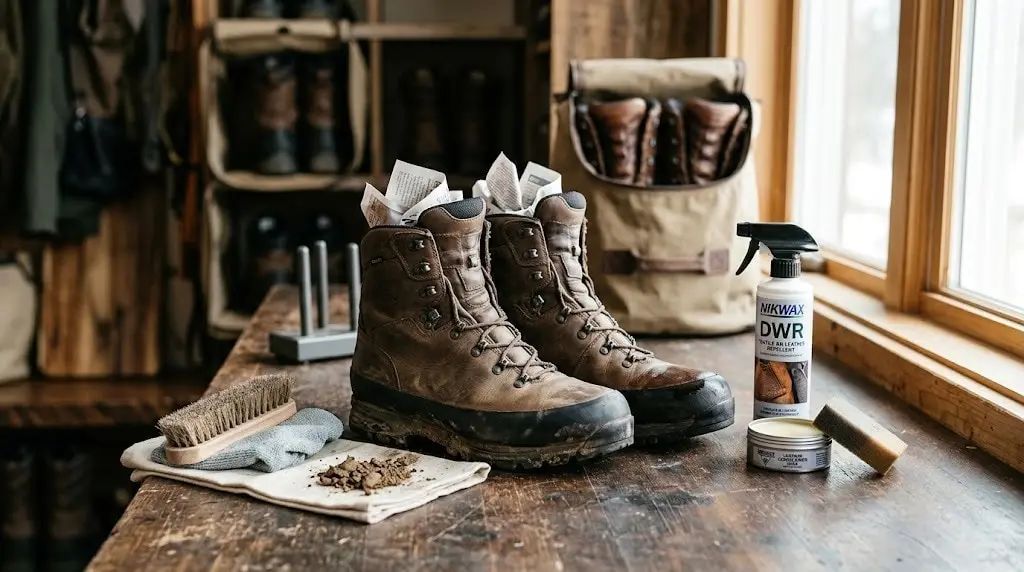
How boots are cleaned, dried and stored affects their life as much as the miles you walk in them. This guide covers the routine for leather and membrane boots and notes on rubber boots, following REI’s guide to caring for leather boots and the Alaska Bowhunter Safety Course. Your boot maker’s care instructions come first. For choosing boots, see best hunting boots.
Know what you’re looking after
REI notes boot leather can dry out and crack, so boots need regular cleaning and conditioning. Care products are made for either full-grain leather or “rough” leathers such as suede and nubuck, so read the product description before you buy. Waterproof-breathable membranes such as Gore-Tex need no treatment themselves; just clean the fabric over them.
After every hunt
Clean off mud and grit, which REI notes can stop conditioners and waterproofing treatments working properly. For a thorough clean, use running water and a boot cleaner.
Drying without damage
REI: dry boots at normal room temperature in a low-humidity place. Stuff them with newspaper to speed drying, and change it whenever it’s damp. Keep boots away from fires, stoves and heaters.
Conditioning and re-proofing leather
- Full-grain leather: conditioners also renew the boot’s durable water repellent (DWR) finish, restoring waterproof performance (REI).
- Suede and nubuck: cleaning and re-waterproofing (restoring the DWR) is enough.
- Apply to clean, damp boots, so the treatment soaks in; follow the product’s instructions.
- Wax: REI notes wax-based treatments are less common now and that wax residue can stop a new sole bonding if you want the boots resoled later.
Rubber and neoprene boots
Rinse, dry at room temperature and store out of sun and heat, and follow the maker’s instructions for any cleaning or repair products.
Off-season storage
REI: store boots where temperatures are stable and normal, not in attics, garages, car trunks or any damp, hot or unventilated place.
When a pair is finished
REI says a gouge that goes all the way through is a job for a cobbler, and that glue fixes are temporary. Boots that no longer keep water out, have worn-out soles, or no longer fit with your hunting socks are due for repair or replacement. The Alaska course notes boots that fit poorly or have the wrong soles or treads cause problems, and that some soles can be slippery enough to cause a fall. See our socks guide, cold and snow guide and gear section.
Sources
- REI Expert Advice, How to treat and care for leather boots. Read 28 October 2026.
- Alaska Bowhunter Safety Course (bowhunter-ed.com), Clothing selection is critical. Read 28 October 2026.
Recommended Gear on Amazon
- Convection boot dryer - browse current options and reviews on Amazon.
- Unscented leather conditioner - browse current options and reviews on Amazon.
- Water-repellent spray for nubuck and fabric - browse current options and reviews on Amazon.
- Boot brush - browse current options and reviews on Amazon.
As an Amazon Associate, we earn from qualifying purchases - at no extra cost to you. This helps us keep producing free, in-depth guides.