Chamois
The chamois is a small, agile goat-antelope of the high mountains, and hunting one is as much a test of legs and lungs as of marksmanship.
🗓️ Last reviewed: July 2026
Overview
The chamois is a small, agile goat-antelope of the high mountains, and hunting one is as much a test of legs and lungs as of marksmanship. Native to the Alps and other European ranges and famously established in New Zealand's Southern Alps, the chamois lives in the steepest, most broken terrain a hunter can walk into. It is not a heavy trophy, but it is one of the most demanding, prized for the physical challenge, the spectacular country, and the beautiful dark winter cape. Both sexes carry the distinctive hook-tipped horns. For the mountain hunter who wants a true spot-and-stalk in vertical terrain, the chamois offers an experience out of all proportion to its size.
Identification & Appearance
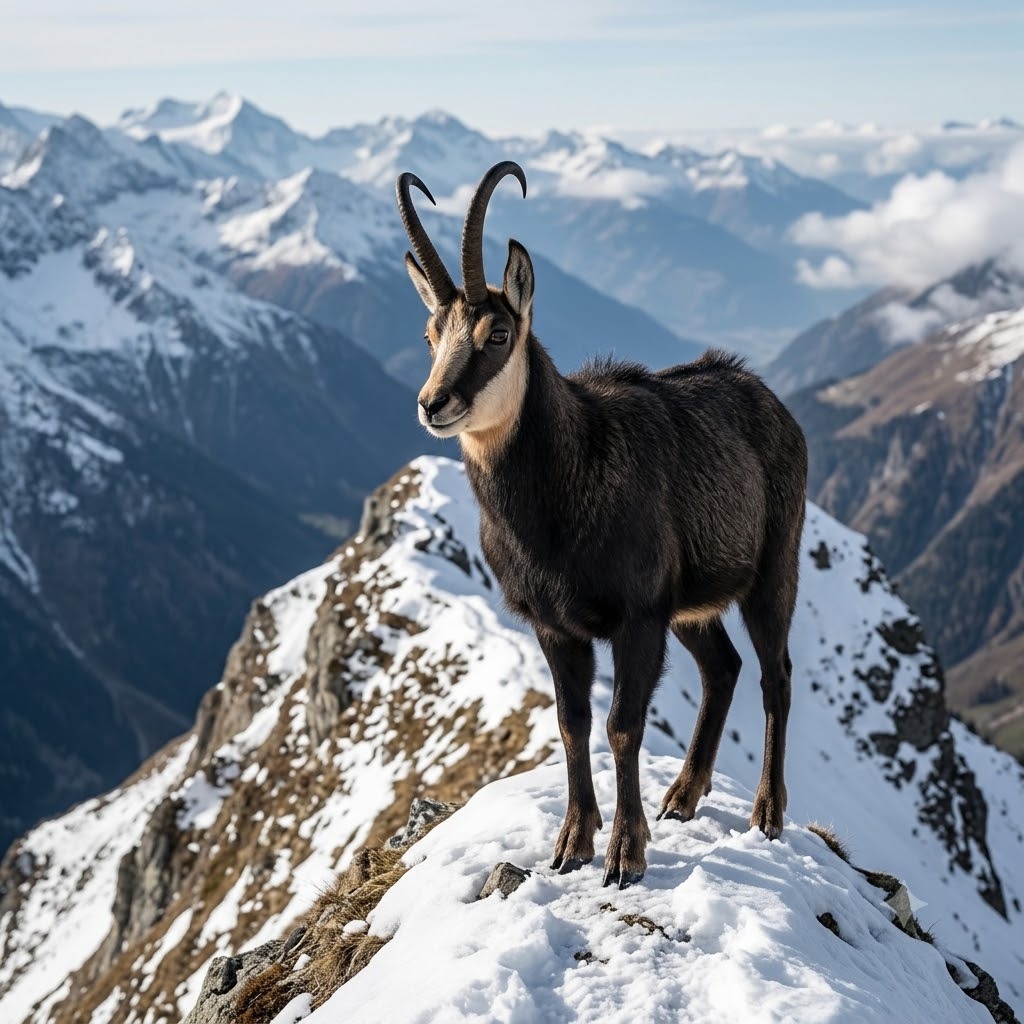
The chamois is a compact, sure-footed mountain animal weighing 55 to 130 pounds, with rams heavier than ewes. The summer coat is a light tawny-brown; in winter it darkens to a rich chocolate-black that contrasts with a pale rump, throat, and face - the cape most prized by hunters. A dark stripe runs from each ear through the eye to the muzzle, giving the face a distinctive bandit mask. The defining feature is the horns, carried by both sexes: slender black spikes that rise nearly vertically before hooking sharply backward at the tips. The build is stocky and low, with powerful legs and broad, cushioned hooves for grip on rock and ice.
Range & Habitat (US)
The chamois is a mountain species of Europe's Alps, Pyrenees, Carpathians, and Balkan ranges, and it was introduced to New Zealand's Southern Alps, where it now provides world-class free-range hunting. It is not native to the United States, so American hunters pursue it abroad - most commonly on a New Zealand or European alpine hunt. The habitat is unmistakable: steep alpine slopes, rocky bluffs, scree fields, tussock basins, and the broken ground just above and below the treeline. Chamois shift with weather, sheltering on leeward faces in storms and feeding on high pastures in fair conditions, but always tied to escape terrain among the crags.
Behavior & Sign
Chamois are herd animals for much of the year, with ewes and young grouping together while mature rams are often solitary outside the autumn rut. They are supremely adapted to their terrain, bounding across near-vertical rock and ice, and their eyesight is exceptional - a chamois will spot movement across an entire basin. When alarmed they give a sharp whistling call and flee uphill to the safety of the bluffs. Sign includes small cloven tracks in soft ground and snow, pelleted droppings on bedding ledges, and worn trails across steep faces. Because the country is so open, glassing rather than tracking is how hunters locate them.
Hunting Seasons & Timing
In New Zealand, chamois may be hunted year-round on public land, but the timing that matters most is the coat: the dark, full winter cape peaks from roughly May through August, when most trophy hunters go. The autumn rut brings mature rams down among the herds and makes them less wary. In Europe, seasons are tightly regulated by region and typically fall in autumn and early winter, again favoring the prime-cape period. Weather rules the mountain hunt more than the calendar: clear, stable conditions allow the long glassing and steep stalking the hunt requires, while storms shut it down. Early morning and late afternoon are best for catching animals feeding in the open.
Hunting Methods
Chamois hunting is spot-and-stalk in its purest and most physical form. The hunter climbs to a vantage, glasses vast slopes to locate animals, judges the horns, then plans a stalk using ridgelines, gullies, and wind to close across brutally steep ground. The stalk often means a hard climb to get above the animals, since chamois flee uphill and watch the ground below them. Shots often come at longer ranges from an improvised rest, so steadiness and a practiced field position are vital. There is no shortcut: success comes from good glass, fitness, route-finding, and patience for a settled shot.
Where to Find Them - Reading the Terrain
Read chamois country vertically. Glass the high tussock basins, alpine pastures, and grassy benches where animals feed, then trace the routes back to the bluffs and scree where they bed and escape. In fair weather look high and in the open; in wind and storm, check sheltered leeward faces and gullies. Sunny slopes draw feeding animals on cold mornings. Always identify the escape terrain, because a chamois is never far from it and your stalk must account for where it will run. Spend far more time behind the binoculars than on your feet: a rushed stalk usually ends with a whistle and an empty basin.
Gear & Optics Needed
Optics carry the chamois hunt. A first-rate binocular in the 10x42 class and, ideally, a spotting scope let you glass enormous country and judge horns before a punishing climb. A flat-shooting mountain rifle, light to carry yet accurate at range, with a quality scope and a solid field rest, is the tool for the job. A rangefinder is essential in steep terrain where distances deceive. Build the rest of the kit for the mountains: layered clothing for cold and wet, sturdy boots, trekking poles, and a capable pack. Above all, arrive fit - conditioning is the single most important "equipment" a chamois hunter can bring.
Shot Placement & Field-Dressing
Ethical, fair-chase hunting demands a clean, quick harvest. The broadside shot to the heart-lung area - low and just behind the front shoulder - offers the largest margin for error, but mountain shots add complications: steep angles, wind, and distance all shift the point of aim, so range carefully and hold true. Take only a shot you can make from a steady rest at a calm animal, and pass anything marginal, because a wounded chamois lost in the bluffs is a hard outcome. Secure the animal on the steep ground before working on it. Protect the prized cape and horns and cool the meat; cool mountain air helps, but clean, prompt handling still matters.
Meat & Eating Quality
Chamois provides fine, lean venison with a mild flavor, well regarded when handled properly. As with all game, eating quality depends far more on field care than on the animal: cool alpine air aids cooling, but the meat should still be bled, opened, and kept clean promptly. The loins and backstraps suit quick cooking, while the working muscles reward slow, moist methods. A chamois is not large, so the yield is modest, but it is genuinely good eating - a fitting reward to go with the cape and horns.
Common Mistakes
The most common chamois mistake is going in unfit: the terrain is merciless, and a hunter who cannot climb cannot get into position. Underestimating the animal's eyesight is another - chamois spot movement across a whole basin, so slow, hidden movement is essential. Hunters also rush the stalk, skyline themselves, or fail to climb above the animals and get busted from below. On the shot, misjudging steep-angle distance and wind leads to poor hits. Fitness, patience behind the glass, careful route-finding, and a rock-steady shooting position solve nearly all of them.
Regulations & Conservation Note
Chamois are managed differently across their range: in New Zealand the animal is an introduced species hunted freely to limit its impact on native alpine plants, while in Europe it is a regulated native game animal with strict quotas and seasons. In every case, hunt legally - buy required permits, follow the area's rules, and, on an international hunt, arrange trophy-export and health documentation correctly. Guided hunts in this dangerous terrain are strongly advised for visiting hunters. Respect the mountain environment, pack out what you bring in, and follow the local conservation framework.
Best Suited For
The chamois is best suited to the fit, experienced mountain hunter who relishes steep country, long glassing, and a genuine physical challenge. It is not a beginner's animal in terms of easy access, but a motivated newcomer in excellent condition, hunting with a good guide, can succeed. It rewards those who value the experience - the vertical terrain, the scenery, the hard-won cape - as much as the trophy. For the hunter building toward mountain game or seeking a first alpine hunt abroad, especially in New Zealand, the chamois is a superb, honest challenge.
FAQ
Can I hunt chamois in the United States? No - the chamois is not native to or established in the US. American hunters pursue it abroad, most commonly on a free-range hunt in New Zealand's Southern Alps or a regulated hunt in the European Alps.
How physically demanding is a chamois hunt? Very. Chamois live in extremely steep, broken terrain and flee uphill, so hunters must climb hard and often get above the animals. Mountain fitness is the single most important requirement.
Do both male and female chamois have horns? Yes. Both sexes carry the distinctive slender, black, hook-tipped horns, so judging a good animal in the field is a skill worth practicing with a guide.
When is the best time to hunt chamois? For the prized dark winter cape, the southern-hemisphere winter (roughly May to August) in New Zealand or the autumn-into-winter seasons in Europe. Stable, clear weather matters as much as the calendar.
What optics do I need for chamois? Excellent glass is essential - a top-quality binocular and ideally a spotting scope to locate and judge animals across huge country, plus a rangefinder for the steep-angle shots.