Eland
The common eland is the largest antelope on earth, an ox-like giant that can rival a cape buffalo in body mass while carrying itself with the surprising grace of a deer.
🗓️ Last reviewed: July 2026
Overview
The common eland is the largest antelope on earth, an ox-like giant that can rival a cape buffalo in body mass while carrying itself with the surprising grace of a deer. For the American hunter, the eland is most often encountered on African plains-game safaris, though free-ranging herds are also hunted on a handful of large Texas exotic ranches. It is a species that humbles first-time African hunters: its sheer size, its nervous herd behavior, and the toughness that demands precise, well-constructed bullet placement all combine into a serious challenge. An eland is not a casual add-on to a plains-game list; it is a marquee animal, and one that yields an enormous quantity of superb meat.
Identification & Appearance
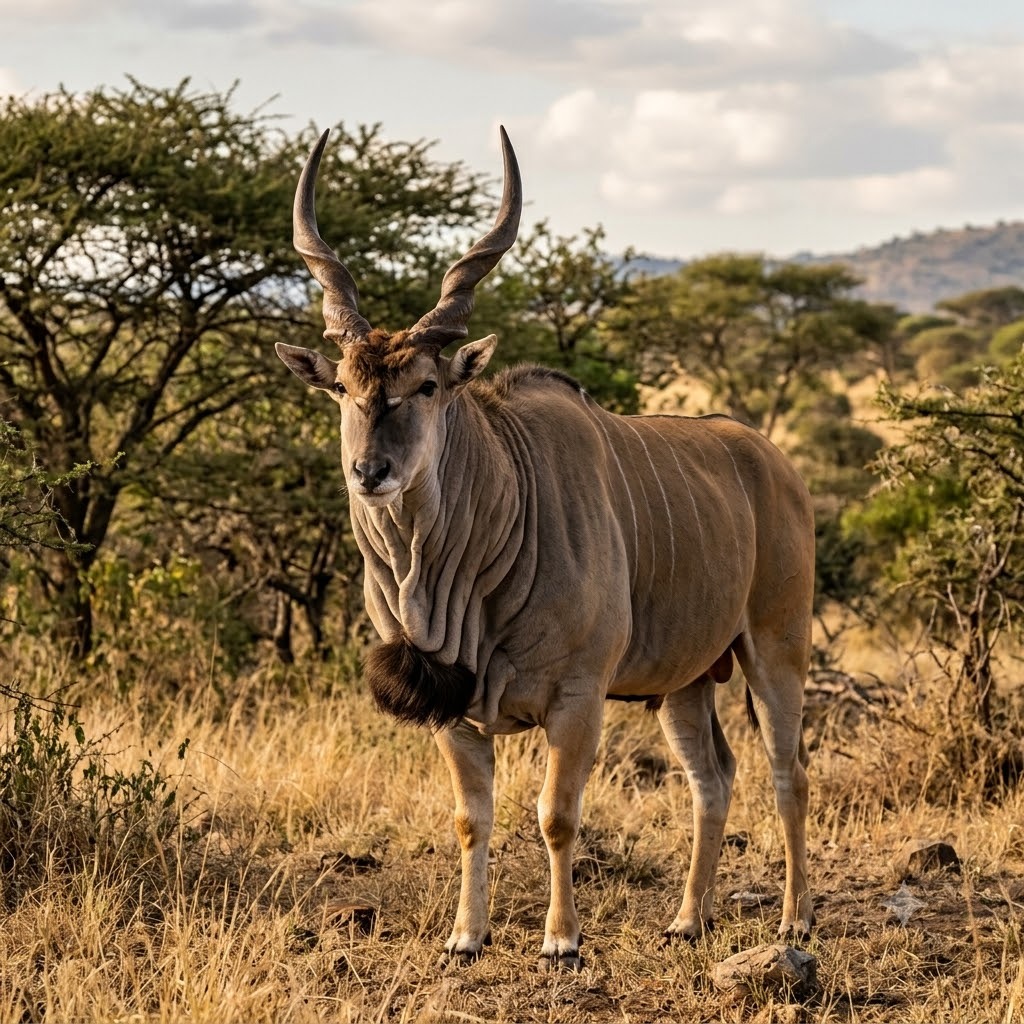
An adult eland bull is unmistakable - a fawn-to-slate-gray colored animal standing up to six feet at the shoulder and weighing between 1,300 and 2,000 pounds, with a heavy dewlap swinging beneath the throat and a distinctive tuft of dark hair on the forehead. Both sexes carry tightly spiraled, ridged horns, though the cow's are longer and thinner while the bull's are shorter and much more massive at the base. Older bulls develop a bluish-gray "blue" tinge on the neck and shoulders as the hair thins, and a loud clicking sound accompanies their walk, produced by the tendons in the legs. Thin vertical white body stripes are visible on many animals, fading with age.
Range & Habitat (US)
There are no wild elands native to the United States. American hunters pursue them on African plains-game safaris across southern and eastern Africa - South Africa, Namibia, Zimbabwe, Zambia, Tanzania, and neighboring countries - where the animal ranges across open savanna, acacia bushveld, semi-desert scrub, and light woodland. Within the US, common eland have been established on large high-fence exotic-game ranches, most notably in the Texas Hill Country and South Texas brush, where the mild climate and open browse suit them well. On those ranches they occupy expansive pastures of oak savanna, mesquite flats, and rolling brush that loosely mimic African bushveld.
Behavior & Sign
Elands are nomadic herd animals, forming loose groups that can number from a handful to well over a hundred, and they cover long distances in search of browse and water. Despite their bulk they are remarkably agile: a startled eland can clear a fence well over six feet from a standstill. They are wary and tend to keep their distance from danger, using their size and mobility rather than concealment for security. Sign includes very large cattle-like tracks, sizable droppings, browse lines on shrubs and low trees, and the beaten trails their heavy bodies press through the bush. The tell-tale clicking of a walking bull can betray a herd before it is seen.
Hunting Seasons & Timing
On African safaris, eland are hunted during the southern-hemisphere hunting season, broadly April through September, when winter conditions concentrate animals near water and the bush thins for better visibility. The cooler, drier months also make the long tracking efforts an eland hunt often requires far more bearable. On Texas exotic ranches, common eland are considered non-native and can generally be hunted year-round without a closed season, subject to the ranch's own management. As always, confirm the specific dates, permit requirements, and rules of the country, province, or ranch before booking or hunting.
Hunting Methods
Spot-and-stalk and tracking are the classic eland methods. Hunters glass open country from vantage points or follow fresh tracks on foot, often for miles, as the herd feeds and moves. A herd of elands is nervous and hard to approach, so the stalk demands patience, wind discipline, and a willingness to cover ground. On the more open Texas ranches, spot-and-stalk from a vehicle-and-foot combination is common, and some hunts use waterhole or feeder ambushes. Because the animal is so large and tough, the emphasis is always on closing to a range where a confident, anatomically precise shot is possible rather than forcing a marginal opportunity.
Where to Find Them - Reading the Terrain
Read eland country by connecting browse and water. These animals favor the transition zones between open grassland and thicker bush, where they can feed on leaves, shoots, and pods while keeping an escape route into cover. Look for fresh browse damage on acacia and other shrubs, large tracks leading to and from water, and the well-worn trails a herd stamps into the ground. In hot, dry conditions they water regularly, so pans, rivers, and ranch tanks become key. Elevated glassing points that let you scan large blocks of country pay off, because a moving herd can be spotted at long distance before it winds you.
Gear & Optics Needed
Eland demand a serious rifle. A flat-shooting cartridge in the .30 caliber class at minimum, and more commonly a .338, 9.3mm, or .375, paired with heavy, premium controlled-expansion bullets, is the sensible choice for driving through thick muscle and heavy bone. A quality 8x42 or 10x42 binocular is essential for picking herds out of the bush, and a rangefinder removes distance guesswork on open shots. Sturdy boots, sun protection, and plenty of water support the long stalks. Shooting sticks are near-mandatory for a steady field rest, and a knowledgeable professional hunter or guide is standard and often legally required on African hunts.
Shot Placement & Field-Dressing
An eland's size is its own hazard: hunters routinely underestimate how far back and how low the vitals sit behind that massive shoulder. Ethical, fair-chase hunting demands a calm, well-ranged broadside or slightly quartering shot into the heart-lung area, placed tight behind the on-side shoulder. Use enough gun and a bullet built to penetrate. After the shot, allow time before following up, and approach with caution. Field care on an animal this large is a major undertaking - the carcass is usually quartered in the field, and on safari the staff handle skinning and recovery. Rapid cooling and clean handling preserve the substantial yield of meat.
Meat & Eating Quality
Eland is widely regarded as some of the finest wild meat in Africa - mild, tender, and less "gamey" than many antelope, with a texture and flavor often compared favorably to beef. A single bull yields an enormous amount of table meat, which is one reason the species has been farmed as well as hunted. As with all wild game, quality comes down to fast cooling and careful handling in the field. On safari the meat typically goes to camp staff, local communities, or is processed for the hunter; on Texas ranches it can often be kept and processed. Backstraps and prime cuts grill beautifully, while tougher portions braise, roast, or grind well.
Common Mistakes
The classic mistake is bringing too little gun or too light a bullet - an eland's bulk and tough hide can swallow a poorly constructed projectile and lead to a long, difficult follow-up. Hunters also misjudge the vitals, aiming as if for a deer and hitting too far forward into the heavy shoulder. Impatience during the stalk is another common error: elands are nervous and will move off at the first swirl of wind or careless approach. Underestimating the physical demands of tracking a herd for miles, skimping on a steady rest, and rushing a shot on an animal that is simply hard to anchor all cost hunters their opportunity.
Regulations & Conservation Note
The common eland is not a threatened species and is a mainstay of Africa's well-regulated, license-funded plains-game hunting industry, which channels significant revenue into habitat and community conservation. On safari, elands are taken under strict permit and quota systems with a licensed professional hunter. In the United States, common eland on private exotic ranches are managed as livestock under state game-ranch rules rather than as wild game, and are generally not subject to a hunting season. Wherever you hunt, buy the correct permits, hunt with reputable, licensed operators, follow all quotas and export rules, and treat the animal and the resource with respect.
Best Suited For
The eland suits the hunter ready to step up to a large, tough plains-game animal and to invest in the rifle, the stalking effort, and often the international travel the pursuit involves. It rewards those with the discipline to close the distance, the patience to track a wary herd, and the marksmanship to place a heavy bullet precisely. For the safari hunter it is a prized centerpiece; for the Texas exotic hunter it offers a large, challenging quarry close to home. It is not the ideal first big-game animal, but it is a memorable one for a prepared hunter.
FAQ
Where can I actually hunt eland? Most eland hunting happens on African plains-game safaris across southern and eastern Africa. In the United States, common eland are hunted on large high-fence exotic-game ranches, chiefly in Texas.
What rifle and bullet do I need for eland? Use enough gun. A .30 caliber is a practical minimum, with .338, 9.3mm, or .375 more comfortable, always paired with heavy, premium controlled-expansion bullets that penetrate deep muscle and bone.
Are elands dangerous to hunt? They are not aggressive like buffalo, but their size makes a wounded animal difficult to recover and best approached with caution. The bigger challenge is their wariness and mobility.
Is eland meat good to eat? Yes - it is considered some of the finest game meat in Africa, mild and tender, and a single bull produces an enormous quantity of it.
Can a big antelope like this really jump? Yes. Despite weighing over half a ton, a startled eland can clear a fence well over six feet high from a standstill, which is why they are so hard to contain and to approach.