Himalayan Tahr
The Himalayan tahr is a shaggy, powerfully built mountain goat-antelope native to the high Himalaya and, since a long-ago introduction, established as a famous free-range game animal in the Southern Alps of New Zealand.
🗓️ Last reviewed: July 2026
Overview
The Himalayan tahr is a shaggy, powerfully built mountain goat-antelope native to the high Himalaya and, since a long-ago introduction, established as a famous free-range game animal in the Southern Alps of New Zealand. There is no wild tahr population in the United States, so American hunters pursue it as an international mountain adventure - most iconically in New Zealand, where a free-range bull tahr on a snow-dusted alpine face is one of the great trophies of the mountain-hunting world. The tahr hunt is defined by extreme terrain, brutal physical demand, and the reward of a magnificent, mane-draped animal in spectacular country. It is a bucket-list pursuit for hunters who love steep ground, big optics, and hard-earned success at altitude.
Identification & Appearance
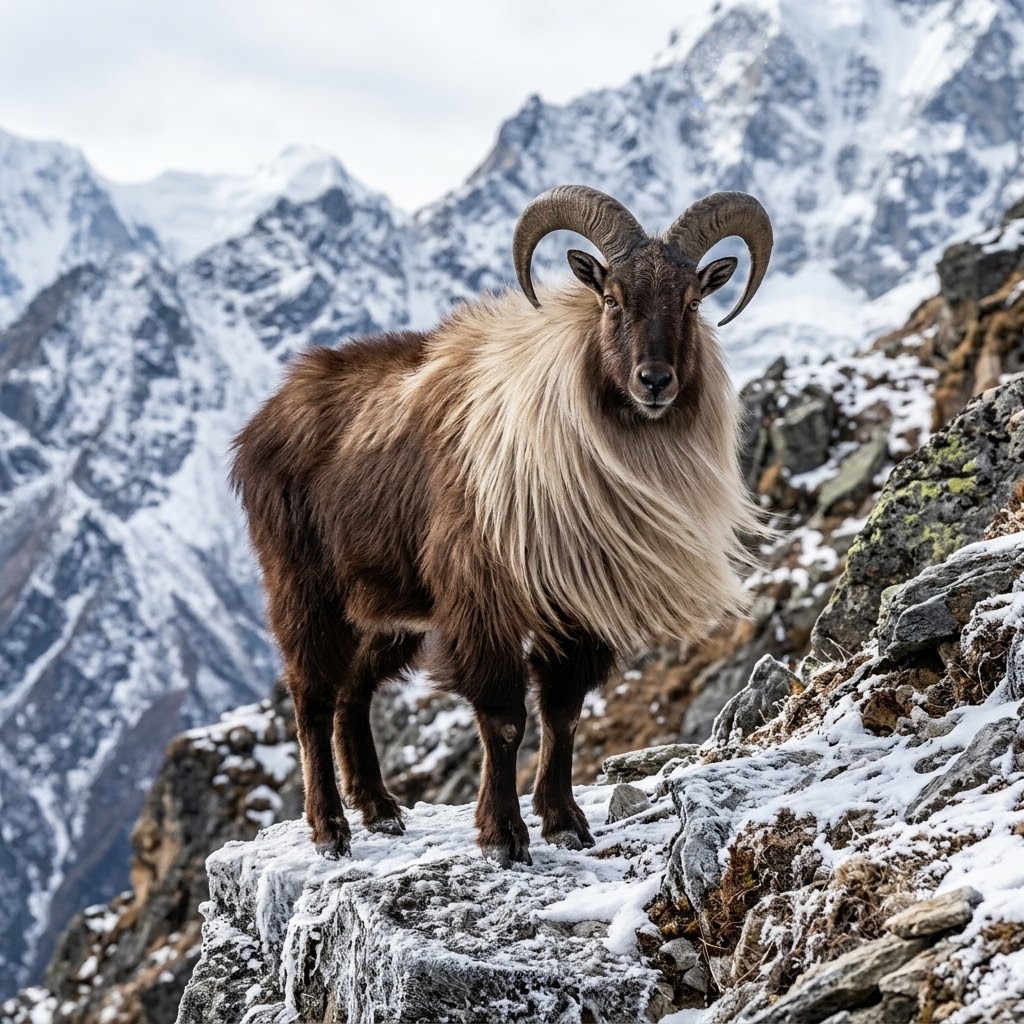
The tahr is stocky and immensely strong, built for near-vertical rock. Its most striking feature is the bull's dense, flowing mane - a cape of long, coarse hair over the neck, shoulders, and chest that lengthens and pales toward a rich blond or golden ruff in prime winter condition, contrasting with a dark body. Bulls stand robustly muscled and may weigh well over 200 pounds; nannies are considerably smaller and lighter-maned. Both sexes carry short, curved, backswept black horns, thicker and longer on mature bulls but modest compared to the body's bulk. The coat is dense and reddish to dark brown, superbly insulated against alpine cold. Splayed, rubbery hooves grip rock with astonishing surefootedness.
Range & Habitat (US)
There is no wild Himalayan tahr in the United States. The species is hunted in its introduced free-range stronghold, the Southern Alps of New Zealand's South Island, and in its native high-Himalayan range across parts of Nepal and northern India. In New Zealand, tahr occupy steep alpine and subalpine terrain - tussock basins, bluffs, rock faces, snow gullies, and the high faces above the bushline. This is severe, near-vertical country of loose scree, snow, and abrupt weather. For the US hunter, the practical reality is that tahr are a travel species pursued in extreme mountain terrain abroad, most accessibly through New Zealand's free-range and guided hunts.
Behavior & Sign
Tahr are herd animals of the high country. Nannies and young form groups on the faces, while mature bulls are often solitary or in small bachelor bands, frequently holding higher and in more broken, defensible terrain. They are superbly adapted to cliffs, moving across ground that looks impassable and using sheer bluffs as security. Their rut falls in the Southern Hemisphere late autumn and winter, roughly May through July, when bulls are in prime maned condition and gather with nannies - the classic time to hunt a heavy-maned trophy. Sign includes droppings on bedding ledges, trails etched across faces, and animals themselves spotted from great distance. In this country, glassing is the primary way to locate tahr.
Hunting Seasons & Timing
In New Zealand, tahr are managed as an introduced species and can be hunted year-round on much public conservation land, but the prime time is the Southern Hemisphere winter rut, roughly May to July, when bulls carry their fullest, palest manes and are in top trophy condition. Winter also brings snow that concentrates animals lower and makes them easier to spot against white faces, though it sharply increases danger and difficulty. Summer hunts are possible but manes are shorter. Regulations, access rules, and any control measures vary and can change, so a visiting US hunter should book through a reputable New Zealand outfitter and confirm current seasons, access, and any restrictions before the trip.
Hunting Methods
Tahr hunting is spot-and-stalk mountain hunting in its purest, most demanding form. The core method is to gain a vantage, glass the faces methodically for hours to locate a bull, then plan and execute a stalk that uses terrain and wind to close within a safe, ethical shooting distance - often a grueling climb across steep, loose, exposed ground. Some hunts use helicopter access to reach remote basins, after which the hunting is still on foot and steep. Patience with the optics and sound judgement of the mountain - snow, rock, weather, and one's own limits - matter as much as marksmanship. It is as much mountaineering as hunting.
Where to Find Them - Reading the Terrain
Read tahr country from the bottom up and glass the tops. Nanny groups favor open faces and tussock basins where they can feed and watch, while trophy bulls hold higher and in the most broken, cliffy, defensible ground - bluff systems, rock outcrops, and the heads of gullies where escape terrain is a step away. Look for animals on sunny faces in cold weather and near the security of bluffs at all times. Snow lines concentrate feeding lower. Plan stalks to approach from above or along terrain that hides your movement, always with the wind in your favor. In this vast country, disciplined glassing from a good vantage finds far more tahr than walking does.
Gear & Optics Needed
Tahr hunting is unforgiving of poor gear. Top-tier optics are essential: a high-quality binocular and, above all, a spotting scope to judge bulls at long range across huge faces. A reliable, flat-shooting mountain rifle with a solid zero, plus a rangefinder for the steep, deceptive distances of alpine country, are core. Serious mountain footwear with aggressive grip, layered technical clothing for fast-changing alpine weather, trekking poles, and often crampons or an ice axe for snow are needed. A comfortable, capable pack carries it all and the cape and meat out. A safe, sober assessment of one's own fitness and mountain skills is the most important piece of equipment.
Shot Placement & Field-Dressing
Ethical, fair-chase hunting demands a clean, quick harvest, and in tahr country a wounded animal can be lost over a cliff, so shot selection is critical. Take only calm, well-ranged, unobstructed broadside or slightly quartering shots to the heart-lung area, accounting for steep uphill or downhill angles that change the true range. Pass any shot where a hit animal might fall into unrecoverable terrain. After the shot, reach the animal safely - the recovery itself can be the hardest part. Cape and bone out the meat on the mountain to save weight for the pack-out, keeping everything clean and cool. Follow your outfitter's guidance and all local rules on trophy and meat handling.
Meat & Eating Quality
Tahr meat is edible and, from a young animal in good condition, can be perfectly good table fare, though old rutting bulls are strong and best reserved for the trophy and cape. Because hunts happen in remote, steep country, hunters typically bone out and pack what meat they can carry, prioritizing the prime cuts. As with all game, careful field handling - cooling the meat quickly and keeping it clean during the arduous pack-out - determines quality. In New Zealand's tahr hunting culture, the animal is valued chiefly for the trophy of a prime maned bull and the extraordinary experience of the hunt, with the meat a welcome bonus rather than the primary goal.
Common Mistakes
The single biggest and most dangerous mistake is underestimating the terrain and one's own fitness and mountain skill - tahr country kills, and poor judgement about weather, snow, and exposure is deadly. Other errors: bringing inadequate optics and failing to glass patiently, so bulls go unseen; misjudging the steep-angle range and missing or wounding; and pushing a stalk into terrain where a downed animal cannot be recovered. Hunters also underestimate how much a prime-maned bull requires timing the winter rut. Rushing, poor footwear, and ignoring changing alpine weather turn a hard hunt into a disaster. Fitness, patience, and mountain sense are everything.
Regulations & Conservation Note
In New Zealand, Himalayan tahr are an introduced species managed for both hunting opportunity and control of their impact on fragile alpine plant communities, so seasons, access, and control measures are set by authorities and can change. A visiting US hunter must comply with local firearm, access, and hunting rules, typically arranged through a licensed outfitter. In the tahr's native Himalayan range, hunting is tightly restricted and permit-based where allowed at all. Everywhere, respect the law, take only ethical shots, and hunt within your abilities. Responsible tahr hunting supports population management in New Zealand while honoring one of mountain hunting's greatest challenges.
Best Suited For
Tahr hunting is for the fit, experienced mountain hunter who craves extreme terrain, big-country glassing, and a hard-won trophy. It rewards mountaineering skill, patience behind a spotting scope, sound judgement in dangerous ground, and genuine physical conditioning. It is not a beginner's hunt and not a pursuit to attempt undertrained. For the hunter drawn to the high places, willing to travel to New Zealand and climb for days after a maned bull, the Himalayan tahr offers one of the most spectacular and demanding adventures in the hunting world - and a trophy that captures the wild soul of the Southern Alps.
FAQ
Can I hunt Himalayan tahr in the United States? No - there is no wild tahr in the US. They are hunted mainly in New Zealand's Southern Alps as a free-range introduced species, and in their native Himalayan range where permitted.
When is the best time to hunt a trophy bull tahr? The Southern Hemisphere winter rut, roughly May through July, when bulls carry their fullest pale manes and snow concentrates and reveals animals on the faces.
How physically demanding is a tahr hunt? Extremely - it is steep, exposed alpine hunting that demands real fitness, mountain skill, and sound judgement. It is among the most physically challenging of all hunts.
What optics do I need for tahr? Top-quality binoculars and, crucially, a spotting scope to judge bulls across vast faces at long range, plus a rangefinder to handle steep, deceptive alpine distances.
Is tahr meat worth taking? Meat from young animals in good condition is good eating, while old rutting bulls are strong. Hunters usually bone out and pack the prime cuts; the maned trophy is the main prize.