Hog Deer
The hog deer is a small, stocky, low-slung deer that hunts nothing like its taller relatives.
🗓️ Last reviewed: July 2026
Overview
The hog deer is a small, stocky, low-slung deer that hunts nothing like its taller relatives. Native to the grasslands and floodplains of South Asia, it is a prized quarry in Australia - especially Victoria, where a tightly regulated ballot and quota system governs a short, coveted season - and appears on some exotic-game ranches in Texas. The name comes from its habit of running head-down and bursting through cover like a hog rather than bounding like an axis deer. For the hunter, the hog deer is a study in close-cover craft: a small target that lives in thick grass and reed beds, rewards careful glassing and quiet stalking, and delivers superb meat. It is a specialist's animal more than a beginner's, but a deeply satisfying one.
Identification & Appearance
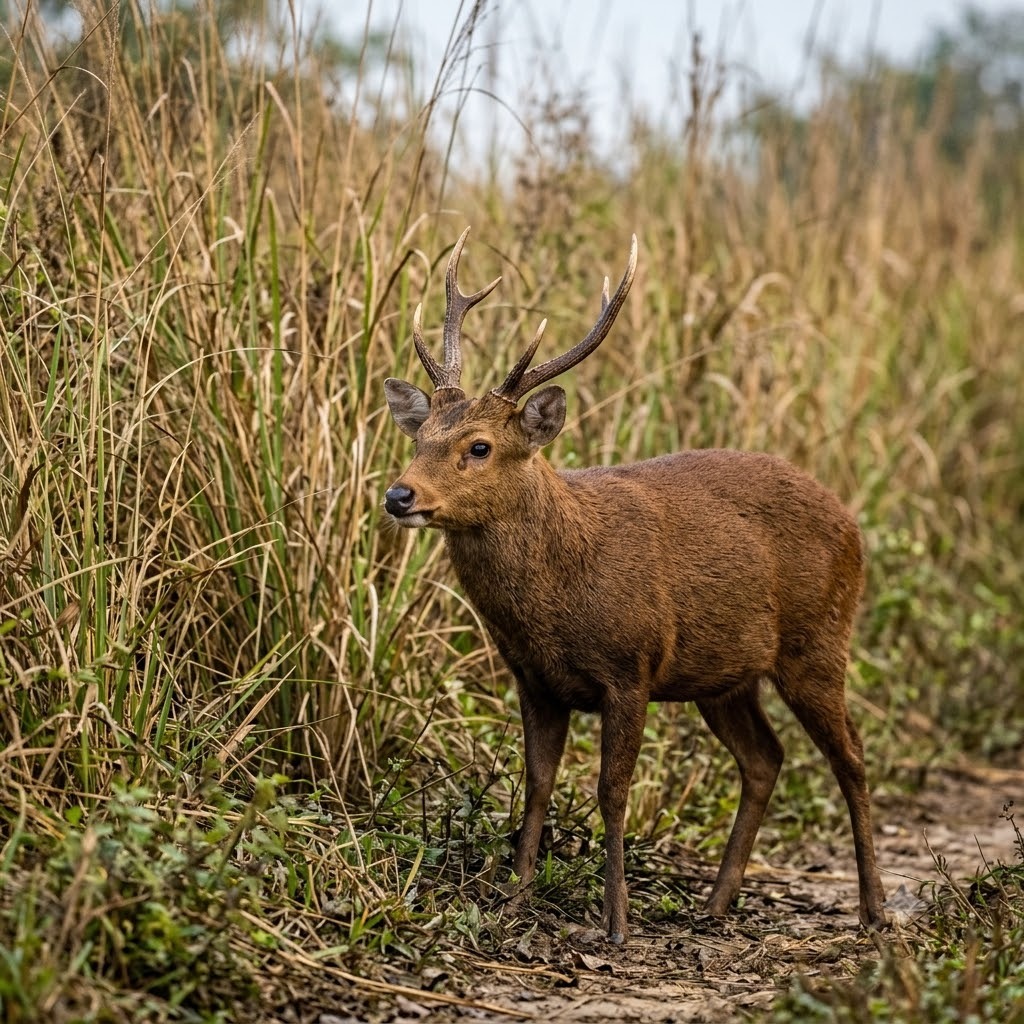
The hog deer is compact and heavily built, standing only about 24 to 30 inches at the shoulder with a body that seems long for its short legs. Coats are a warm brown, sometimes faintly spotted in summer; a dark dorsal stripe often runs down the back. Stags are heavier than hinds, with adults commonly weighing 70 to 110 pounds. Antlers are modest - typically three points per side on a mature stag, carried on long pedicles that give them a distinctive lyre-like set. The face is short, the ears rounded, and the tail brown above with a pale underside that lifts when the deer flushes. The overall impression is of a small, muscular deer built to move fast and low through dense cover.
Range & Habitat
In the United States, hog deer are found almost entirely on exotic-game ranches in the Texas Hill Country and South Texas brush. Their stronghold as a huntable wild population is Australia - Victoria's coastal wetlands, swamps, and tea-tree scrub - along with their native South and Southeast Asia, where they inhabit tall grasslands, reed beds, and river floodplains. The common thread is dense, low cover near water: rank grass, reeds, and scrub a small deer can disappear into. They favor flat, moist ground with open feeding lanes and thick bedding cover, and rarely stray far from that security.
Behavior & Sign
Hog deer are largely solitary or found in small, loose groups rather than big herds. They are most active at dawn and dusk, feeding in open lanes and clearings and retreating into heavy cover through the day. When alarmed they do not bound with the tail-flagging bounce of an axis deer; they drop low and crash through the grass, which is where the name originates. Sign includes small, neat tracks, cropped feeding on grasses and forbs, flattened oval beds in reed and grass cover, and worn trails connecting feeding lanes to bedding. Because they hold tight and move little in daylight, glassing edges at first and last light is often more productive than still-hunting the cover itself.
Hunting Seasons & Timing
Where hog deer are hunted as wild game - most notably Victoria, Australia - the season is short, tightly controlled, and allocated through a ballot with a strict quota and tag system; hunters must apply, draw, and report as required. On US exotic ranches, hog deer can typically be hunted year-round since exotics are not governed by state game seasons, though ranch policy and animal condition guide timing. The best hunting anywhere lines up with cool, calm mornings and evenings when deer feed in the open lanes. Always confirm the exact rules for your location well in advance, as ballot deadlines and quotas for wild hog deer are unforgiving.
Hunting Methods
The dominant methods are glassing and spot-and-stalk along the edges of feeding lanes, and patient ambush from a stand or blind overlooking a clearing where deer emerge. Because the animal is small and lives in thick cover, first- and last-light positioning is everything: set up where you can see the open ground before the deer melt back. Still-hunting is difficult given how tightly hog deer hold and how fast they flush, but a slow, wind-conscious approach can work. Whatever the method, quiet movement and constant attention to the wind decide the outcome.
Where to Find Them - Reading the Terrain
Look for the seam between rank cover and open feeding ground. Hog deer bed in the thickest grass, reeds, or tea-tree they can find and step out to graze the adjacent lanes, edges, and clearings at low light. Find water and follow the moist ground: floodplains, swamp margins, and reed-lined channels concentrate the animals. Mark the trails punched through the heavy cover and the cropped feeding lanes, then position downwind of where deer will emerge. On ranch ground, glass the field edges and the necks of cover between blocks. The whole game is catching a low-profile deer in the open before it drops back into security.
Gear & Optics Needed
A quality 8x42 or 10x42 binocular is the workhorse for picking a small, low deer out of tall grass. A rangefinder helps in the flat, deceptive terrain these deer favor. Quiet, muted clothing suited to warm, humid conditions keeps you concealed, and insect protection matters in the wetlands they inhabit. Sturdy, waterproof footwear handles the soft ground. Round out the kit with a sharp knife, a compact pack, a headlamp for low-light approaches, and a mapping app for e-scouting. As always, playing the wind outweighs any piece of gear you can buy.
Shot Placement & Field-Dressing
Ethical, fair-chase hunting demands a clean, quick harvest, and the hog deer's small frame makes precise placement essential. The broadside shot to the heart-lung area - low and just behind the front shoulder - offers the best margin. Wait for a calm, unobstructed, well-ranged deer standing clear of the grass, and pass anything marginal, since a hit animal in thick cover is hard to recover. After the shot, give it time before following up carefully. Field-dress promptly to cool the carcass in the warm climates these deer inhabit, and follow all local regulations on carcass handling.
Meat & Eating Quality
Hog deer venison has an excellent reputation - fine-grained, tender, and mild, often rated among the best of the deer eaten by those who pursue it. As with all wild meat, eating quality depends far more on field care than on the animal: rapid cooling in a warm climate is critical, along with clean handling and proper aging where conditions allow. The compact carcass yields modest but high-quality cuts; backstraps and tenderloins shine under quick, high-heat cooking, while the rest roasts, grinds, or braises well. For many hunters the table quality is a large part of the hog deer's appeal.
Common Mistakes
The most common error is ignoring the wind, since these deer live by their noses in tight cover. Others include trying to still-hunt cover so thick the deer flush before they are seen, arriving at feeding lanes too late and missing the low-light window, and taking a rushed shot at a small target half-hidden in grass. Hunters new to wild hog deer also underestimate the ballot process and miss deadlines. Patience, punctual low-light setups, and disciplined shot selection outperform aggressive tactics every time.
Regulations & Conservation Note
Hog deer sit at a crossroads of conservation. In their native South Asian range they are protected and, in places, threatened, so there is no hunting there. In Australia, Victoria manages a carefully limited ballot-and-quota season that channels hunter interest and funding into monitoring and habitat work. In the United States they exist as ranch-raised exotics outside the state game framework. Wherever you hunt them, buy the proper tags or permits, honor quotas and reporting, respect ranch rules, and never confuse a protected native population with a huntable one. Hunting within the law keeps the resource legitimate.
Best Suited For
The hog deer suits the patient, detail-oriented hunter who enjoys close-cover craft, careful glassing, and precise shooting on a small target. It is not the ideal first big-game animal; it rewards experience with wind, low-light timing, and quick shots. Hunters drawn to a unique, tightly managed pursuit - whether the wild ballot animals of Australia or an exotic on a Texas ranch - and those who prize top-tier venison will find it a worthy quarry.
FAQ
Where can I actually hunt hog deer? As wild game, primarily in Victoria, Australia, under a strict ballot-and-quota season. In the United States they are found on exotic-game ranches, mainly in Texas. They are protected in much of their native South Asian range.
Why are they called hog deer? Because when flushed they run head-down and crash through cover like a hog rather than bounding with the tail-flagging leap of an axis deer.
Are hog deer hard to hunt? They can be. They are small, live in thick low cover, and move mostly at dawn and dusk, so success comes from careful glassing, low-light timing, and precise shooting rather than covering ground.
Is hog deer meat good to eat? Yes - it is widely considered excellent, tender and mild, provided the carcass is cooled quickly in the warm climates these deer inhabit and handled cleanly.
Do I need a special permit for wild hog deer? In Australia, yes - a ballot, quota, and reporting system applies. On US exotic ranches, standard game seasons do not apply, but you must follow the ranch's rules and any local requirements. Always confirm before you go.