Ibex
The ibex is the iconic wild mountain goat of the high country, instantly recognized by the massive, backward-sweeping scimitar horns of a mature billy.
🗓️ Last reviewed: July 2026
Overview
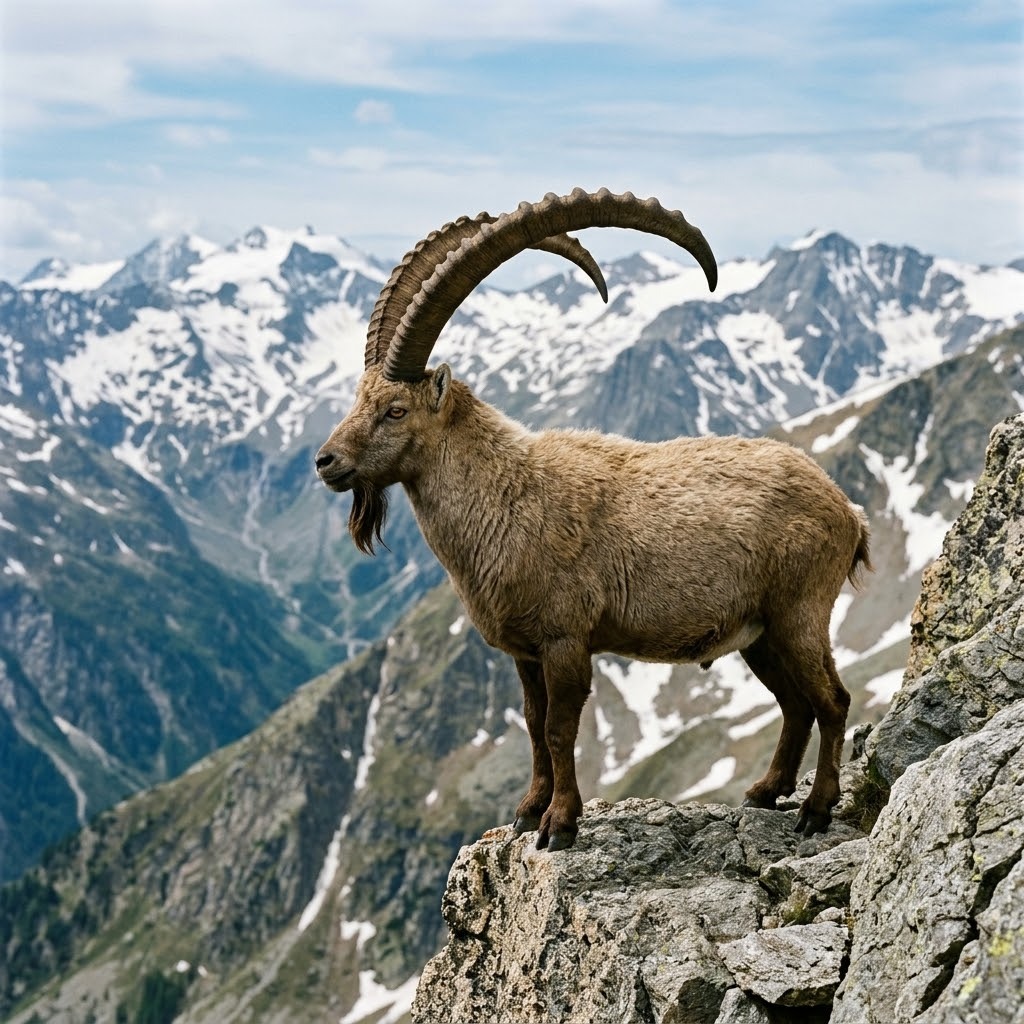
The ibex is the iconic wild mountain goat of the high country, instantly recognized by the massive, backward-sweeping scimitar horns of a mature billy. Several species and subspecies range across the mountains of Europe, the Middle East, and Central Asia - from the Alpine ibex of the European Alps to the Nubian ibex of desert ranges and the great horned ibex of Spain and the mountains of Asia. There is no wild native ibex in the United States, so American hunters pursue it as a premier international mountain adventure: spot-and-stalk hunting in steep, rugged high country abroad. With its dramatic horns, spectacular terrain, and demanding physical challenge, the ibex ranks among the most coveted trophies in mountain hunting, drawing hunters to Spain, Central Asia, and beyond.
Identification & Appearance
The ibex is a robust, powerfully built wild goat superbly adapted to precipitous rock. The signature feature is the billy's horns: long, curved, backward-sweeping scimitars, heavily ridged or knobbed along the front, that grow more massive with age and can reach impressive length on an old animal. Nannies carry much shorter, thinner horns. Coat color and body size vary by species and season - Alpine ibex are grey-brown and heavy-bodied, desert forms like the Nubian ibex are sandy and lighter, and Asian ibex are large and long-horned. Mature billies often show a darker coat, a beard in some forms, and heavy neck and shoulder musculature. Splayed, gripping hooves make them astonishingly surefooted on sheer cliffs and ledges.
Range & Habitat (US)
There is no wild native ibex population in the United States. Ibex are hunted in their native and established ranges abroad: Alpine ibex in parts of the European Alps, Spanish ibex across several mountain ranges of Spain, Nubian ibex in Middle Eastern desert mountains, and Asian and mid-Asian ibex across the vast ranges of Central Asia. Habitat everywhere is steep, rocky, high-elevation terrain - alpine crags and snowfields, arid desert mountains, and remote Asian massifs - typically at or above the treeline, broken by cliffs, gullies, and rock faces. For the US hunter, ibex are a travel species, pursued through licensed outfitters in these mountain regions abroad, each with its own species and rules.
Behavior & Sign
Ibex are herd animals of the high country. Nannies, kids, and young form groups on the more open faces, while mature billies frequently band together or hold alone in higher, more broken, defensible terrain. They are diurnal, feeding on mountain grasses and browse morning and evening and bedding on cliff ledges through midday, always with escape terrain close at hand. The rut falls in late autumn into winter, when billies gather with nannies and become more visible and predictable, the classic season for a heavy-horned trophy. Sign includes droppings on bedding ledges, worn trails across faces, and the animals themselves, spotted at long range. As with all mountain game, glassing is the primary way to locate ibex.
Hunting Seasons & Timing
Ibex seasons are set by each host country and region and vary widely by species, so there is no single framework. Broadly, autumn into winter is prime, coinciding with the rut when billies are with the nannies, more visible, and often in best coat, and when cold weather can concentrate animals. Spanish ibex hunts, for example, are commonly offered across autumn and winter. Access, quotas, and permit systems differ sharply between Spain, Central Asian countries, and Middle Eastern ranges, and many are tightly limited and expensive. A visiting US hunter should book through a reputable specialist outfitter who arranges the correct permits and confirm the current season, species, and rules well before travelling.
Hunting Methods
Ibex hunting is spot-and-stalk mountain hunting at its most classic. The method is to reach a commanding vantage, glass the faces and basins patiently to locate a mature billy, then plan a stalk that uses terrain and wind to close within a safe, ethical range - frequently a hard climb over steep, loose, exposed ground. In some ranges hunters ride horses or use vehicles to reach the base of the mountains, but the killing stalk is on foot and steep. Shots are often at longer mountain distances across canyons, demanding a steady rest and careful range and angle judgement. Patience with the optics and respect for the mountain define success.
Where to Find Them - Reading the Terrain
Read ibex country by separating the animals from their escape terrain. Nanny groups favor more open feeding faces and grassy basins, while trophy billies hold higher and tighter to broken cliffs, rock outcrops, and gully heads where a few bounds carry them to safety. Glass sunny faces in cold weather, feeding areas at first and last light, and the shaded ledges where ibex bed through midday. Look along the transition between grass and rock. Plan stalks to approach from above or through terrain that screens your movement, always keeping the wind in your favor. In this enormous country, disciplined glassing from a good vantage locates far more ibex than covering ground on foot.
Gear & Optics Needed
Ibex hunting demands serious mountain gear. First-rate optics are essential: a high-quality binocular and a spotting scope to find and judge billies across vast faces at long range. A flat-shooting, accurately zeroed mountain rifle and a rangefinder are core, since shots can be long and steep-angled. Rugged, high-grip mountain boots, layered technical clothing for extreme and changeable weather, trekking poles, and, in snowy ranges, appropriate winter gear are needed. Shooting sticks or a bipod steady the long shots. A capable pack carries gear in and cape and meat out. As with all high-country hunting, honest physical conditioning and mountain judgement are as important as any piece of equipment.
Shot Placement & Field-Dressing
Ethical, fair-chase hunting demands a clean, quick harvest, and in cliff country a wounded ibex can be lost over unrecoverable ground, so shot selection is critical. Take only calm, well-ranged, unobstructed broadside or slightly quartering shots to the heart-lung area, correcting for the steep uphill or downhill angles that alter the true range. Pass any shot where a hit animal could fall into terrain you cannot reach. After the shot, get to the animal safely - recovery on steep rock is often the hardest work of the hunt. Cape and bone out the meat to save weight for the pack-out, keeping everything clean and cool. Follow your outfitter's guidance and all local trophy and meat rules.
Meat & Eating Quality
Ibex meat is edible and, from a younger animal in good condition, makes fine table fare with a flavor akin to other wild mountain goats, while old rutting billies are stronger and valued chiefly for the horns and cape. Because hunts take place in remote, steep terrain, hunters typically bone out and pack the prime cuts they can carry. Careful field handling - cooling the meat quickly and keeping it clean during a demanding pack-out - determines eating quality, as with all game. In most ibex hunting, the animal is prized above all for its magnificent scimitar horns and the extraordinary mountain experience, with the meat a welcome and respected part of the harvest.
Common Mistakes
The most serious mistake is underestimating the terrain and one's own fitness and mountain skill - steep, exposed ibex country is dangerous, and poor judgement about weather, footing, and exposure can be deadly. Other common errors: skimping on optics and failing to glass patiently, so billies go unspotted; misjudging steep-angle range and missing or wounding at long distance; and pushing a stalk into ground where a downed animal cannot be recovered. Hunters also mistime the trip, missing the rut when billies are most visible. Rushing, inadequate footwear, and ignoring the mountain's changing conditions turn a difficult hunt into a dangerous one. Fitness, patience, and sound judgement are everything.
Regulations & Conservation Note
Ibex are managed across their range through permit and quota systems, and in many places regulated trophy hunting funds conservation and anti-poaching efforts that have helped recover populations, particularly in Central Asia and Spain. Rules, permits, and legal methods differ sharply by country and species, and several are strictly limited, so a visiting US hunter must comply with all local requirements, normally arranged through a specialist outfitter. Respect quotas, take only mature animals where selective harvest is expected, and take only ethical shots. Legal, well-managed ibex hunting can be a genuine conservation tool, and hunting within the law and within one's abilities honors both the animal and the wild high country it inhabits.
Best Suited For
Ibex hunting is for the fit, experienced mountain hunter who seeks steep terrain, long-range glassing, and a truly iconic trophy. It rewards conditioning, patience behind a spotting scope, marksmanship at mountain distances, and sound judgement in hazardous ground. It is not a beginner's pursuit and demands genuine preparation and, often, significant expense and travel. For the hunter captivated by the high peaks and the dream of an old billy's sweeping scimitar horns - in the Spanish sierras, the Central Asian massifs, or the desert mountains - the ibex offers one of the most classic, coveted, and rewarding adventures in all of mountain hunting.
FAQ
Can I hunt ibex in the United States? No - there is no wild native ibex in the US. Ibex are hunted abroad in their native ranges, including Spain, Central Asia, the European Alps, and Middle Eastern desert mountains.
What makes ibex horns so distinctive? Mature billies grow long, backward-sweeping scimitar horns heavily ridged along the front, which become more massive with age and are among the most prized trophies in mountain hunting.
When is the best time to hunt a trophy billy? Autumn into winter, during the rut, when billies gather with the nannies, become more visible and predictable, and are typically in their best coat and condition.
How hard is an ibex hunt physically? Very - it is steep, high-elevation spot-and-stalk hunting that demands real fitness, mountain skill, and long-range marksmanship. It is not a beginner's hunt.
Does ibex hunting help conservation? In many regions, yes - regulated, permit-based trophy hunting funds conservation and anti-poaching work that has helped recover ibex populations, especially in Central Asia and Spain.