Oribi
The oribi is a slender, graceful little antelope of open grassland, one of the prized "tiny ten" trophies and a genuine challenge to approach across the wide, sparse country it favors.
🗓️ Last reviewed: July 2026
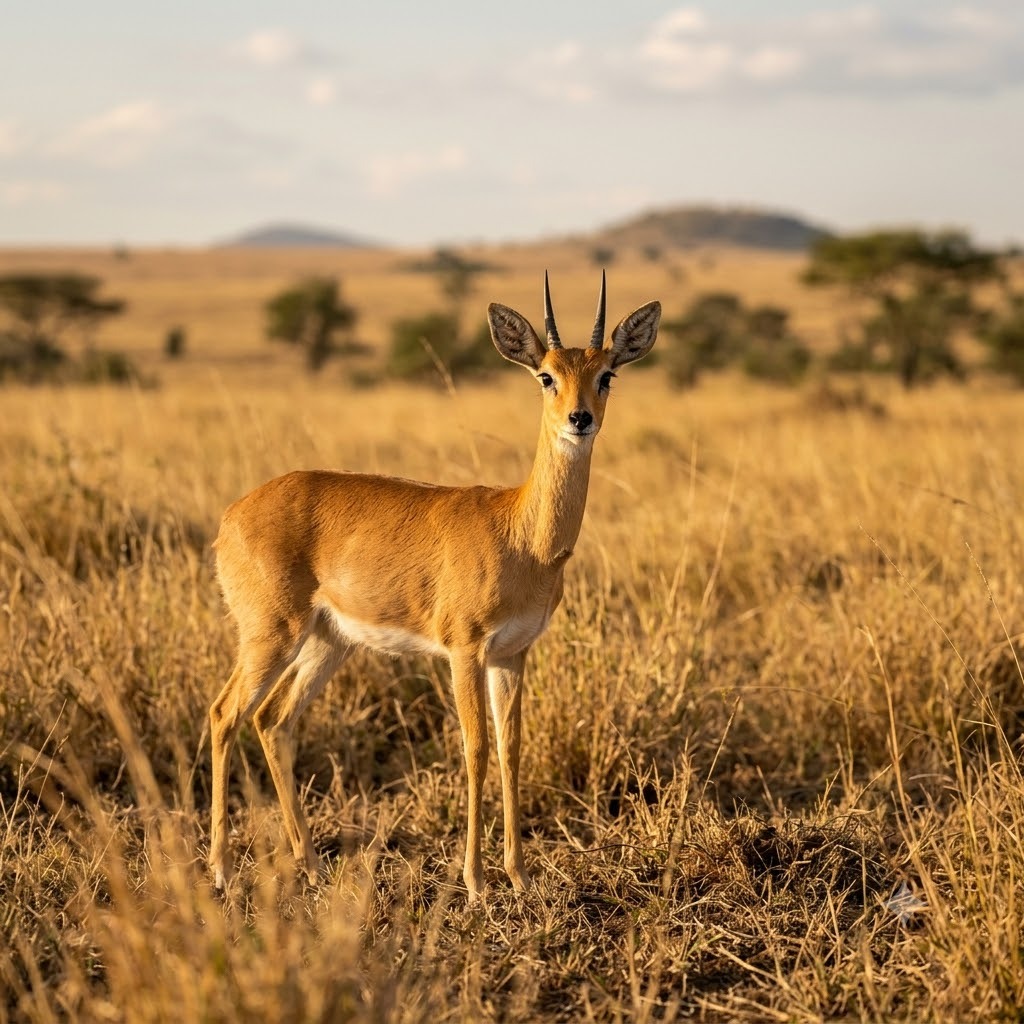
Overview
The oribi is a slender, graceful little antelope of open grassland, one of the prized "tiny ten" trophies and a genuine challenge to approach across the wide, sparse country it favors. Elegant and quick, a good ram is a rewarding miniature trophy.
Identification & Appearance
Oribi are sandy-rufous above and white below, long-necked and long-legged, with a black tail tip, a bare glandular spot below the ear, and short straight spike horns on rams. They are larger and more upright than a duiker or steenbok.
Range & Habitat
They occupy open, short-to-medium grassland and floodplain margins across parts of eastern and southern Africa, favoring wide country with scattered light cover.
Behavior & Sign
Oribi live singly or in small groups, lie in the grass, and burst away in a bounding, stotting run with a sharp whistle. Sign includes forms in the grass, tracks and dung middens.
Hunting Seasons & Timing
Hunted on the plains-game calendar, most visible feeding on the open grassland early and late.
Hunting Methods
Open-country spot-and-stalk and walking them up from the grass, with quick shots as they flush and bound away.
Gear & Optics
A flat-shooting, accurate rifle in .22 centerfire to .243 suits the small target and open ground; good binoculars pick them out of the grass.
Shot Placement & Field Care
Precise broadside placement on a small animal; full-body mounts suit such an elegant miniature.
Meat & Eating Quality
Oribi venison is tender and mild, good eating for its size.
Common Mistakes
Rushing a shot on a small, moving target and misjudging open-country distance.
Regulations & Conservation
Locally common but declining in places, hunted under standard licensing where quotas allow. Confirm availability and import rules. This is a reading guide, not legal advice.
FAQ
Oribi or steenbok? Oribi are larger, longer-necked, and stick to open grassland.
Why the whistle? Their alarm call as they flush and bound away.