Roe Deer
The roe deer is a small, elegant deer of Europe and the classic quarry of the Continental and British stalker.
🗓️ Last reviewed: July 2026
Overview
The roe deer is a small, elegant deer of Europe and the classic quarry of the Continental and British stalker. It is important to be clear at the outset: the roe deer does not live wild in the United States. American hunters encounter it by traveling abroad - to the United Kingdom, Scandinavia, the Baltics, Germany, Austria, France, and across much of temperate Europe - where roe stalking is a deeply rooted tradition. For the US hunter looking to broaden horizons on an international trip, the roe offers an accessible, affordable, and genuinely challenging introduction to European-style hunting: intimate, precise, and steeped in centuries of woodcraft and ritual. It is often the first species a visiting hunter pursues overseas, and it hooks many for life.
Identification & Appearance
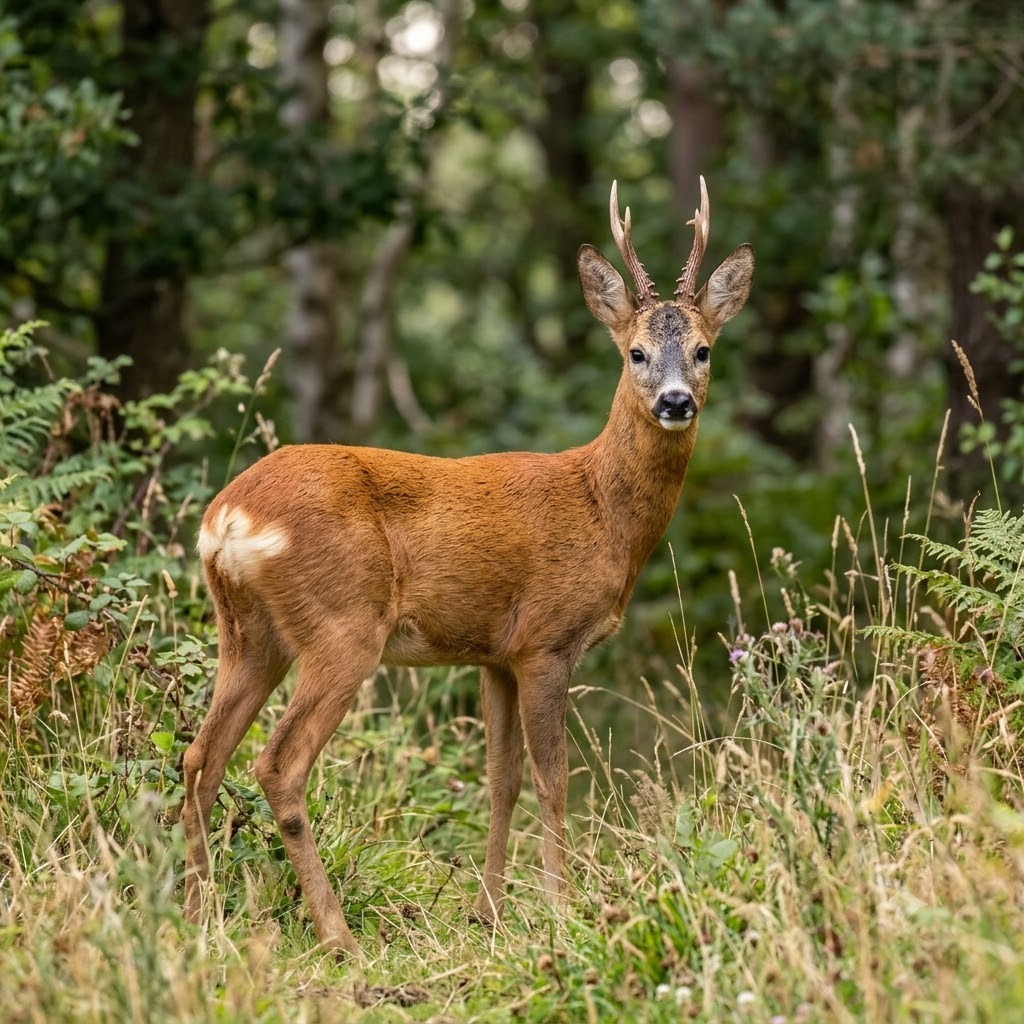
Roe are among the smallest of the true deer, standing only about two feet at the shoulder and weighing roughly 35 to 65 pounds. The summer coat is a bright foxy red; the winter coat turns grey-brown. A conspicuous white or cream rump patch is flared when the animal is alarmed, and roe famously appear almost tailless. Bucks carry short, upright, roughly three-tined antlers, heavily pearled and knobbed at the base - small but characterful trophies judged on form and mass rather than length. A black nose and pale chin patch complete the look. When startled they give a sharp, dog-like bark and bound away with a distinctive bouncing gait.
Range & Habitat (US)
There is no wild roe deer range in the United States - the species is absent from North America entirely. Where it is actually hunted is Europe: from Scottish woodland and hill edges to English farm country, across the forests and field margins of Germany, France, Scandinavia, the Baltics, and Central Europe. Roe thrive in a mosaic of woodland, field edges, hedgerows, young plantations, and agricultural country - the same edge habitat that favors many deer, at a smaller scale. They tolerate farmland closely and are often hunted on managed estates and forestry ground. For a US hunter, the practical takeaway is that roe are a travel species, pursued on guided or leased ground abroad.
Behavior & Sign
Roe are largely solitary or found in small family groups, territorial, and most active at dawn and dusk. Unusually among deer, their rut falls in mid to late summer - the famous July-August period when bucks chase does in tight circles, sometimes wearing "roe rings" into the ground around a bush or tree. Delayed implantation then times the birth of fawns for the following spring. Sign includes small neat slots, droppings, fraying stocks where bucks clean and mark with their antlers, and the worn roe rings of the rut. Bucks bark to advertise territory and can be called during the rut. Their small size and preference for cover edges make patient observation essential.
Hunting Seasons & Timing
Roe seasons are set by each European country and region and differ for bucks and does, so the framework varies by destination. Broadly, buck seasons open in spring and run through summer into early autumn, making the summer rut a prime and popular time to hunt as bucks respond to calling. Doe culling seasons typically fall in autumn and winter as part of estate management. Early mornings and late evenings are the productive windows year-round. Because rules differ sharply from country to country, a visiting US hunter should book through a reputable outfitter or estate who handles the local licensing, seasons, and legal caliber requirements, and confirm every detail before travelling.
Hunting Methods
Two methods dominate roe hunting. The first is stalking - moving slowly and quietly through woodland and along field edges at first and last light, glassing constantly and closing carefully on a located deer. The second is sitting a high seat, an elevated box or ladder stand overlooking a clearing, ride, or field edge, which offers safe shooting angles and clear observation, a cornerstone of the Continental tradition. During the July rut, calling with a roe call that imitates a doe's fieep can draw a territorial buck into the open, an exciting and effective tactic. All of these are close-to-medium-range, precision affairs suited to a small, alert target.
Where to Find Them - Reading the Terrain
Read roe country as a patchwork of cover and feeding edges. Roe bed and shelter in woodland, thickets, young plantations, and standing crops, and feed out onto field margins, clearings, forest rides, and meadows at dawn and dusk. Focus on the edges and transitions - the seam between wood and field, a ride cut through timber, the corner of a crop, a hedgerow linking cover. During the rut, worn roe rings and heavily frayed stocks mark buck territories worth watching. High seats are placed to command these edges with the wind in the hunter's favor. As with all hunting, position so scent drifts away from where deer are expected.
Gear & Optics Needed
Roe hunting is an optics-and-precision game. A quality binocular - a bright 8x42 or 8x56 for low light - is used constantly to pick small deer out of cover in dim conditions. A rangefinder helps on longer field-edge shots. Clothing should be quiet, muted, and layered for cool European mornings. Because roe are small, shot placement is everything, so a well-zeroed rifle in a legal local caliber, often provided or arranged by the outfitter, matters more than raw power. Sticks or a bipod steady offhand shots. A sharp knife, a headlamp, and a small pack complete the kit. On a high seat, comfort and stillness keep a hunter watching longer.
Shot Placement & Field-Dressing
Ethical, fair-chase hunting demands a clean, quick harvest, and on an animal as small as a roe, precise placement is critical. The broadside heart-lung shot, low and just behind the front shoulder, is the standard, taken only when the deer is calm, well-ranged, and unobstructed. Pass anything marginal. European practice, known as the gralloch, calls for prompt field-dressing to cool the small carcass quickly and preserve the excellent meat. Many estates have strict protocols for handling, inspection, and larder preparation. Follow your outfitter's guidance, wear gloves, keep the cavity clean, and respect all local rules on carcass handling and, in some regions, disease testing.
Meat & Eating Quality
Roe venison is prized across Europe as a delicacy - fine-textured, tender, mild, and delicately flavored, often considered the finest of the European deer for the table. The small backstraps and tenderloins are exquisite with quick, high-heat cooking, while the legs roast beautifully. Because the animal is small, a roe yields a modest but premium amount of meat, treated in European kitchens as a special-occasion food rather than everyday fare. As always, eating quality rests on fast cooling and clean handling in the field. For the visiting hunter, a meal of roe prepared in the estate larder is often a memorable part of the experience.
Common Mistakes
For a visiting US hunter, the biggest mistakes are logistical: underestimating the differences in local law, seasons, and legal calibers, and failing to book with a reputable outfitter who handles them. In the field, common errors mirror all deer hunting - ignoring the wind, moving too fast while stalking, and glassing too little. Roe are small and easily overlooked, so hunters who hurry miss deer standing in plain view. Taking a poorly steadied shot at such a small target risks a wound, so using sticks or a high-seat rest is essential. Skipping the rut-calling opportunity in July is a missed chance at the most exciting hunting of the year.
Regulations & Conservation Note
Roe deer are carefully managed across Europe through regulated seasons, culling plans, and estate stewardship, with hunters playing a central role in balancing populations against forestry and farmland. Rules on licensing, seasons, calibers, and firearm import differ sharply by country, and a visiting hunter must comply with all of them - typically arranged through the host outfitter or estate. Respect bag limits, sex- and age-selective culling guidance, and local carcass and disease rules. The European tradition places heavy emphasis on ethics, respect for the animal, and precise, humane shooting. Hunting roe legally and respectfully honors both the quarry and the deep culture that surrounds it.
Best Suited For
Roe hunting suits the US hunter with an appetite for travel and a curiosity about European hunting tradition. It is an accessible, relatively affordable introduction to international deer stalking, rewarding patience, sharp glassing, and precise shooting rather than long-range firepower or hard physical grind. Those who enjoy the intimacy of close-range stalking, the stillness of a high seat, and the excitement of calling a rutting buck will find the roe deeply satisfying. It is an ideal first overseas species and a gateway into the wider world of Continental and British sporting culture.
FAQ
Can I hunt roe deer in the United States? No - roe deer do not live wild in the US. They are hunted in Europe, including the UK, Scandinavia, the Baltics, and much of Central Europe, on a hunting-travel trip.
When is the roe deer rut? Unusually for deer, the roe rut falls in mid to late summer, typically July into August, when bucks chase does and can be drawn in with calling.
What makes roe hunting different from US deer hunting? It is a smaller, more intimate, precision pursuit centered on stalking and high seats, steeped in European tradition, and it requires travel and compliance with local laws through an outfitter.
Is roe venison good to eat? Yes - it is regarded as one of the finest wild meats in Europe, fine-textured, tender, and delicately flavored, though a small animal yields a modest amount.
Do I need to arrange licensing myself? Generally not - a reputable European outfitter or estate handles local licensing, seasons, legal calibers, and often the rifle, but confirm every detail well before you travel.