Sable Antelope
The sable antelope is widely considered one of the most striking and coveted trophies in all of African hunting.
🗓️ Last reviewed: July 2026
Overview
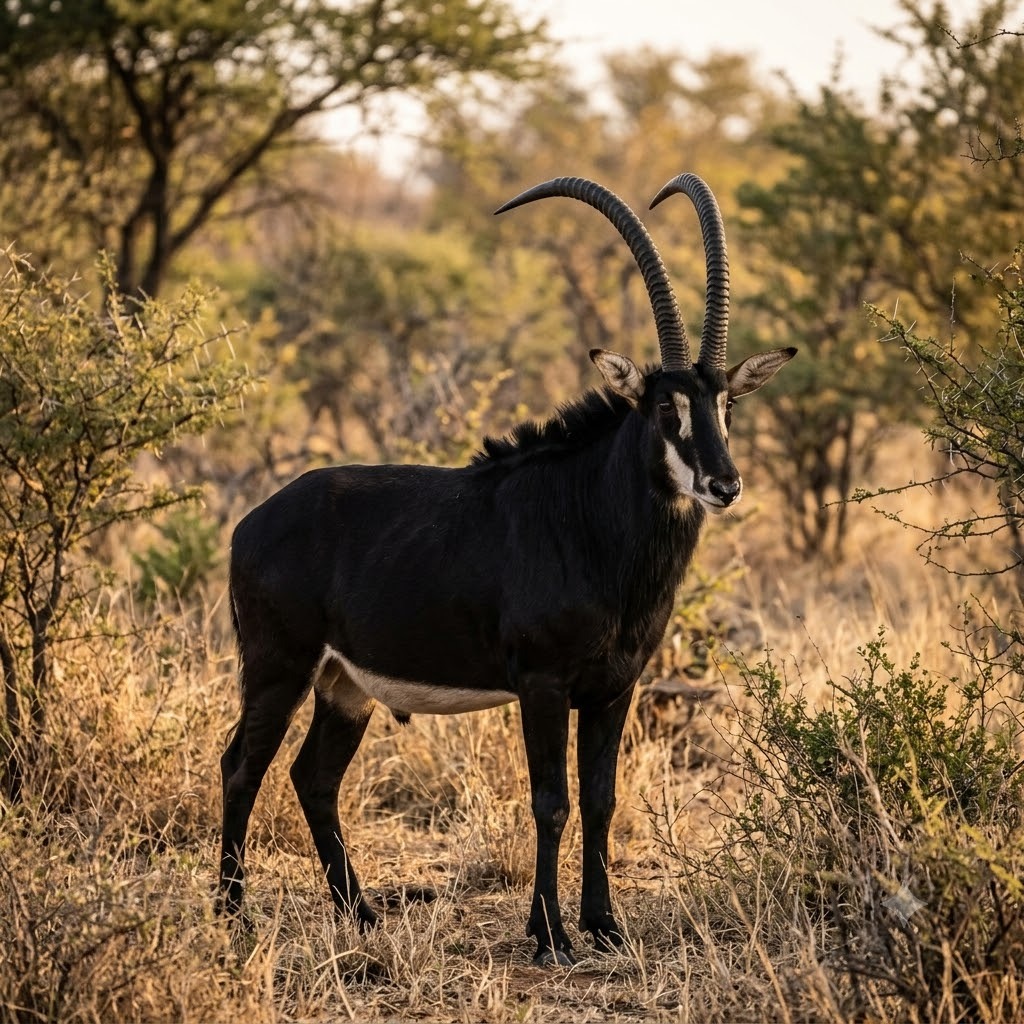
The sable antelope is widely considered one of the most striking and coveted trophies in all of African hunting. A mature bull, jet-black with a white belly and face markings, carrying a great pair of scimitar-shaped horns swept back over his shoulders, is an unforgettable sight. For the American hunter, the sable is a premium plains-game safari animal found across parts of southern and eastern Africa, with a small number also held on large Texas exotic ranches. The sable earns its reputation not only for its beauty but for its temperament: a wounded bull is genuinely dangerous, known to stand its ground and use those horns. It is a marquee pursuit that rewards careful shooting and a healthy respect for the animal.
Identification & Appearance
The adult sable bull is dramatic: a glossy black coat set off by a white belly, white facial blazes, and a stiff, dark upright mane along the neck. Both sexes carry ringed, backward-sweeping scimitar horns, but the bull's are far heavier and longer, arching in a bold crescent that can exceed forty inches in exceptional animals. Cows and younger bulls are a rich reddish-brown to dark chestnut, darkening with age until mature bulls turn nearly coal-black. Standing over four feet at the shoulder and weighing 400 to 550 pounds, the sable is a large, powerfully built antelope with an unmistakable, almost horse-like carriage and a proud, head-high posture.
Range & Habitat (US)
There are no wild sable antelope native to the United States. American hunters pursue them on African plains-game safaris in countries such as South Africa, Namibia, Zimbabwe, Zambia, and Tanzania, where sable inhabit savanna woodland - open forest interspersed with grassy clearings, typically within reach of water. Within the US, sable antelope are kept and hunted on a limited number of large high-fence exotic-game ranches, principally in Texas, where they graze open pastures of oak and mesquite savanna. On both continents the species favors a mix of tree cover for shade and browse with open grass for grazing, avoiding both dense forest and true open desert.
Behavior & Sign
Sable live in herds led by a dominant territorial bull, with cows and young forming the core group while bachelor bulls range on the edges. They are grazers of medium-height grasses and are strongly tied to water, drinking regularly. Sable are alert and can be aggressive; a cornered or wounded bull will drop to its knees and slash upward with its horns, and even lions treat adult sable with caution. Sign includes cattle-like tracks somewhat smaller than an eland's, droppings on grazing lawns, and worn trails between feeding areas and water. Herds are often found returning to favored grazing clearings and shaded midday resting spots within their territory.
Hunting Seasons & Timing
On African safaris, sable are hunted through the southern-hemisphere season, broadly April to September, when the dry winter draws animals toward water and reduces cover for easier glassing and stalking. The cooler months also ease the walking and tracking involved. On Texas exotic ranches, sable are treated as non-native game and can generally be hunted year-round with no closed season, subject to the individual ranch's management goals. Because sable are territorial and tied to specific grazing and watering areas, patterning their daily movement matters more than a calendar date. Always confirm the country, province, or ranch rules and permit requirements before hunting.
Hunting Methods
Spot-and-stalk is the primary method for sable. Hunters glass the edges of savanna clearings and the approaches to water, locate a herd or a lone bull, then work in on foot using terrain and wind to close within confident shooting range. Because sable favor semi-open woodland, stalks often thread through scattered trees where a steady rest and a clear lane are prized. Ambush near water or established grazing lawns is also effective, particularly on ranches. Whatever the approach, the goal is to identify a mature bull and set up an unhurried, well-supported shot - a wounded sable is dangerous, so a clean first shot is paramount.
Where to Find Them - Reading the Terrain
To find sable, read the balance between grass, shade, and water within a bull's territory. They favor rolling savanna woodland with medium grass for grazing, tree groves for midday shade, and reliable water they visit regularly. Look for grazing lawns kept short by the herd, tracks and trails converging on water, and droppings that reveal preferred feeding areas. The edges where open grass meets tree cover are prime, as sable feed in the open but retreat to the trees to rest and escape heat. Glass these transition zones in the cool of morning and evening when the herd is most active and exposed.
Gear & Optics Needed
A sable calls for an adequate plains-game rifle: a .270 as a light minimum, with .30 caliber cartridges and up through .338 or 9.3mm being ideal, always loaded with a tough, controlled-expansion bullet capable of clean penetration on a heavy-bodied antelope. A quality 8x42 or 10x42 binocular is essential for judging horn length and picking bulls out of dappled woodland, and a rangefinder steadies distance calls in mixed cover. Shooting sticks provide the stable field rest these stalks demand. Good boots, sun protection, and water support the walking, and on African hunts a licensed professional hunter is standard and usually required by law.
Shot Placement & Field-Dressing
Ethical, fair-chase hunting on an animal as tough and potentially dangerous as the sable demands a clean, well-placed first shot. The broadside heart-lung shot, tight behind the on-side shoulder and low in the chest, offers the surest anchor; avoid raking, marginal, or too-far-back angles. Wait for a calm, ranged, unobstructed opportunity and pass anything doubtful, because a wounded sable is a serious matter to follow up. After the shot, allow time and approach with caution from behind, alert to those horns. On safari the professional hunter and staff handle the recovery, quartering, and skinning; rapid cooling and clean field care preserve the excellent meat.
Meat & Eating Quality
Sable venison is good table fare - lean, dark, and flavorful, in keeping with other quality African plains-game meat. As with all wild game, eating quality depends chiefly on prompt cooling and clean handling in the field rather than on the animal itself. On African safaris the meat is generally used at camp, distributed to staff and local communities, or processed for the hunter where regulations allow; on Texas ranches it can often be kept and processed at home. The prime backstrap and loin cuts are excellent grilled or seared, while the heavier muscles are well suited to slow roasting, braising, or grinding into sausage and burger.
Common Mistakes
A common mistake is treating the sable like an ordinary soft-skinned deer and using too little gun or too light a bullet on a heavy, tough animal that can be dangerous when wounded. Rushing the shot is another: hunters excited by a great bull may fire from an unsteady position or at a poor angle, when patience and a solid rest would have delivered a clean kill. Underestimating the danger of following up a wounded bull - approaching carelessly from the front - can lead to injury. Misjudging horn maturity, ignoring the wind on a stalk through open woodland, and failing to glass the grass-and-tree edges also cost hunters opportunities.
Regulations & Conservation Note
The sable antelope is not globally threatened and is a valued, well-managed component of Africa's regulated, license-funded plains-game hunting, which supports habitat protection and rural communities. On safari, sable are taken under strict permit and quota systems in the company of a licensed professional hunter. In the United States, sable on private exotic ranches are managed under state game-ranch rules as livestock rather than as native wildlife, and are generally not subject to a formal hunting season. Wherever you hunt, secure the correct permits, use reputable licensed operators, observe all quotas and export requirements, and honor both the animal and the resource.
Best Suited For
The sable suits the hunter drawn to a spectacular trophy and prepared to shoot well under pressure on a large, tough, and potentially dangerous antelope. It rewards patience on the stalk, disciplined marksmanship, and the judgment to hold fire until the shot is right. For the safari hunter it is a headline animal often placed high on a plains-game wish list; for the Texas exotic hunter it offers a striking and challenging quarry closer to home. It is best approached by a hunter with some big-game experience and a serious respect for the species.
FAQ
Where can I hunt sable antelope? Chiefly on African plains-game safaris in countries like South Africa, Namibia, Zimbabwe, and Zambia. In the United States, sable are hunted on a limited number of large high-fence exotic ranches, mainly in Texas.
Is the sable really dangerous? Yes, when wounded or cornered. A sable bull will drop to its knees and slash upward with its scimitar horns, and even predators respect it - which is why a clean first shot matters so much.
What rifle should I use for sable? An adequate plains-game rifle from around .270 up through .30 caliber, .338, or 9.3mm, loaded with a tough controlled-expansion bullet for reliable penetration on a heavy-bodied animal.
How do I tell a mature bull? Mature bulls turn glossy near-black with bold white markings and carry the heaviest, longest scimitar horns. Cows and young bulls are reddish-brown to chestnut, darkening with age.
Is sable meat worth keeping? Yes - it is lean, dark, and flavorful. As with all game, quality comes down to fast cooling and clean field care, and where rules allow the meat is well worth taking home or processing.