Hog Night Hunting: Thermal Gear
Feral hogs are nocturnal, destructive, and legal almost everywhere. Thermal and night vision turn nights into the most productive time to thin a herd…
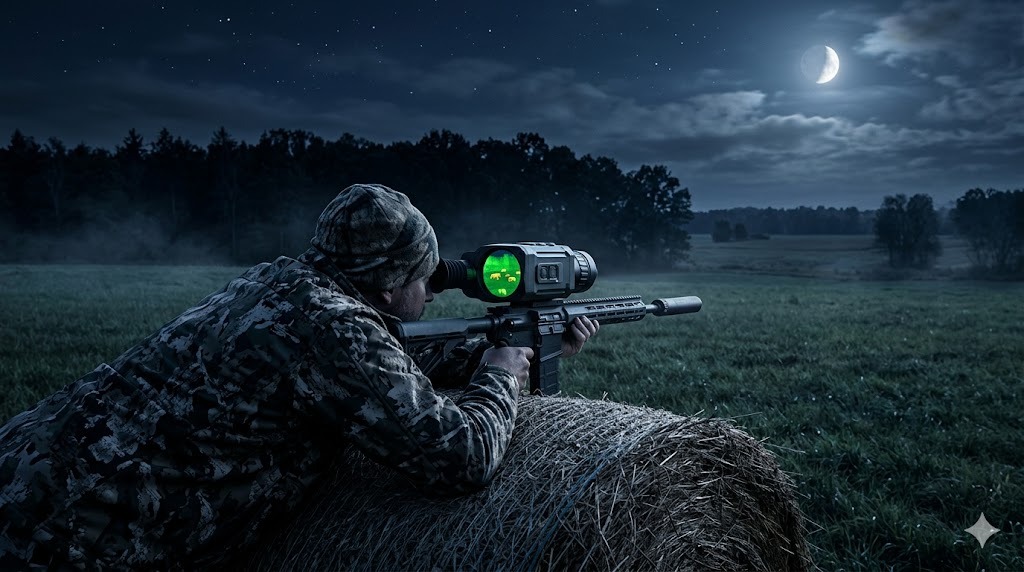
For night hog hunting, thermal is the better tool for finding and scanning - it sees heat through brush and total darkness - while night vision costs less and gives a more natural sight picture for the shot. Many serious hog hunters run a handheld thermal to locate the sounder and a thermal or night-vision scope to take it.
Feral hogs cost American agriculture an estimated $2.5 billion annually in crop damage, fences destroyed, and pasture rooted up. They’re also nocturnal, smart, and tough enough to absorb poor shots. The best way to thin a sounder is to hunt them at night, when they’re active and unwary. The technology choice between thermal imaging and night vision shapes how you hunt, what shots you can take, and how much you spend. This guide cuts through the marketing and lays out what works.
Why Hogs at Night
Pressured hogs become almost entirely nocturnal within a few weeks of being hunted. By the time you spot a sounder during the day, they’ve already been bumped multiple times. Night hunting catches them at their most active, in their most predictable feeding patterns, and most importantly, legal in nearly every state for feral hogs because they’re classified as invasive.
Texas, Oklahoma, Arkansas, Louisiana, Mississippi, Alabama, Georgia, Florida, Tennessee, Missouri, Kansas, California - all permit night hunting of hogs with thermal or night vision. Always verify current state regulations.
Thermal vs Night Vision: Core Differences
Thermal imaging detects heat. Hogs glow against a cooler background regardless of ambient light. You can spot a hog through tall grass, around corner of brush, and at distance with no visible light. Modern thermal scopes resolve game out to 400+ yards.
Night vision (Gen 2, Gen 3, digital) amplifies existing visible light or near-infrared. You see in essentially black-and-white video, can identify the animal precisely, and benefit from supplemental IR illuminators. Range and detail depend heavily on ambient light (moon, stars).
Quick verdict: For finding hogs in the dark, thermal wins by an enormous margin. For identifying details (target ID, distinguishing boar from sow, picking shot placement), night vision is often better. The best setups combine both.
Thermal Scopes Compared
Entry-level ($1,500-2,500):
- ATN ThOR LT - solid 256x192 sensor, recording, ballistic calculator
- AGM Rattler - tough, simple, popular for first-time thermal buyers
- Bering Optics Hogster - purpose-built for hog hunters, good value
Mid-tier ($3,000-5,000):
- Pulsar Thermion 2 LRF XP50 - laser rangefinder built in, top-tier sensor
- AGM Adder - 384x288 sensor, recording
- Trijicon REAP-IR - durable, rifle-rated, premium glass
Premium ($5,000-10,000+):
- Pulsar Trail 2 LRF XP50 - flagship handheld
- Trijicon SNIPE-IR - military-grade
- N-Vision NOX-18 - handheld thermal scanner pair with daytime scope
For nighttime hog hunting specifically, a 384×288 or better sensor in the 35-50mm lens range provides usable detection out to 600 yards and shootable images to 300+.
Night Vision Options
Digital night vision (Pulsar Digex, ATN X-Sight, Sightmark Wraith):
- $500-1,500
- Daylight + nighttime capable
- Works with IR illuminator at night
- Best for hunters who also want daytime versatility
Analog Gen 3 night vision (PVS-14, scope versions):
- $3,500-7,000
- Best low-light performance, no batteries needed for image
- Mil-spec rugged
- Requires moonlight or IR illuminator
For first-time night hog hunters, a digital scope like a Wraith 4K is a $600 way to start. As you progress, thermal becomes worth the investment.
The Hybrid Setup
Serious hog hunters often run:
- Thermal monocular for scanning (Pulsar Helion, AGM Asp) - find hogs at distance
- Thermal or digital scope on rifle - shoot once located
- Quality IR illuminator for digital scopes - extends usable range
This costs $3,000-8,000 total but lets you cover ground efficiently and identify shots accurately.
Rifles and Calibers
Hogs are tough. They have thick shields of cartilage and fat across the shoulder, heavy bone structure, and the will to disappear into thick brush before they die. The right cartridge isn’t a deer cartridge.
Minimum recommended:
- .223 Remington / 5.56 - works with 64-grain bonded bullets at close range; marginal for big boars
- .243 Winchester - solid pick with 95-grain partition or controlled-expansion
- 6.5 Creedmoor - excellent, especially with 130-grain Barnes TTSX
Better choices:
- .300 Blackout (subsonic suppressed) - for close-range, suppressed hunts
- .308 Winchester - universally lethal, every hog drops in its tracks
- .30-06, 6.8 Western, .300 Win Mag - overkill but effective
A short-barreled bolt or AR in .308 with a suppressor is the most versatile hog-killer in production.
Tactics
Hogs respond to feed. Bait sites with corn, fermented soured corn, or commercial pig attractants pull sounders to predictable locations. In Texas, baited feeders run 24/7; in other states, check baiting regulations.
Beyond bait, hunt food sources (cornfields, peanut fields, sorghum), water (creeks, ponds, wallows), and bedding cover (mesquite thickets, river bottoms, cedar brakes). Night thermal scans of fields and pastures find sounders that have just emerged from cover to feed.
Wind matters less at night when temperatures stabilize, but never approach a sounder upwind. Stalk in crosswind or upwind position, take the shot from 100-200 yards when possible.
Shot Placement
The thermal signature shows you where the hog is, but you still must place a shot correctly - our shot placement guide covers the anatomy in more detail. The ear hole shot is instant - drops the hog where it stands, no tracking. The classic shoulder shot through both shoulders breaks the animal down. Heart-lung shots behind the shoulder kill but allow the hog to run 50-100 yards, often into brush you can’t follow.
For sounders, shoot the lead sow first (the rest mill in confusion), then work outward.
Helicopter and Drone Hunting
Some southern states (Texas especially) allow helicopter hog hunting and drone-assisted hunting. These are guided commercial experiences ($1,500-4,000) and the most efficient way to kill large numbers in one outing. Worth experiencing at least once.
FAQ
What’s the best caliber for big boars? .308 Winchester with bonded 165-180 grain bullets handles any hog cleanly to 300 yards.
Do hogs spook from thermal/NV? They can’t see infrared or visible-spectrum thermal. Some sense IR illuminators if poorly set up.
Can I eat feral hog meat? Yes - younger sows are excellent. Always cook to 160°F internal due to risk of trichinosis and brucellosis. Wear gloves when field-dressing.
Is a suppressor legal for hog hunting? In every state that allows suppressors (most do); requires ATF Form 4 ($200 tax stamp, ~9 month wait).
How many hogs can I shoot? In most states with hog overpopulation, no bag limit. Texas allows unlimited take year-round.
Conclusion
Thermal optics transform hog hunting from frustration into productivity. Start with a $1,500-2,500 entry thermal, pair it with a .308 or AR-platform rifle, and hunt over bait or natural food sources at night. The combination of equipment plus discipline can put 20+ hogs on the ground in a single weekend in good country - a meaningful contribution to land management and a freezer of pork to take home.
🛒 Recommended Gear on Amazon
- Thermal monocular - browse current options and reviews on Amazon.
- Hog hunting light - browse current options and reviews on Amazon.
- Shooting sticks - browse current options and reviews on Amazon.
As an Amazon Associate, we earn from qualifying purchases - at no extra cost to you. This helps us keep producing free, in-depth guides.